Commercial Termite and Cockroach Control in Kerala
Commercial termite and cockroach control is a different discipline from residential work, and the difference is not scale. A business carries obligations a household does not, faces consequences a household does not, and needs to prove what was done rather than simply experience the result. This guide sets out how the two pests behave in commercial premises and what a defensible programme looks like.
Key Takeaways
- In commercial premises the deliverable is a documented programme, not a treatment. If it is not recorded, it did not happen.
- Termites threaten assets and structure. Cockroaches threaten compliance, reputation and in food premises the licence itself.
- Monitoring replaces guesswork. Trend data from monitors decides frequency far better than a fixed calendar.
- Sector determines the constraints. What is permissible in a warehouse is not permissible in a food or healthcare setting.
Why Commercial Work Is Structurally Different
The obvious difference is size, and it is the least important one. A large building simply takes longer. What genuinely separates commercial from residential pest management is accountability, continuity and constraint.
Accountability means someone external will ask what was done. An auditor, an inspector, a client, an insurer or a landlord. A household that clears a cockroach problem needs no evidence beyond the absence of cockroaches. A business needs records showing what was applied, where, by whom and on what date, whether or not anything was found.
Continuity means the programme outlives the individuals running it. Staff change, facility managers move on, and a pest management arrangement that exists only in one person's head fails at the first handover. Constraint means what is permissible varies enormously by sector, and a method that is routine in a godown may be prohibited in a production area.
The cost of a failure is asymmetric
In a home, a cockroach problem is unpleasant. In a restaurant it can close the kitchen. In a pharmaceutical or food unit it can trigger a batch rejection. In a warehouse a termite problem can destroy stock and racking. The treatment cost is broadly similar across all of these. The failure cost is not, which is what justifies the additional rigour.
Where the existing guidance fits
This article is specific to termites and cockroaches. Broader coverage of sector requirements, contracts and general pest scope sits in the existing guide to commercial pest control services in Kerala, which is worth reading alongside this one rather than instead of it.
Termites in Commercial Buildings
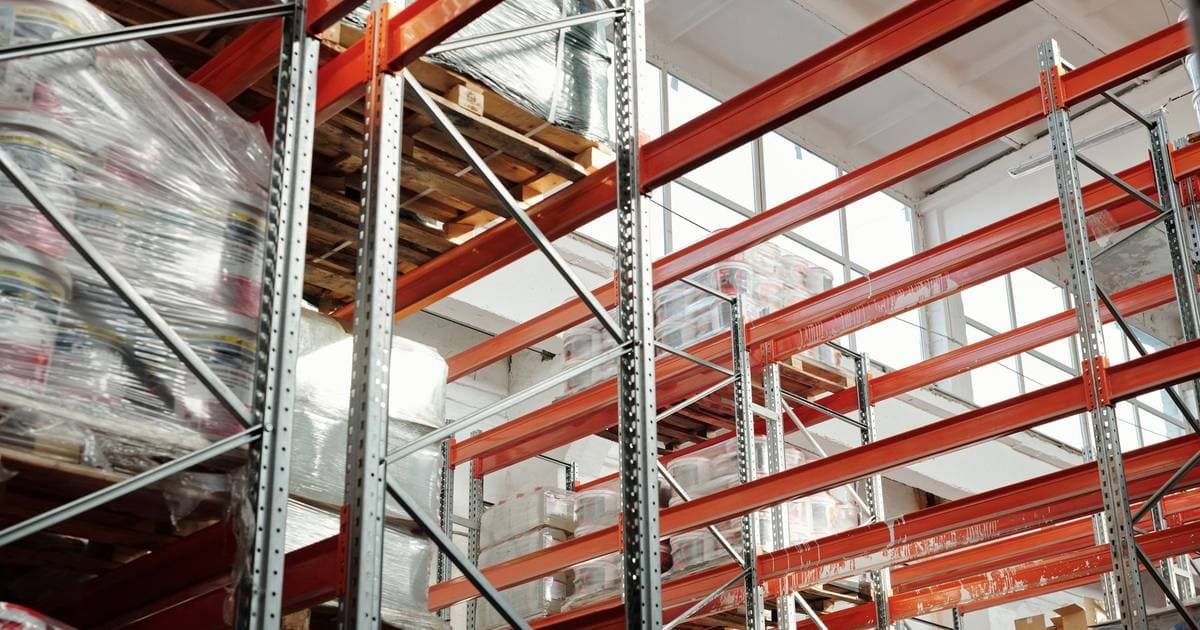
Termite risk in commercial premises is usually underestimated because the visible business does not involve timber. A warehouse stores goods, an office houses people, and neither feels like a timber building. The timber is nonetheless there, in pallets, packaging, partitions, false ceiling framing, door frames, furniture and stored paper.
The exposure is also larger in ways that matter. Commercial floor plates are bigger, so a soil barrier has a longer perimeter and more service penetrations. Buildings are frequently extended, which breaks existing barriers. And large areas of a commercial building are inaccessible during working hours, so inspection has to be planned rather than incidental.
The species profile matches residential work. Subterranean termites cause the structural damage and arrive through the ground. Drywood colonies arrive inside timber, which in a commercial setting usually means pallets, crates, furniture or timber brought in during a fitout. The extension guidance on termite biology and control applies in both settings.
Cockroaches in Commercial Premises
Cockroaches in a business are a compliance problem before they are a hygiene one, and the distinction changes how they should be managed. A single insect seen by a customer, an auditor or an inspector can trigger consequences entirely out of proportion to the size of the population.
The species distinction from residential work holds. German cockroaches establish in warm equipment housings, which in commercial premises means kitchen equipment, vending machines, dishwashers, electrical panels and server cabinets. American cockroaches live in drainage, sumps and service ducts and surface at night.
What differs is the scale of the harbourage. A commercial kitchen has far more warm equipment than a domestic one, a commercial drainage system is far more extensive, and a large building has service voids running between areas under different management. That last point is why a treatment confined to one tenancy so often fails.
Monitoring Rather Than Guessing
The single biggest technical difference between a good commercial programme and a poor one is monitoring. Residential work can reasonably operate on a fixed interval. Commercial premises are large enough that a fixed interval either wastes money in low risk areas or misses activity in high risk ones.
Monitoring devices placed at defined points and checked on schedule turn pest management into a data exercise. Numbered locations recorded on a site plan, catch counts logged at each visit, and trends reviewed over months tell you where pressure is rising well before anyone reports a sighting.
The value is threefold. Frequency can be set by evidence rather than by contract default. Emerging problems are caught early, when they are cheap. And the log itself is the documentation an auditor will ask for, which means the monitoring pays for itself twice.
What a monitoring plan should specify
A site plan with numbered device locations, the type of device at each point, the inspection frequency, who records the readings and where they are stored, and the threshold at which a reading triggers intervention rather than simply being noted. Without a defined threshold, monitoring becomes record keeping rather than management.
Structural and Behavioural Causes
Chemical treatment addresses the population present. It does nothing about the reasons the premises keep acquiring one, and in commercial buildings those reasons are usually structural or behavioural rather than mysterious.
The structural list is short and consistent. Unsealed service penetrations where pipes and cables pass through walls and slabs. Gaps under external doors, particularly goods doors that sit open for loading. Damaged drain covers and dry floor traps. Redundant pipework left capped but not removed. Standing water in yards, plant rooms and basement sumps.
The behavioural list is shorter still. Cardboard stored against walls. Waste held too long or in unsealed containers. Food debris behind equipment that cleaning schedules do not reach. Doors propped for convenience. Deliveries accepted without any inspection of packaging.
A provider who reports these alongside pest findings is doing the job properly. One who treats repeatedly without ever mentioning why the problem returns is selling visits. The framework for this is standard integrated pest management, set out in the integrated pest management principles published by the US Environmental Protection Agency, which puts source elimination ahead of routine application.
Working Around Operations
The technical solution is usually straightforward. Delivering it inside a working business is where commercial pest management actually gets difficult, and it is the part most quotations gloss over.
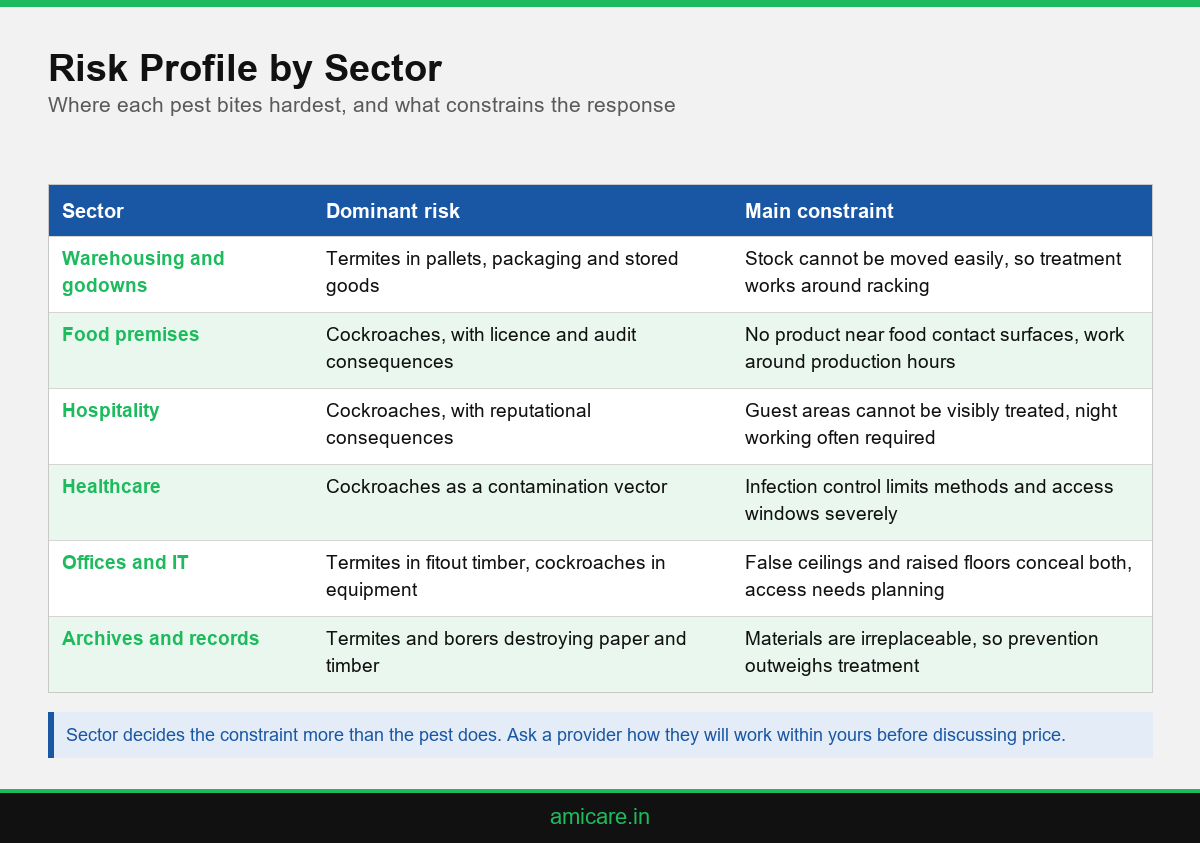
Access windows are the first constraint. A restaurant kitchen is unavailable during service. A warehouse floor is congested during dispatch. A hospital ward has infection control protocols governing who enters and when. A treatment plan that ignores these will be postponed indefinitely and eventually abandoned.
Method selection follows from the constraint rather than the other way round. Where a space cannot be vacated, bait and dust replace spraying. Where drilling is impossible during operating hours, perimeter baiting replaces internal barrier work. Where an area is inaccessible for months, monitoring devices provide coverage until it opens up.
Ask a prospective provider how they would handle your specific constraints before discussing price. The answer separates companies that work in commercial premises from those that do residential work in larger buildings, and that distinction predicts almost everything about how the contract will run.
Documentation: The Actual Deliverable
In commercial pest management the file is the product. A business that cannot demonstrate what was done is in the same position as one that did nothing, regardless of how effective the treatment actually was.
A defensible file contains the service agreement and scope, a site plan showing treated areas and monitoring points, a visit report for every attendance including nil findings, product records with names, concentrations and quantities, safety data sheets, applicator licensing or certification evidence, and a record of corrective actions raised and closed.
The last item is the one most often missing and the one auditors focus on. A report noting a structural defect that was never rectified, repeated across twelve visits, is worse than no report at all, because it demonstrates the problem was known and tolerated. The reason businesses prefer certified providers is largely that documentation of this kind is built into their process.
Food Premises and Regulatory Exposure
Any premises handling food carries obligations that make cockroach management non discretionary. Pest control forms part of the hygiene requirements under the food safety framework, and the regulations administered by the food safety authority expect documented measures rather than reactive treatment.
In practice this means three things. A written pest management programme rather than ad hoc calls. Records retained and available rather than discarded after the visit. And methods appropriate to a food environment, which rules out broadcast spraying near production and food contact surfaces.
It also means treating structural and behavioural causes rather than only the insects. An inspector who sees a clean pest log alongside an unsealed pipe penetration, a propped fire door and cardboard stored against a wall will draw the obvious conclusion, and correctly so.
Termite Protection for Commercial Buildings
Commercial termite work divides the same way as residential, into protecting a new building and dealing with an existing problem. For new construction the economics are overwhelming. Treatment applied in stages during the build costs a fraction of retrofitting protection to a completed warehouse or office.
For existing buildings the constraint is operational rather than technical. Barrier work needs access along the internal wall line, which in a stocked warehouse means racking cannot be against every wall, and in an office means working outside business hours. This has to be planned into the programme rather than discovered on the day.
Baiting deserves particular consideration in commercial settings for the same reason it suits finished homes. It avoids extensive drilling, works without disrupting operations and eliminates the colony. The trade off, set out in the guide to termite baiting systems, is that it depends on disciplined monitoring visits.
Cockroach Management in Commercial Kitchens and Equipment
Commercial kitchens concentrate every condition a German cockroach population needs into one room. Continuous warmth from equipment running most of the day, permanent moisture, food residue in places cleaning schedules do not reach, and a dense arrangement of equipment housings offering tight dark harbourage.
The harbourage list is consistent across premises. Dishwasher and glasswasher housings, the motor compartments of refrigeration units, the void behind and beneath cooking ranges, hollow legs of stainless steel tables, wall mounted shelf brackets, and the gap between equipment and the wall where cleaning equipment cannot reach.
Treatment has to reach those locations, which means equipment must be moved or opened. This is the single largest practical difference between a competent commercial kitchen treatment and a fast one, and it is why a visit scheduled into a thirty minute gap between services achieves very little. Access has to be planned with the kitchen team.
Drainage completes the picture. Floor gullies, grease traps and the drain runs beneath a commercial kitchen sustain American cockroach populations that surface at night, entirely independently of anything happening in the equipment. Treating one without the other leaves half the problem in place, which is the same pattern seen in domestic kitchens where the drain is ignored.
Termite Damage to Commercial Assets
The structural conversation about termites tends to dominate, but in commercial premises the asset loss is often larger and arrives sooner. Buildings degrade slowly. Stock, records and fitout can be destroyed within a single season.
The exposure varies by sector in ways worth thinking through. A warehouse holds pallets, cartons and packaging, all cellulose, stacked in bulk on a slab. An office holds engineered board partitions, workstations and ceiling framing. An institution holds paper records that may be irreplaceable. A showroom holds timber furniture and display fittings.
Insurance rarely helps as much as businesses assume. Damage caused by insects is commonly excluded or heavily limited on commercial policies, on the reasoning that it develops gradually and is preventable through maintenance. Checking the wording before a loss is considerably more useful than discovering the exclusion afterwards.
That exclusion is itself an argument for documented prevention. A business that can demonstrate a maintained pest management programme is in a materially better position in any dispute, whether with an insurer, a landlord over dilapidations, or a client whose goods were damaged in storage.
Contracts and What They Should Specify
Broader coverage of annual maintenance contracts sits elsewhere, but three points are specific to termite and cockroach work and worth stating plainly in any agreement.
First, whether termite cover is included at all. Many general pest contracts exclude termites entirely, treating them as a separate specialist engagement. A facility manager who assumes termites are covered because pest control is covered may discover otherwise at the worst moment.
Second, whether drain and sump treatment is inside the scope. In Kerala this materially affects cockroach outcomes and is frequently a separate line. Third, what response time applies to a callback, because in a food or hospitality setting the difference between same day and next week is the difference between an incident and a closure.
Multi tenant buildings
Where a building has several occupiers, cockroach populations travel through shared service voids and drainage regardless of tenancy boundaries. A tenant treating only its own demise will be reinfested from common areas. Landlord obligations for common parts should be established before a problem arises rather than during one.
Staff Training and the Reporting Loop
The people on site every day see far more than a technician visiting monthly, and in the best programmes that observation is captured rather than wasted. Most commercial pest problems are noticed first by a cleaner, a storeman or a kitchen porter.
What is usually missing is a route for that observation to travel. Staff see a cockroach, mention it to a colleague, and nothing reaches the facility manager or the pest contractor until the population is large enough that someone senior notices. A simple sighting log, physical or digital, closes that gap for almost no cost.
Brief training helps more than it sounds. Staff who can distinguish a large drain dwelling cockroach from the small kitchen species report something far more useful than an insect was seen. Staff who know that cardboard against a wall matters will stop stacking it there. Twenty minutes at induction changes behaviour for years.
Then close the loop visibly. When a sighting is reported and acted on, tell the person who reported it. Reporting systems die quietly when staff conclude nothing happens, and reviving one is much harder than maintaining it.
Handling an Incident
At some point a business will have an incident rather than a finding. A customer complaint, a sighting during an audit, a photograph on social media, or an inspector's observation. How the business responds in the first day matters more than how many visits it had booked beforehand.
Respond factually and fast. Establish what was seen, where and when, and get the provider on site rather than promising a scheduled visit will cover it. Document the response as it happens, because the record of prompt action is what demonstrates control, and control is what an inspector or a client is actually assessing.
Avoid two common mistakes. The first is over treating in panic, spraying heavily through areas that do not need it, which in a food setting creates a compliance problem worse than the original sighting. The second is treating the visible insect and stopping, without establishing where the population is and how it arrived.
Afterwards, close the loop properly. A brief written incident record covering what was found, what was done, what structural or behavioural cause was identified and what changed as a result belongs in the pest file. That single document does more to protect the business at the next audit than any amount of routine treatment.
Reputational exposure differs by sector
In hospitality and food service a single sighting can generate a review that outlasts the infestation by years. In healthcare it can trigger a formal report. In warehousing the exposure is usually contractual, through damaged client stock. Knowing which applies to you shapes how much monitoring is proportionate.
Choosing a Commercial Provider
The selection criteria differ from residential work. Technical competence matters equally, but documentation, continuity and the ability to work within your operational constraints matter more.
Ask for a sample visit report and a sample site plan rather than a brochure. Ask how nil findings are recorded, how corrective actions are tracked to closure, and what happens to the records if you change provider. Ask whether technicians are consistent, because a rotating cast has no memory of your building.
Then test the constraint. Explain your access limitations, your production hours and your compliance context and ask how they would work within them. A provider who answers with a schedule has understood. One who answers with a price has not, which is the same distinction that separates a reliable provider from a cheap one in any setting.
Finally, ask what happens at the end of the contract. Records generated during the term should belong to the business rather than to the contractor, and a provider who will not release the site plan, the monitoring history and the visit reports on exit is holding your compliance evidence hostage. Agree that point at the start, when it costs nothing, rather than during a transition when it costs leverage.
Conclusion
Commercial termite and cockroach control succeeds on programme rather than on product. Monitor rather than guess, record every visit including the ones that find nothing, close out corrective actions rather than repeating them, and match the method to the constraints of your sector. That is what survives an audit and what actually keeps a building clear. Discuss a documented programme with Amicare rather than booking visits as problems arise.
Frequently Asked Questions
How is commercial pest control different from residential?

Are termites usually included in a commercial pest contract?
Why does monitoring matter more in commercial premises?
What should a pest management file contain?
Do food premises have specific obligations?
Why do repeated corrective actions matter to auditors?
Can one tenant solve a cockroach problem alone?
Is baiting suitable for commercial termite work?
How often should commercial premises be treated?
What matters most when choosing a provider?