Commercial Pest Control Services in Kerala: A Complete Guide
A pest problem in a home is uncomfortable. In a business it is a licence risk, a reputation risk and sometimes a closure risk. Commercial pest control services in Kerala therefore differ from a residential treatment programme in almost everything except the underlying biology: the scope is larger, the chemistry is constrained, the scheduling is dictated by trading hours and the deliverable is as much a documented record as a treated building. This guide covers what each sector actually needs and how to buy it well.
Key Takeaways
- Commercial work is bought on compliance and continuity, not only on treatment outcomes.
- Hotels, restaurants, hospitals, offices and warehouses each carry a distinct pest and regulatory profile.
- An annual maintenance contract is the standard structure because reactive callouts cost far more.
- The documentation file is frequently the deliverable that matters most when an auditor arrives.
Why Commercial Pest Control Is a Different Discipline
The first difference is consequence. A cockroach in a family kitchen is unpleasant and private. The same cockroach photographed in a restaurant becomes a public review, a regulatory complaint and, in the worst case, a suspension of the licence that the whole business depends on for its right to trade.
The second is scale and complexity. A commercial building carries plant rooms, service voids, false ceilings, waste holding areas, loading bays, staff canteens and landscaped grounds, each with its own harbourage and its own access constraints, and none of which exist in a house.
The third is people. Staff turnover, contractors, deliveries and customers all move material and food through the building constantly, which means pest pressure is renewed daily by ordinary operations rather than arriving occasionally from outside.
The fourth is constraint. Food premises restrict where product can be applied, healthcare settings restrict aerosols around vulnerable patients, and occupied offices restrict when work can happen at all. The technically ideal treatment is frequently unavailable and a compliant alternative has to be found.
The fifth is evidence. A household wants the problem gone. A business needs to be able to demonstrate, months later and to a sceptical third party, that a competent programme was in place, was followed and was adjusted when monitoring showed a problem.
There is a sixth difference that buyers discover late: continuity of knowledge. A commercial building accumulates history, and a programme that remembers which void had rodents two monsoons ago, which drain runs slow and which supplier consistently delivers infested pallets is worth far more than one that starts fresh with every technician.
Taken together these turn pest control from a service call into a managed programme. That is why commercial pest control services in Kerala are almost always sold as contracts rather than visits, and why the cheapest quotation is so often the most expensive outcome. Our note on why businesses prefer ISO certified providers makes the same case from the buyer side, and why bedbug numbers are rising in urban apartments is the residential mirror of the same trend.
Sector by Sector: What Each Type of Premises Needs
Generic commercial pest control does not exist in practice. What a hotel needs, what a hospital needs and what a warehouse needs share a method and diverge sharply in target pests, treatment constraints and inspection frequency, so a serious provider scopes by sector rather than by square footage.
The sector also decides who inside the business owns the relationship. In hospitality it is usually housekeeping or the executive chef, in healthcare it is infection control, in manufacturing it is quality assurance, and in offices it is facilities. Each of those has a different definition of success.
What follows sets out the profile for the sectors that matter most in Kerala. Each has its own cluster article in this pillar with the operational detail, and the summaries here are intended to help a buyer recognise which profile their own premises actually fits. Kitchen roach pressure is the most common of them, and why kitchens take the worst of it explains the mechanism.
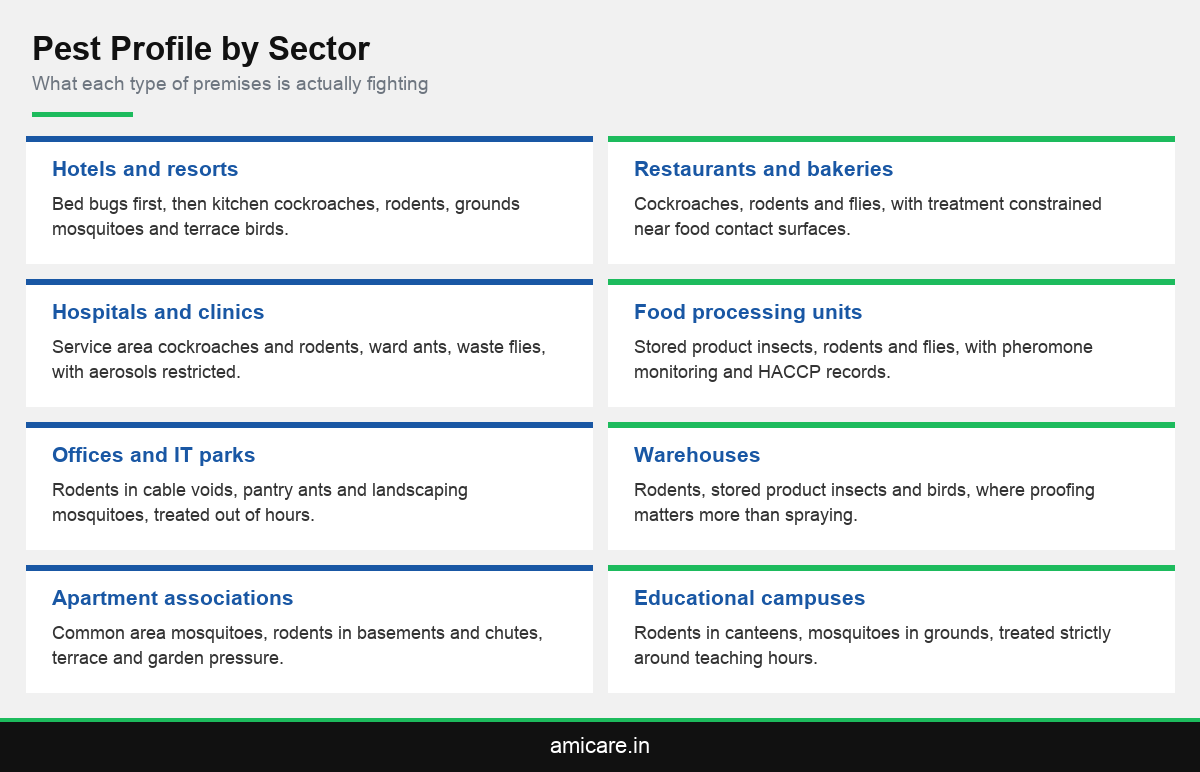
Hospitality: hotels, resorts and serviced accommodation
Bed bugs are the defining risk because they travel with guests and generate reviews faster than any other pest. Add cockroaches and rodents in kitchens and back of house, mosquitoes in landscaped grounds, and birds on terraces. Treatment has to work around occupancy, floors are handled in rotation, and brand standards audits examine the pest file closely. Amicare's bed bug treatment work in the sector focuses on early detection rather than reactive fumigation.
Food service and manufacturing: restaurants, bakeries, processing units
Cockroaches, rodents, flies and stored product insects dominate, and the regulatory frame is the Food Safety and Standards Authority licence combined with a HACCP based plan in which pest control is a prerequisite programme. Application near food contact surfaces is restricted, monitoring is documented, and inspection can arrive unannounced. Frequency is monthly as a baseline and higher in high volume kitchens.
Healthcare: hospitals, clinics and diagnostic centres
Cockroaches and rodents in service areas, ants in wards, flies near waste holding and mosquitoes around the campus. The distinguishing constraint is patient vulnerability, which restricts aerosol use near immunocompromised, neonatal and respiratory patients and pushes the programme toward physical exclusion, gel baiting and external larviciding. Accreditation bodies examine the pest management record as part of the environmental control review.
Offices, IT parks and warehousing
Offices see rodents in cable voids, ants around pantries and mosquitoes in landscaping, with the main constraint being that treatment must not disrupt working hours or trigger complaints about odour. Warehouses face rodents, stored product insects and birds, with pheromone monitoring and proofing carrying more weight than spraying. Both are usually managed through facilities on an annual contract.
How an AMC Is Structured and Why It Wins
The annual maintenance contract is the standard commercial structure for good reason. It converts an unpredictable series of emergencies into a fixed cost with a fixed schedule, and it gives the provider a commercial interest in preventing problems rather than being paid to attend them.
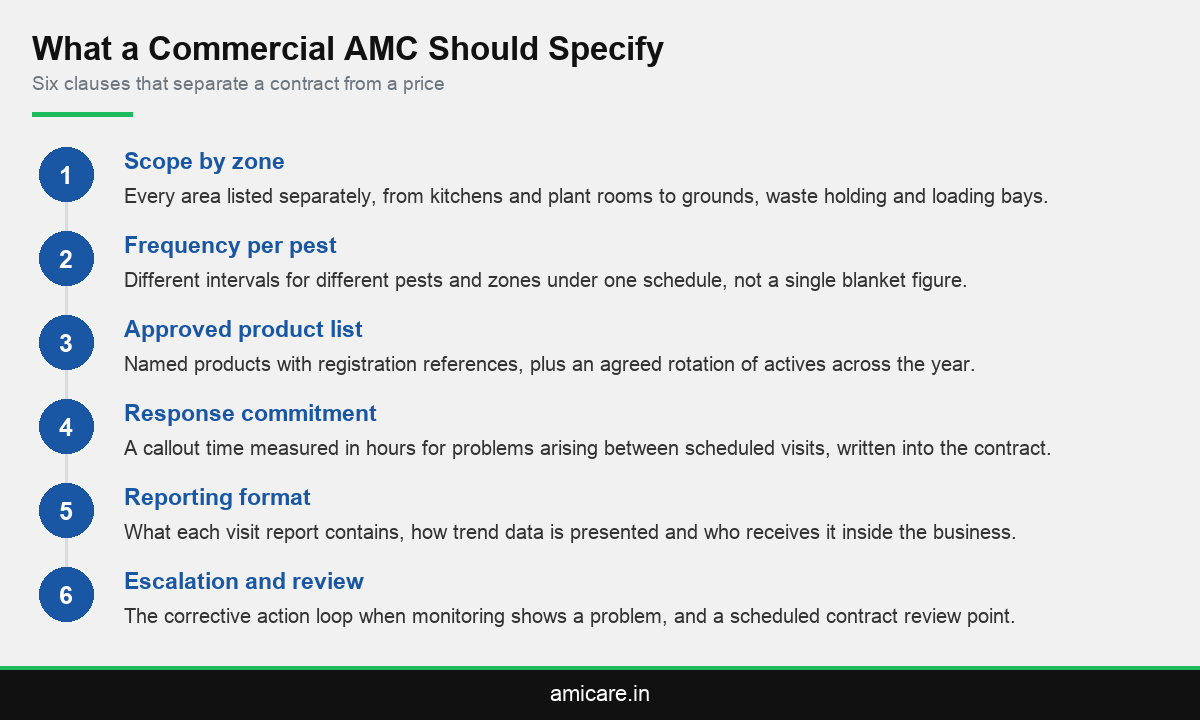
A properly written AMC specifies the scope by zone, the treatment frequency for each pest category, the products approved for use, the response time for callouts between scheduled visits, the reporting format and the escalation path when monitoring shows a problem developing.
Frequency varies by sector and zone within the same contract. A hotel might have monthly kitchen treatment, quarterly guest floors, monthly grounds during monsoon and continuous rodent monitoring, all under one agreement with one schedule and one reporting line.
Emergency response is what businesses actually value most and notice least until they need it. A contracted callout commitment measured in hours means a restaurant with a sighting during service can get a technician the same day rather than joining a queue.
The economics favour the contract clearly once reactive costs are counted honestly. Emergency callouts carry premium rates, arrive after the problem is established and treat a larger infestation, whereas scheduled work catches the same issue while it is still small and cheap.
There is also a compliance dividend. A contract generates the continuous record that audits require, whereas ad hoc callouts produce a scattered pile of invoices that demonstrates nothing about the adequacy of the programme. The argument parallels our residential case for regular pest management, with higher stakes attached.
Compliance, Documentation and Audit Readiness
The paperwork is not administrative overhead in commercial pest control. It is a substantial part of the product, because the business is buying the ability to demonstrate diligence to a regulator, an auditor, an insurer or a court, potentially long after the treatment itself.
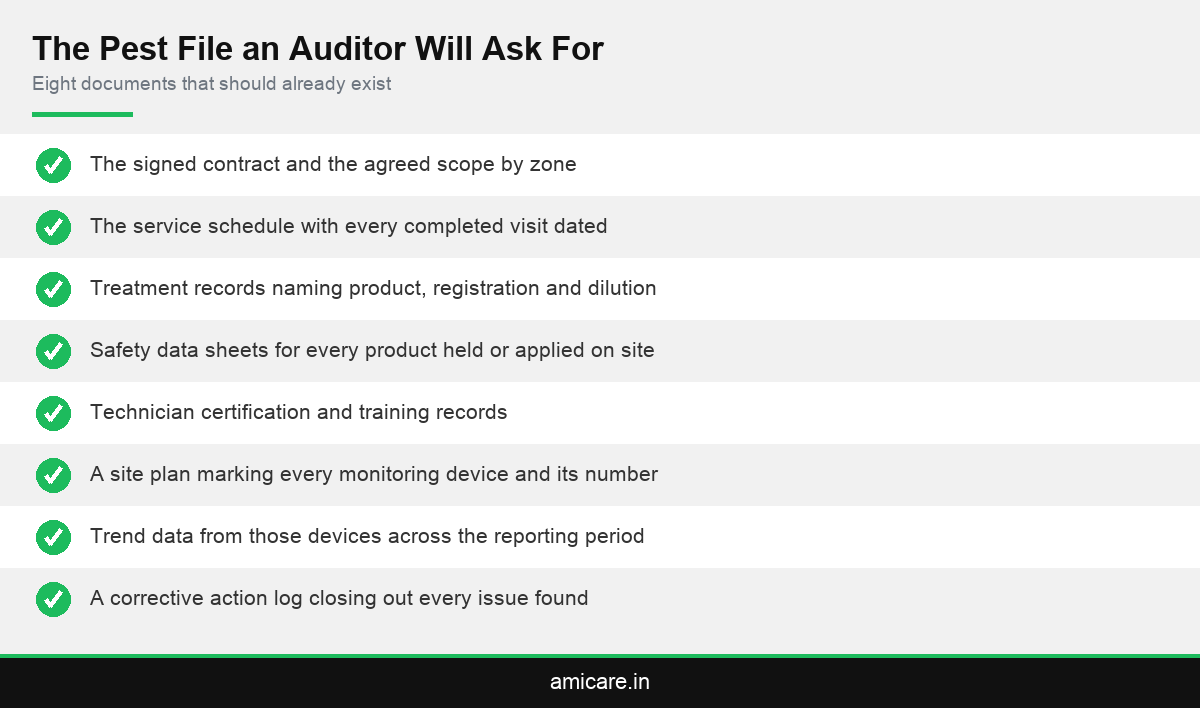
A complete pest management file holds the contract and scope, the service schedule, treatment records naming product and dilution, safety data sheets, technician certification, a site plan marking every monitoring point, trend data from those points and a corrective action log. Under a HACCP based system this is a documented prerequisite programme.
Trend data is the element businesses undervalue until an audit. Counts from fixed monitoring points across months demonstrate whether the position is improving or deteriorating, which is the difference between managing pest risk and merely responding to it.
The corrective action log matters just as much. Finding a problem is not a failure; failing to record what was found, what was done about it and whether it worked is. Auditors look for that loop far more than they look for a spotless monitoring history.
Different sectors examine the file differently. Food business audits focus on prerequisite programme adequacy and the absence of contamination risk, hotel brand standards focus on guest impact and response times, and hospital accreditation reviews pest management within environmental control.
For a buyer the practical implication is straightforward. Ask any prospective provider to show a redacted example of the file they would maintain for your site. A provider who has one will produce it immediately, which is a far stronger signal than any claim made in a proposal document. Continuous rodent monitoring is the line auditors query most often, and our rodent archive collects the detail behind it.
Monitoring devices and the site plan
Every rodent station, insect light trap and pheromone trap should be numbered, marked on a site plan and checked on a fixed schedule. The plan is what makes the data interpretable, because a count means nothing without a location. It also protects the business during an audit, since it demonstrates that coverage was designed rather than improvised, and it lets a new technician service the site correctly without relying on the memory of the person who set it up.
Treatment records and safety data
Each visit should produce a record naming the product applied, its registration reference, the dilution used, the zones treated and any re entry interval imposed. Safety data sheets for every product held on site sit alongside those records. Together they answer the two questions an inspector actually asks: was the product legal for this use, and was it applied somewhere it could contaminate product or harm occupants.
The corrective action loop
Auditors expect to find problems in the record, because a site with no findings across a year is more likely to be under monitored than genuinely pest free. What they look for is closure. Each finding should show what was observed, what root cause was identified, what action was taken, who owned it and whether follow up monitoring confirmed the fix. An open finding carried across months is the single worst thing a pest file can contain.
What Commercial Pest Control Costs in Kerala
Commercial pricing is built from treated area, the number of zones needing separate handling, visit frequency, the monitoring device count and the response commitment. It is not a per square foot figure, and any provider quoting one before surveying has not understood the building.
Sector drives most of the variation. A food processing unit with stored product monitoring, a hotel with rotating guest floors and a warehouse with a large proofing requirement will all price very differently even at identical floor areas, because the work involved genuinely differs.
Access constraints raise cost in a way that surprises first time buyers. Work that has to happen between midnight and five in the morning, or that requires an escort through secure areas, or that can only proceed when a production line is down, consumes far more provider time per treated square metre than the same work in an empty building would.
Monitoring devices are a real line item that buyers frequently overlook when comparing quotations. Rodent stations, insect light traps and pheromone traps all need supplying, servicing and recording, and a quote that omits them is not comparable with one that includes them.
Response commitments carry a cost because the provider must reserve capacity. A four hour callout guarantee is genuinely more expensive to deliver than next available slot, and a buyer who does not need that speed should not pay for it.
The cheapest quotation is usually cheap for identifiable reasons: fewer visits, no monitoring devices, no documented reporting, unregistered products or untrained applicators. Comparing on headline price without normalising for scope is the most common purchasing error in this category.
Against that, the cost of failure is asymmetric. A closure, a failed audit or a viral review costs multiples of any annual contract, which is why sophisticated buyers evaluate on scope and evidence first and price second. Our checklist on choosing a reliable provider translates directly to commercial procurement. How rats damage electrical wiring shows what the avoided cost actually looks like on a real site.
Integrated Pest Management in a Commercial Setting
Integrated pest management is the framework every credible commercial programme runs on. It means understanding the pest's biology, monitoring continuously, correcting the conditions that support the pest, and applying chemistry as a targeted intervention rather than a routine broadcast.
In a commercial building the conditions half of that is where most of the value sits. Waste holding practice, drainage maintenance, stock rotation, door seals, gaps around service penetrations and landscaping choices collectively determine how much pest pressure the building generates for itself.
This is why a good provider spends time on recommendations the client must action rather than only on treatment they perform themselves. A report that repeatedly flags an unsealed loading bay door is doing its job even though nobody enjoys receiving it.
It also changes how a visit report should read. A report listing only what the technician applied is an invoice with extra words. A report that additionally records what was observed, what it implies and what the client needs to change is a management document, and it is the one that reduces cost over time.
Monitoring provides the evidence that drives those recommendations. Fixed devices produce counts, counts produce trends, trends identify the zone where something has changed, and the investigation of that zone identifies the structural or operational cause behind it.
Chemical intervention then becomes precise. Gel baiting in a specific run of kitchen cabinetry, a targeted rodent programme in a defined void, a residual application to one section of external wall: all far more defensible in an audit than routine blanket spraying of occupied space.
Resistance management is the final piece and it matters more commercially because treatment is frequent and areas are large. Rotating actives across the year keeps efficacy up, and it is the kind of decision a certified provider documents and an unqualified one never makes at all. Amicare's cockroach treatment page and fly management page set out the per pest detail underneath the programme.
Exclusion and proofing: the structural half
Door sweeps, mesh on ventilation openings, sealed service penetrations, self closing doors on waste rooms and intact drain covers do more sustained work than any chemical programme. They are capital expenditure rather than service cost, which is why they get deferred, and deferring them is the single most common reason a commercial site keeps paying for the same treatment indefinitely without the underlying position ever improving.
Sanitation and operational practice
Waste holding discipline, drain cleaning frequency, stock rotation, spillage response and the state of the staff canteen collectively decide how much pest pressure a building generates internally. None of this is the provider's to fix, which is exactly why the visit report should name it explicitly. A programme where the client actions the sanitation findings outperforms one where the provider simply treats harder every month.
Targeted chemical intervention
Once monitoring has located the problem and the conditions have been addressed, chemistry is applied precisely: gel bait into a specific run of cabinetry, a rodenticide programme in a defined void, a residual band on one external elevation. Precision is both more effective and far more defensible in an audit than routine blanket spraying of occupied commercial space, which increasingly reads as poor practice rather than thoroughness.
Choosing a Commercial Provider in Kerala
Commercial selection should look nothing like residential selection. The question is not who will treat the building most cheaply but who can run a programme, evidence it, and still be operating in three years when the audit history matters.
Financial stability is an unglamorous criterion that matters here. Pest management files have value precisely because they are continuous, and a provider who ceases trading takes the practical continuity of that record with them, leaving the business to rebuild monitoring history from scratch at exactly the moment an auditor wants to see it.
Certification is the entry criterion. ISO certification, government approval and industry body membership are verifiable, and for food and healthcare clients they are frequently a procurement requirement rather than a preference.
Sector experience is the second filter and it is worth probing specifically. A provider competent in residential work may have never built a HACCP prerequisite programme or worked around infection control, and those are learned rather than improvised.
Capacity matters for multi site businesses. A provider who can cover Kochi, Ernakulam, Thrissur and Trivandrum under one contract with consistent reporting is worth considerably more to a chain than several local operators with incompatible paperwork.
Transparency on products and dosing is the same test as in residential work, applied more strictly. Ask for the intended product list with registration references, and ask how actives will be rotated across the year to manage resistance.
Finally, ask about the exit. Who owns the monitoring data, how is the file handed over, and what happens to device infrastructure if the contract ends. A provider comfortable with those questions is confident in the relationship. Amicare works with commercial clients across Kerala from its Ernakulam base on exactly that footing.
Conclusion
Commercial pest control services in Kerala are bought for continuity and evidence as much as for treatment. The sector decides the pest profile and the constraints, the contract decides whether problems are prevented or attended, and the documentation decides whether the business can demonstrate diligence when someone eventually asks. Evaluate providers on scope, certification and the file they will maintain before comparing prices. Contact Amicare to scope an annual contract for your premises.
Frequently Asked Questions
What is included in commercial pest control services in Kerala?

Why do businesses use an AMC rather than booking as needed?
How often should commercial premises be treated?
Is pest control legally required for a food business?
What makes hospital pest control different?
How is commercial pest control priced?
What is trend data and why do auditors want it?
Can one provider cover multiple sites across Kerala?
What is actives rotation and does a commercial site need it?
What should I ask a provider before signing a contract?