Mosquito Control Services in Kerala: The Complete Guide
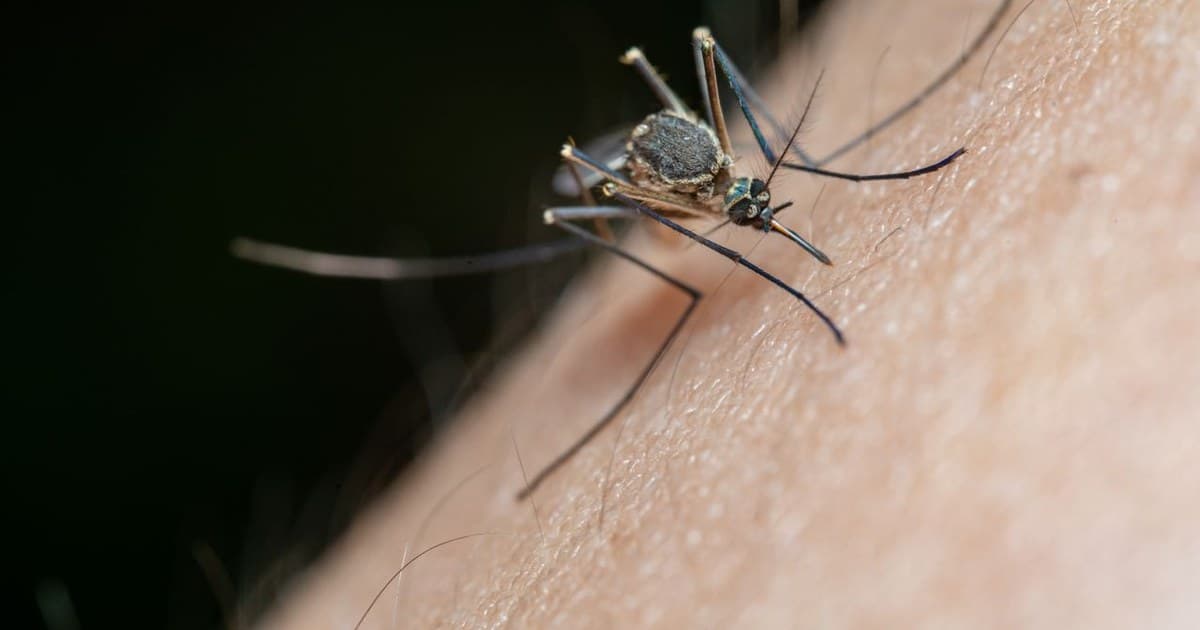
Kerala gives mosquitoes almost everything they need. Warm temperatures year round, two monsoons, standing water in a thousand small places and dense housing add up to breeding conditions that barely pause. Professional mosquito control services in Kerala exist because the problem is a breeding site problem rather than a spraying visit, and treating it properly means finding water before you ever reach for a fogger. This guide covers the species that matter, the methods that work, what they cost, and how to tell a competent provider from an operator with a smoke machine.
Key Takeaways
- Effective mosquito management targets larvae in water first and adults second, never the other way round.
- Kerala's two monsoons create two distinct risk peaks, so treatment timing matters as much as treatment method.
- Fogging alone gives a few days of relief, while larviciding plus source reduction holds for weeks.
- Central Insecticide Board approval and documented dosing separate a safe provider from a merely cheap one.
Why Kerala Has a Year Round Mosquito Problem
Most of India gets a mosquito season. Kerala gets a mosquito year. The state sits in a humid tropical belt where temperatures rarely drop far enough to interrupt the breeding cycle, and its climate delivers rain across two separate monsoon windows rather than one, which keeps the cycle running when other states get a natural break.
The southwest monsoon arrives around June and runs into September. The northeast monsoon follows in October and November. Between and after them, intermittent rain keeps refilling the small containers that matter most. That double pattern is why a single annual treatment never holds in Kerala the way it might in a drier part of the country.
Water is the constraint that decides everything else. A female mosquito needs standing water to complete her cycle, and she is not fussy about volume. A bottle cap holds enough. A plant saucer, a discarded tyre, an unused sump, a roof gutter with the fall running the wrong way, a coconut shell in the yard: each of these is a functioning nursery.
Density then multiplies the consequence. Kerala's settlement pattern places houses close together with gardens, wells and water tanks in between, so a breeding site in one compound produces adults that feed and rest three compounds away. Individual effort has a genuine ceiling, which is why neighbourhood scale work consistently outperforms household scale work.
Rubber and coconut cultivation adds a distinctly Kerala dimension to this. Latex collection cups left in the field and fallen coconut shells both hold rainwater for exactly the period a larva needs to mature, which is why plantation edges and homes bordering them see pressure that suburban averages simply do not capture in their figures.
The practical conclusion is uncomfortable but useful. You cannot spray your way out of a breeding problem. Any provider whose plan begins and ends with fogging is treating the symptom, and the population will be back within the week, because the water that produced it was never touched at any point during the visit. Our note on how Keralas climate and lifestyle drive infestations covers the wider seasonal picture.
The Mosquito Species That Matter in Kerala
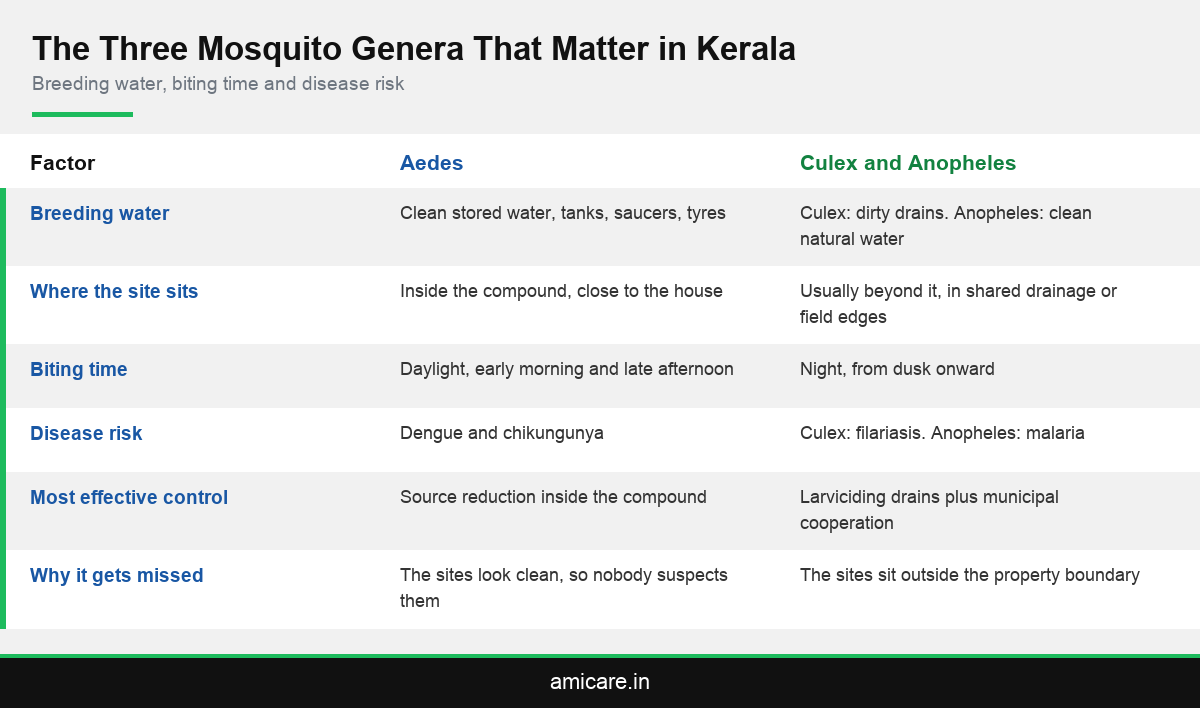
Three genera account for almost all of the nuisance and all of the disease risk in Kerala homes. They behave differently, breed in different water and bite at different times of day, which is precisely why identification changes the treatment plan rather than being academic detail for entomologists.
Getting this wrong wastes money. A provider who fogs at dusk for a daytime biting species, or who treats the garden while the actual breeding site is a clean water drum on the terrace, will produce an invoice and very little else. The species tells you where the water is and when to intervene.
It also tells you what is medically at stake. Nuisance biting is unpleasant, but vector borne transmission is a public health matter. The World Health Organization counts vector borne disease among the largest preventable disease burdens worldwide, and Kerala records cases across several of them every year. Amicare's species gallery shows what each of them looks like in a Kerala home.
Aedes: the daytime biter behind dengue and chikungunya
Aedes aegypti and its close relative Aedes albopictus breed in clean stored water close to houses: overhead tanks, plant saucers, refrigerator drip trays and discarded containers. They bite during daylight, particularly early morning and late afternoon, and they carry dengue and chikungunya. Because their sites are domestic and small, source reduction inside the compound is unusually effective against this genus.
Culex: the night biter behind filariasis and most evening nuisance
Culex breeds in dirty, organically rich water: blocked drains, septic overflow, stagnant canals and neglected sumps. It bites at night and transmits lymphatic filariasis. Culex is the species behind most of the evening biting households actually complain about, and its breeding sites usually sit outside the compound in shared drainage, which is why municipal cooperation matters for genuine control.
Anopheles: the malaria vector that still warrants attention
Anopheles prefers clean, slow moving or still natural water such as stream margins, paddy edges and seepage pools. It bites at night and transmits malaria. Kerala's malaria burden is comparatively low and much of it arrives through migrant labour movement, but plantation and construction settings still justify attention, and the national programme monitors the position closely.
How Professional Mosquito Control Actually Works
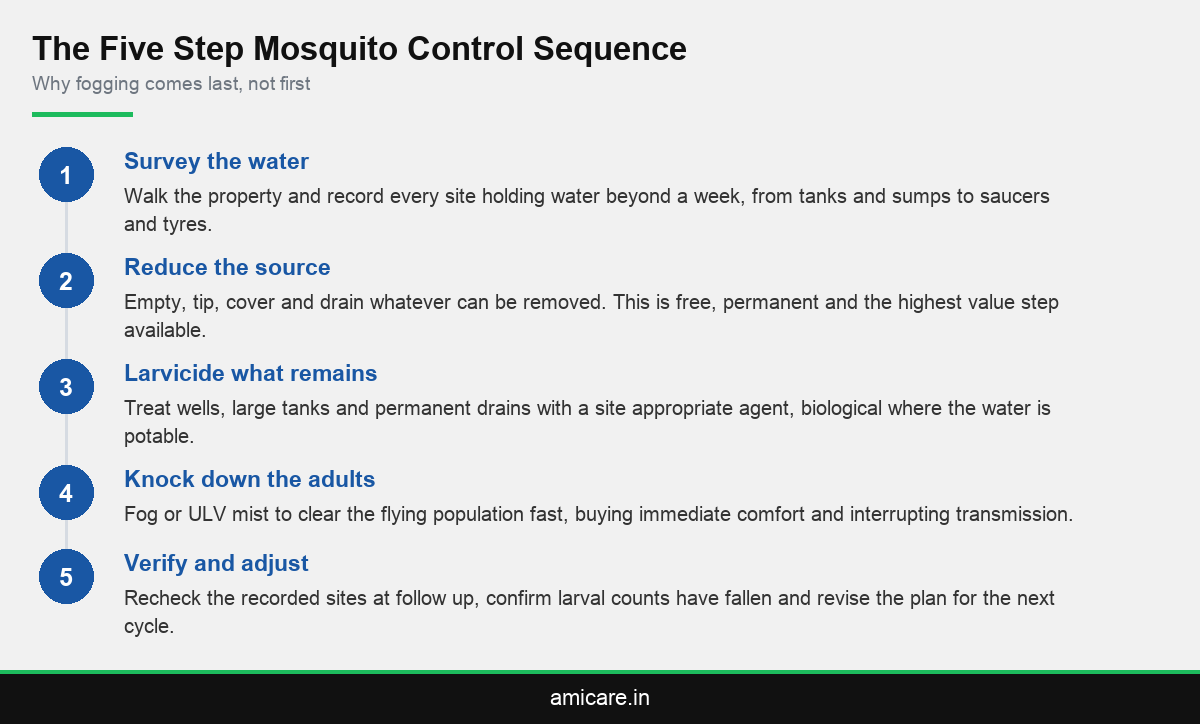
Competent mosquito control services in Kerala run in a fixed order, and the order is the method. Survey first, then reduce the source, then treat the larvae, then knock down the adults, then verify the result. Reversing those steps produces the familiar pattern of a treatment that works beautifully for four days and then stops.
The difference between a plan and a visit shows up in what the technician does in the first twenty minutes. If that time goes into walking the property with a torch and a notebook, you have bought a plan. If it goes into assembling equipment, you have bought a visit, and the two cost about the same.
Underneath the sequence sits integrated pest management, which is simply the discipline of understanding a pest's life cycle and intervening at its weakest point rather than its most visible one. For mosquitoes the weakest point is the larva, because it cannot fly away and it is concentrated in known locations. Amicare's service gallery shows the survey and treatment stages in progress.
Survey and source reduction: the unbillable step that matters most
A technician walks the property recording anything that holds water beyond a week: tanks, sumps, gutters, saucers, tyres, drums, air conditioner trays, unused toilets and construction pits. Each site goes on a register. Then the removable ones are emptied, tipped, covered or drained. This costs nothing in materials and removes breeding capacity permanently, which is why a provider who skips it is acting against your interest rather than saving you money.
Larviciding: treating the water that cannot be removed
Wells, large storage tanks and permanent drains cannot simply be emptied, so they are dosed with an agent matched to the site. Where the water is used for drinking or washing, that means a biological larvicide or a compound specifically evaluated for potable use rather than a general purpose agricultural product. This distinction is where genuine product knowledge separates a certified provider from an operator working off a single drum.
Adult control and verification: fast relief, then proof
Thermal fogging and cold ULV misting knock down the flying population quickly, which buys immediate comfort and interrupts transmission during an outbreak window. Both are fast acting and short lived, so they belong at the end of the sequence. A follow up visit then rechecks the recorded water sites, confirms larval counts have fallen and adjusts the schedule, which is the part a service contract is genuinely buying you.
Fogging, Larviciding and Residual Spraying Compared
Households often assume these are competing options and ask which one to buy. They are not alternatives at all. They act on different life stages over different timescales, and any real plan uses two or three of them together in a deliberate sequence rather than picking a favourite.
Fogging disperses a fine insecticide aerosol that kills adult mosquitoes on contact. Its advantage is speed, since a compound can be noticeably clearer the same evening. Its limitation is that it leaves almost no residual life behind, so anything emerging from water the following morning is entirely unaffected by it.
Larviciding works on the immature stages sitting in water. It is slower to feel, because the adults already flying are untouched, but it cuts the supply at source. Two to four weeks after a properly larvicided property, the difference is obvious, and it keeps holding for as long as the treated sites stay treated.
Residual spraying applies a longer lasting formulation to the surfaces where adults rest: shaded external walls, the underside of eaves, dense boundary vegetation and furniture on a verandah. Mosquitoes landing on those surfaces pick up a dose for weeks afterwards, which usefully extends protection in the gap between scheduled visits.
Cost tracks effort rather than drama. Fogging looks impressive and is comparatively cheap per visit but needs repeating constantly. Larviciding is unspectacular, costs a little more in survey time and delivers considerably more per rupee across a season. Providers who sell only the visible option are usually selling you the wrong one.
The right combination depends entirely on the property. A flat with no garden may need almost no fogging and a great deal of tank and drain attention. A large compound bordering a canal may need residual spraying on boundary vegetation, larviciding in the drain and fogging reserved for outbreak periods only. Indoor flying insect pressure is a separate control line, covered on Amicare's fly management page.
Safety, Chemicals and the Standards That Matter
Mosquito work puts insecticide into the space where people sleep, so the chemistry is not a footnote. In India the binding reference is the Central Insecticide Board and Registration Committee, which registers every product legally usable for pest control and sits under the Directorate of Plant Protection. Registration is checkable, and it is the first thing worth checking.
Most adult control formulations used residentially are pyrethroids, chosen because they combine rapid knockdown with a comparatively favourable mammalian safety profile at label dose. The phrase carrying all the weight in that sentence is at label dose, and dose is precisely what an unqualified operator tends to get wrong in practice.
Overdosing is the common failure and it is invisible to the customer. A stronger mix does not work better. It raises exposure for the household, accelerates resistance in the local mosquito population and leaves residue where children play. A competent provider states the product, the concentration and the dilution without hesitating or deflecting.
For water that people drink from or wash in, the requirement is stricter again. Biological larvicides and compounds specifically evaluated for potable settings exist for exactly this situation, and using a general purpose agricultural product in a domestic well is both unsafe and, in most circumstances, outside the terms of its registration.
Certification is the proxy a household can actually verify. Amicare is ISO certified, government approved and an IPCA member, working to HACCP aligned protocols, which in practice means documented products, trained applicators and a written record of what went where. Our note on choosing an ISO certified provider sets out what to ask for.
Non chemical measures still carry real weight and cost nothing to combine with treatment. Nets over sleeping areas, intact mesh on windows and ventilators, and personal repellent during peak biting hours all reduce exposure independently. A provider who mentions them is describing the whole picture rather than only the billable part of it.
What Mosquito Control Costs and What Drives the Price
Pricing questions are entirely reasonable and providers should answer them plainly. The honest answer is that mosquito control services in Kerala are priced on survey time rather than floor area. The full answer is that mosquito control is priced on survey time, treated area and the number of water sites needing ongoing attention, rather than on a flat rate per square foot of built up space.
A single fogging visit to a modest compound is the cheapest item on any price list, and also the least durable. Households who buy repeatedly on this basis usually spend more across a season than a structured plan would have cost them, while never getting more than a few clear days at a stretch.
A survey led plan costs more up front because someone competent spends an hour finding water instead of twenty minutes making smoke. That hour is what converts the engagement from a recurring purchase into a declining one, since every visit permanently removes sites that would otherwise keep producing.
Contract arrangements change the economics again. A scheduled quarterly or monthly plan carries a lower per visit rate, keeps the water site register current between visits, and matters most for apartment associations and commercial properties where the treated area is large and responsibility is shared.
Property characteristics move the number far more than floor area does. A well, a large sump, an adjacent canal, dense boundary planting or an active construction site next door all add work. So does poor drainage, which is common in older Kochi and Ernakulam neighbourhoods built before current stormwater standards applied.
The comparison worth making is not between headline rates but between what each plan actually removes. Our broader guidance on why regular pest management is essential makes the same argument across pest types: scheduled prevention costs less than repeated reaction, and mosquitoes are the clearest illustration of it available. The homeowners guide for Kerala houses sets out how the same budgeting logic applies across the other pests a property carries.
Prevention Between Visits: What Households Control
Mosquito control services in Kerala set the baseline, but the weekly habits of the household decide how long that baseline holds. This is unusual among pests. With termites or bed bugs the occupant can do relatively little, whereas with mosquitoes the occupant controls most of the breeding capacity on the property.
The weekly water round is the single highest value habit. Once a week, tip out plant saucers, refill pet bowls, empty and scrub any bucket left standing, check the air conditioner drip tray and look at the roof gutter. Seven days is shorter than the cycle from egg to adult, which is the entire point of the interval.
Storage discipline comes next. Overhead tanks and drums need tight lids rather than a sheet of plastic held down with a stone. Unused sumps and old wells should be sealed or screened. Anything stored outdoors that can collect rain, from tyres to broken buckets, belongs under cover or gone.
Drainage is the part most households ignore because it looks like municipal work. Clearing the length of drain that runs past your compound, and reporting persistent blockages, has a measurable effect, because that is where the night biting population is actually produced rather than in your garden.
Vegetation management works on the resting population rather than the breeding one. Adults shelter in dense shaded growth during the day, so thinning heavy planting near windows and doors, and keeping grass short along the boundary, reduces the reservoir sitting next to the house waiting for dusk.
None of this replaces treatment, and it is not meant to. It changes the slope. A property doing the weekly round well can move from monthly to quarterly service, whereas one doing none of it will need the tighter interval indefinitely. The same principle runs through our guide to residential programmes across Kerala.
How to Choose a Mosquito Control Provider in Kerala
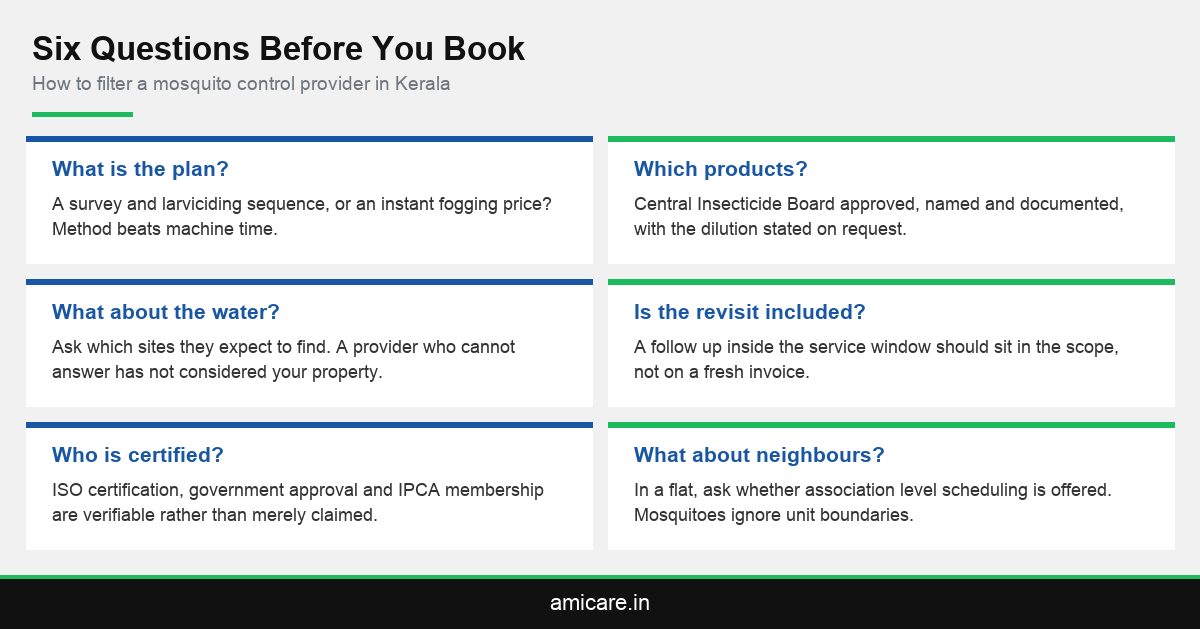
The market has a wide quality range, from certified companies with documented protocols to operators with a rented fogging machine and no product records at all. The gap is not visible from a listing or a roadside board, so a short set of questions does most of the filtering for you.
Ask what the plan is before any fogging happens. A provider who describes a survey, names the water sites they expect to find on a property like yours and explains what they intend to larvicide is working from method. One who quotes a fogging price within thirty seconds is selling equipment time.
Ask which products they use and whether those products carry Central Insecticide Board approval. A credible provider answers without hesitation and can produce documentation on request. Vagueness at this question is the single most reliable warning sign available to an ordinary homeowner.
Ask what happens if it does not work. A follow up visit inside the service window should be included in the scope rather than chargeable, because the follow up is where a plan gets corrected. Providers who treat the revisit as a fresh sale have no real incentive to get the first visit right.
Ask about the neighbours, particularly in an apartment. Mosquitoes do not respect unit boundaries, and a provider experienced in shared buildings will raise association level scheduling without being prompted, because it is the arrangement that actually works when the tanks and drains are common property.
Finally, check the trail. Certification, a written scope, a product record and a named technician are all verifiable after the fact. Our checklist on how to choose a reliable provider covers the same ground in more detail and applies to mosquito work directly. For households in and around the city, why Ernakulam homes need a programme is the local companion to it.
Conclusion
Mosquito control in Kerala rewards method over spectacle. The species tells you where the water is, the water tells you where the population comes from, and removing or treating that water is what produces a result lasting past the weekend. The best mosquito control services in Kerala treat fogging as the fast acting last step rather than the entire service. If mosquitoes are a persistent problem at your property, contact Amicare for a survey led plan built on Central Insecticide Board approved products and a documented schedule instead of a single visit with a smoke machine.
Frequently Asked Questions
How much do mosquito control services in Kerala usually cost?

How long does one mosquito treatment last?
Is mosquito fogging safe around children and pets?
When is the worst mosquito season in Kerala?
Can I handle mosquito control myself without a professional?
Do I need to leave the house during mosquito treatment?
Why do mosquitoes come back so quickly after fogging?
Does mosquito control help against dengue specifically?
How often should mosquito control be scheduled in Kerala?
Do apartments need a different approach from independent houses?