What Chemicals Are Used in Termite and Cockroach Work?
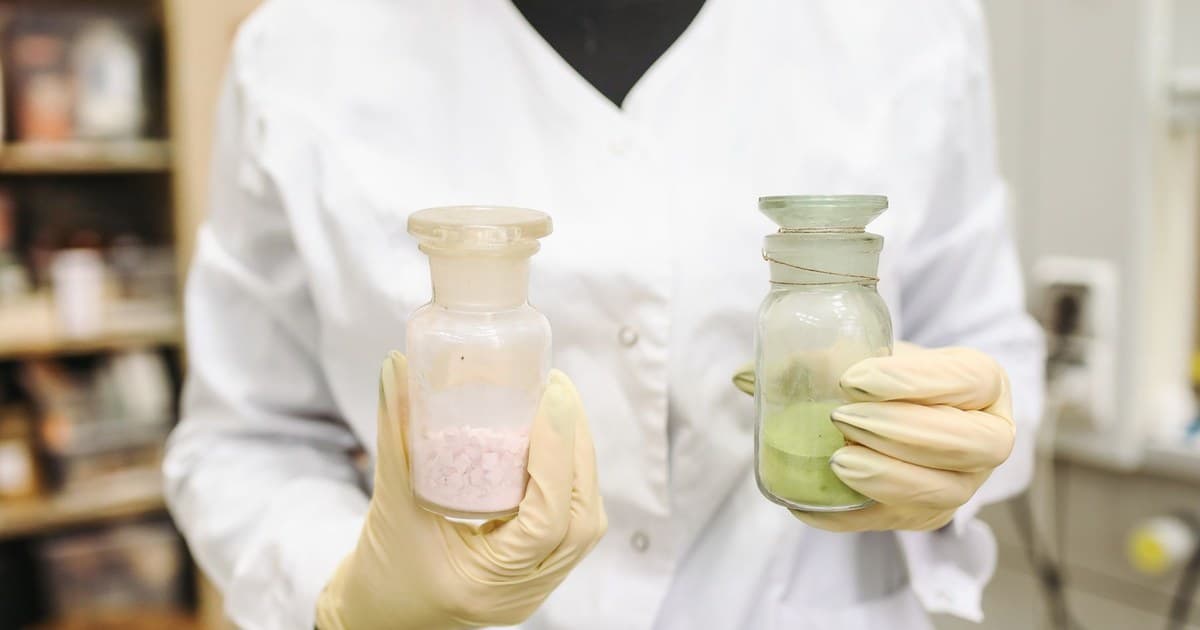
Ask most Kerala households which termite treatment chemical was applied to their property and they will not know. That is a problem, because the product, its concentration and where it went are the three things that determine whether the treatment works and how safe it is. This guide explains what is actually used, what registration means and what to ask before work starts.
Key Takeaways
- Every product used in Indian pest management must be registered with the Central Insecticides Board for the specific use claimed.
- Termite and cockroach work use different product classes. Termiticides treat soil and timber, cockroach baits are ingested.
- Concentration is part of the specification. A registered product applied too dilute is ineffective, not safer.
- You are entitled to the product name, its concentration and where it was applied. A provider who will not say is a warning sign.
What Registration Actually Means
Pesticides sold and applied in India are registered under the Insecticides Act through the Central Insecticides Board and Registration Committee. Registration is specific rather than general. A product is approved for particular pests, particular sites and particular application rates, and using it outside those parameters is a misuse even if the product itself is legitimate.
The framework administered by the plant protection directorate is publicly accessible, which means claims are checkable rather than a matter of trust. If a provider names a product, you can verify that it exists and is registered for the use being proposed.
What registration does not mean is that a product is harmless. It means the hazards, the precautions and the safe handling requirements have been assessed and documented, and that the label carries legally binding directions. That is a meaningful protection, but it depends entirely on the applicator following the label.
Termiticides: Soil and Timber Products
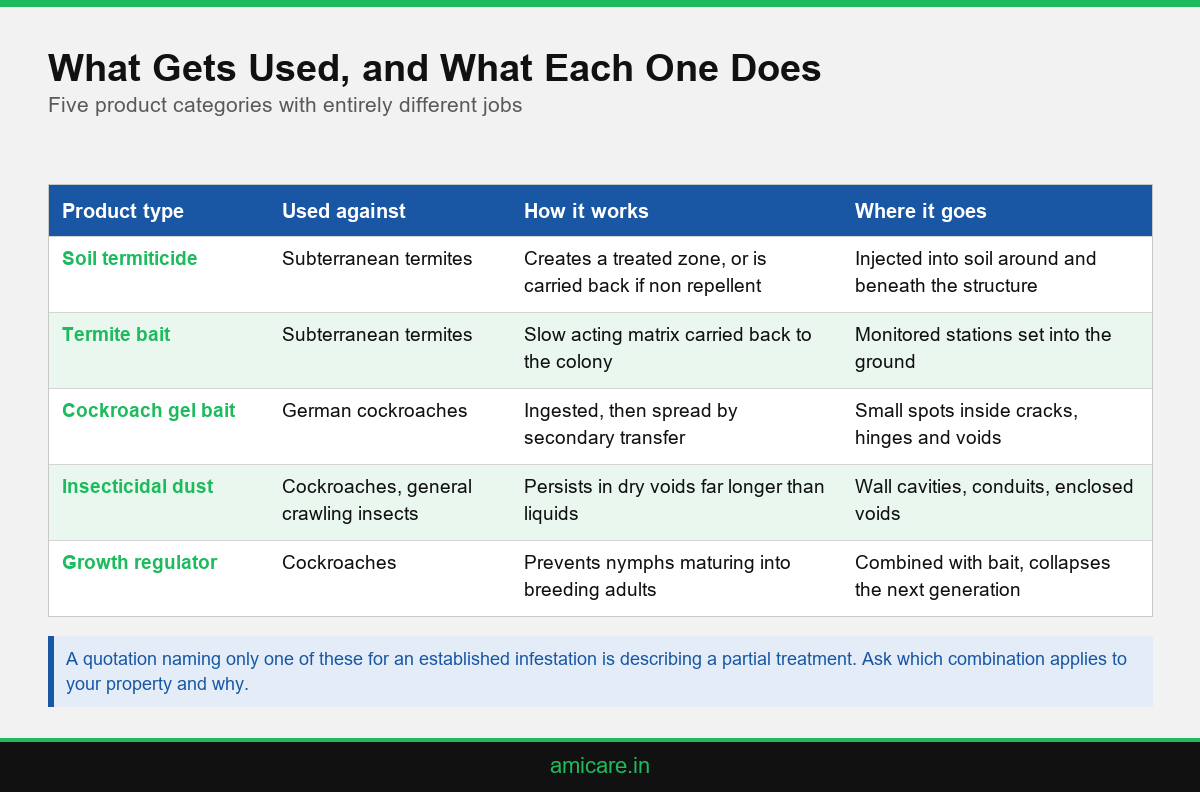
Termite work uses products designed to remain active in soil for years, which is a fundamentally different requirement from a kitchen treatment. A soil applied termiticide has to survive moisture movement, microbial breakdown and, in Kerala, roughly three thousand millimetres of annual rainfall passing through the treated zone.
Products fall broadly into two behavioural categories. Repellent termiticides create a zone termites will not cross, which excludes them from the structure but leaves the colony intact and searching for gaps. Non repellent products are not detected by the insects, so they pass through, pick up the active and carry it back, which affects the colony itself.
Bait systems work differently again. A slow acting ingredient is presented in a cellulose matrix in monitored stations, foraging workers carry it back, and the colony declines over weeks. Which approach suits a property depends on construction, soil and access, and the existing article on the science behind termite treatment covers the mechanisms.
Why concentration is not negotiable
Termiticide concentration and application volume per running metre are part of the specification, not guidance. Halving either produces a barrier with gaps that behaves like an untreated zone within a fraction of the intended life. It is invisible at handover and only becomes apparent when termites reappear, by which time the provider may be unreachable.
Cockroach Products: Baits, Residuals and Dusts
Cockroach work uses three product types with different jobs. Gel baits are the primary method. They combine a food matrix with a slow acting ingredient, are non repellent so insects feed willingly, and spread through the population by secondary transfer as insects contact the dead and their droppings.
Residual liquids are applied to transit surfaces such as duct edges, thresholds and perimeters rather than broadcast through living space. Insecticidal dusts go into dry voids, wall cavities and conduits where liquids would be absorbed and where they remain effective far longer than any surface application.
A fourth category deserves mention because it is often invisible on an invoice. Insect growth regulators do not kill adults but prevent nymphs developing into breeding adults, which collapses the population over a generation. They are frequently combined with bait, and their presence is a sign of a considered programme rather than a single product visit.
Rotation, Resistance and Why Products Change
A competent provider does not use the same product indefinitely. Cockroach populations exposed repeatedly to a single bait matrix can develop reduced acceptance, and populations exposed to one active ingredient class can develop reduced susceptibility. Rotating between classes and matrices between visits is standard practice for exactly this reason.
This is one of the clearer differences between professional and household treatment. A household that buys the same aerosol repeatedly for two years is applying continuous selection pressure with one chemistry, which is close to a textbook recipe for reduced susceptibility in the surviving population.
If a professional treatment underperforms and placement was correct, no spraying occurred and the bait was left undisturbed, rotation is the reasonable next step rather than more of the same product. A provider who responds to failure by simply repeating the identical treatment has not diagnosed why it failed.
Residues, Food and Surfaces
The concern households raise most often is contamination of food and food preparation surfaces, and it is a reasonable concern that has a straightforward answer. Correctly executed treatment does not apply product to worktops, dining surfaces, crockery or anywhere food is prepared or served.
Gel bait goes inside cracks, hinge recesses and appliance voids. Residual application goes to duct edges and thresholds. Dust goes into cavities. None of these are food contact surfaces, and the preparation step of covering or removing food and utensils exists to keep it that way during application.
For households that want to understand the wider context, the World Health Organization briefing on pesticide residues in food sets out how residues are assessed and regulated. The domestic relevance is limited if treatment is targeted, which is another argument for placement over spraying.
Kitchens where food is prepared commercially
Home kitchens running a catering or tiffin business sit under a different standard, because product records and treatment documentation become part of the food safety file rather than a private matter. Requirements there follow commercial pest management practice rather than residential norms.
The Questions That Reveal Everything
Four questions will tell you more about a provider than any amount of marketing, and all four have short factual answers that a professional gives without hesitation.
Which product are you using and is it registered for this application. What concentration and what volume per running metre or per square metre. Where exactly will it be placed, and which areas get nothing. What is the re entry interval for each product used in each area.
Hesitation, vagueness or irritation in response to any of these is informative. So is a provider who describes their product as a company formulation without naming an active ingredient. The National Pesticide Information Center is a useful independent reference if you want to check what an active ingredient is before agreeing to it.
Why Cheap Quotes Usually Mean Diluted Product
Chemical is one of the larger input costs in a termite treatment, and it is also the easiest to reduce invisibly. A provider competing purely on price has three levers, and all three are effectively undetectable at handover.
The first is concentration. Diluting a termiticide below its registered rate cuts the chemical bill proportionately and produces a barrier that behaves like untreated soil within a fraction of its intended life. The second is volume, applying less product per running metre than the specification requires, which leaves gaps between treated zones that termites locate efficiently.
The third is drill spacing. Widening the interval between injection points reduces both labour and chemical, and the finished wall looks identical. None of these are visible to a homeowner on the day, and all three surface eighteen months later as reappearing activity.
This is why an unusually low quotation is information rather than an opportunity. Ask for concentration and volume per metre in writing alongside the price, and compare those figures rather than the headline. The existing analysis of why cheap termite treatment is not a saving makes the same case from the cost side.
Conclusion
The chemical matters, but the specification around it matters more. A registered product at the correct concentration placed precisely is an effective and controlled treatment. The same product diluted to win a price comparison and sprayed broadly is neither. Ask what is being used, at what strength and where. Ask Amicare for the product details before work begins and keep the answer with your treatment record.
Frequently Asked Questions
What does CIB approved mean for a pest control product?

Which is the best termite control chemical?
Can I ask which chemical is being used in my home?
Why is concentration so important?
Do cockroach and termite treatments use the same products?
What is an insect growth regulator?
Will the chemicals contaminate my kitchen surfaces?
Why do providers change products between visits?
Are retail products the same as professional ones?
How long do these products stay active?