Barrier, Baiting or Injection: Choosing Termite Treatment
The termite treatment process is often presented as a single service, which hides the decision that actually matters. There are three principal methods, they solve different problems, and Kerala's soil and rainfall change which one holds. Understanding the difference lets you judge whether a quotation reflects your property or a standard package.
Key Takeaways
- A soil barrier excludes termites from the structure. Baiting eliminates the colony. Injection treats timber already infested.
- Most established Kerala infestations need injection for the immediate problem plus barrier or bait work for the source.
- Laterite soil and heavy monsoon rainfall deplete chemical barriers faster here than in drier states.
- Drill spacing, concentration and volume per metre are the specification. Ask for them in writing alongside the price.
Three Methods, Three Different Jobs
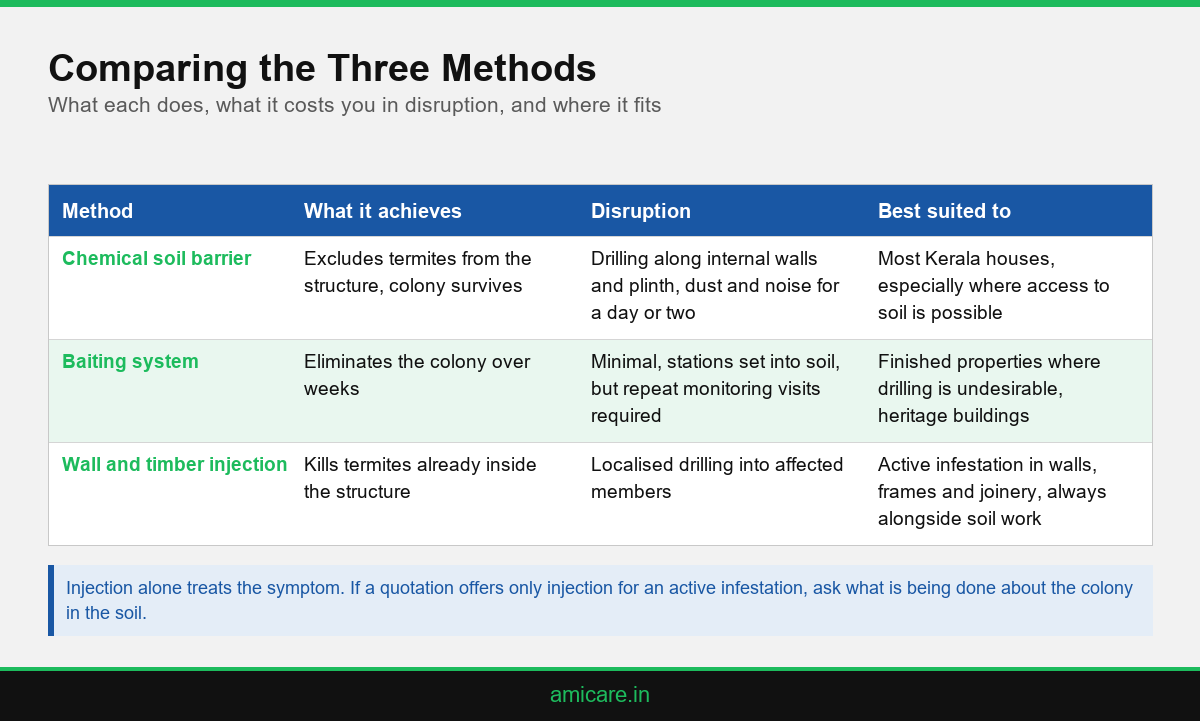
A chemical soil barrier treats the ground around and beneath a building so that termites cannot cross it. The colony survives in the soil but is excluded from the structure. This is the most widely used approach in India and the one most Kerala homeowners will be offered by default.
A baiting system takes the opposite approach. Monitored stations containing a slow acting active in a cellulose matrix are set into the soil, foraging workers feed and carry it back, and the colony declines over weeks. Nothing is excluded because the colony itself is removed.
Wall and timber injection is a third thing entirely. It treats material that is already infested, delivering product into galleries inside walls, frames and joinery. It resolves the immediate infestation and does nothing about the source, which is why it is almost never appropriate on its own.
Repellent and Non Repellent Barriers Are Not the Same
Within barrier treatments there is a distinction that rarely appears in a quotation and matters considerably. Repellent termiticides are detected by termites, which avoid the treated zone. That excludes them, but the colony remains intact and continues probing for a gap, and it will find one if the barrier is discontinuous.
Non repellent products are not detected. Termites move through the treated zone, pick up the active and carry it back into the colony through normal contact and grooming behaviour. The effect extends beyond the treated line into the population itself, which makes a small gap far less consequential.
The practical implication for a Kerala property is that a non repellent product is more forgiving of the imperfect access that finished buildings always present. Guidance from university extension entomologists on termite control covers the distinction, and it is a reasonable question to put to any provider quoting a barrier treatment.
What Kerala Conditions Do to a Barrier
This is where generic advice fails locally. A chemical barrier is a treated volume of soil, and anything that moves water through that soil gradually reduces the concentration within it. Kerala receives roughly three thousand millimetres of rain in a normal year, and laterite soils drain freely.
The consequence is that a barrier rated for a decade in a dry climate should be expected to need attention sooner here. This is not a defect in the product, it is a site condition, and a provider who quotes identical warranty terms regardless of location and drainage has not accounted for it.
Drainage is therefore part of the treatment decision rather than a separate maintenance issue. Water pooling against the plinth accelerates depletion while creating ideal conditions for the colony, which is one reason Kerala's climate raises termite pressure year round in ways that shorten treatment life.
When baiting becomes the better answer
Where soil access is poor, where drilling would damage finishes, where the plinth is largely paved or where repeated barrier depletion has already been experienced, a bait system often outperforms another barrier. The trade off is that it depends entirely on the provider actually returning to monitor the stations, so it is only worth buying from someone you expect to still be servicing it in two years.
Drill Spacing, Concentration and Volume
Three numbers determine whether a barrier performs, and none of them are visible once the work is finished. Drill spacing sets how continuous the treated zone is. Concentration sets how effective it is. Volume per running metre sets how far the product spreads through the soil from each injection point.
All three are the first things reduced when a provider competes on price, and all three are undetectable at handover. A wall with holes at wider intervals looks identical to one drilled correctly, and a diluted product smells the same as a correctly mixed one.
The defence is simple and rarely used. Ask for the drill spacing, the product name, the concentration and the volume per running metre to be stated in the quotation itself. Providers doing the work properly supply these without difficulty. Providers who intend to cut them tend to become vague, and that vagueness is your answer.
What Injection Actually Involves
Where termites are already inside walls or joinery, injection treats them directly. Small holes are drilled into the affected member or the masonry behind it, product is introduced under low pressure so it travels along the galleries, and the holes are sealed and made good.
For timber the same principle applies at smaller scale, with injection into galleries followed by surface treatment of the exposed wood. Badly damaged members are sometimes better replaced than treated, and a provider who never suggests replacement for a structurally compromised piece is not assessing it properly.
Injection produces visible results quickly, which is precisely why it is sometimes sold as a complete treatment. It is not. Without addressing the colony in the soil, the same building will be reinfested through the same route, and the existing article on post construction termite treatment sets out how the two parts fit together.
Matching the Method to the Property
A new build under construction is the easiest case and the cheapest by a wide margin. Soil can be treated in open stages as the structure rises, producing continuous coverage that no post construction method can replicate. Anyone building should read the guidance on pre construction anti termite treatment before the plinth stage.
A finished independent house usually warrants a barrier plus injection where activity is present. A ground floor flat is similar but constrained by what the association permits and by shared structure. An upper floor flat with drywood activity in furniture needs neither soil work nor drilling, only targeted timber treatment.
The decision therefore depends on the building, the species and the access, which is why an inspection has to precede the quotation. A provider offering the same method to every property is selling a product rather than solving a problem, and that is one of the clearest signals of a weak provider.
Questions to Ask Before Agreeing
Five questions will tell you whether a quotation was thought about. Which termite type is present and what evidence supports that conclusion. Which method is proposed and why that one for this property. What drill spacing, concentration and volume per metre will be used.
Then two more about what happens afterwards. What the warranty covers, what voids it, and whether the inspections required to keep it valid are included in the price. And what the provider does if activity continues past the point where it should have stopped.
Answers to all five should be immediate and specific. A provider who treats these as unreasonable questions is telling you something useful, and the buyer's checklist for termite companies covers the same ground from the selection side.
Conclusion
There is no universally best termite treatment process, only a method matched to a property. Barrier for exclusion, baiting for colony elimination, injection for what is already inside, and in most established Kerala cases a combination. Ask which is proposed, why, and at what specification. Ask Amicare to specify the method and the numbers before comparing prices.
Frequently Asked Questions
Which termite treatment method is best?

What is the difference between repellent and non repellent termiticide?
Why does drill spacing matter?
Does heavy rain affect termite treatment?
Is injection alone enough?
How long does a barrier treatment take?
Are bait systems worth the extra cost?
Can termite treatment be done on a concrete building?
What should the quotation actually state?
Does the method change for an apartment?