Termite Inspection Before Buying a House in Kerala

A termite inspection is standard practice for property buyers in several countries and almost unheard of in Kerala, which is odd given that the climate here is considerably harder on buildings. For a fraction of one percent of the purchase price it tells you whether the structure you are buying is sound, and it gives you something concrete to negotiate with if it is not.
Key Takeaways
- Termite damage is concealed by nature. A visual walk through by a buyer or an agent will not find it.
- The cost of an inspection is trivial against a purchase price and against the cost of structural repair.
- Findings are negotiating material. A documented defect either reduces the price or gets remedied before completion.
- Ask the seller for any existing treatment records and warranty, and check whether the warranty transfers.
Why Buyers in Kerala Rarely Do This
The practice simply has not established itself here. Buyers commission legal due diligence as a matter of course, and increasingly a structural or valuation survey, but a pest and timber inspection is still treated as an unusual request rather than a routine one.
The gap is hard to justify on the facts. Kerala's humidity, rainfall and heavy use of timber in construction combine to make termite damage more likely here than in most of India, and the damage is specifically the kind that a visual inspection is designed not to find.
There is also a false comfort in newness. A ten year old property can carry substantial concealed damage, and a recently renovated one can be worse, because fresh paint, new skirting and a new false ceiling are all excellent at hiding what is behind them.
What the Inspection Actually Covers
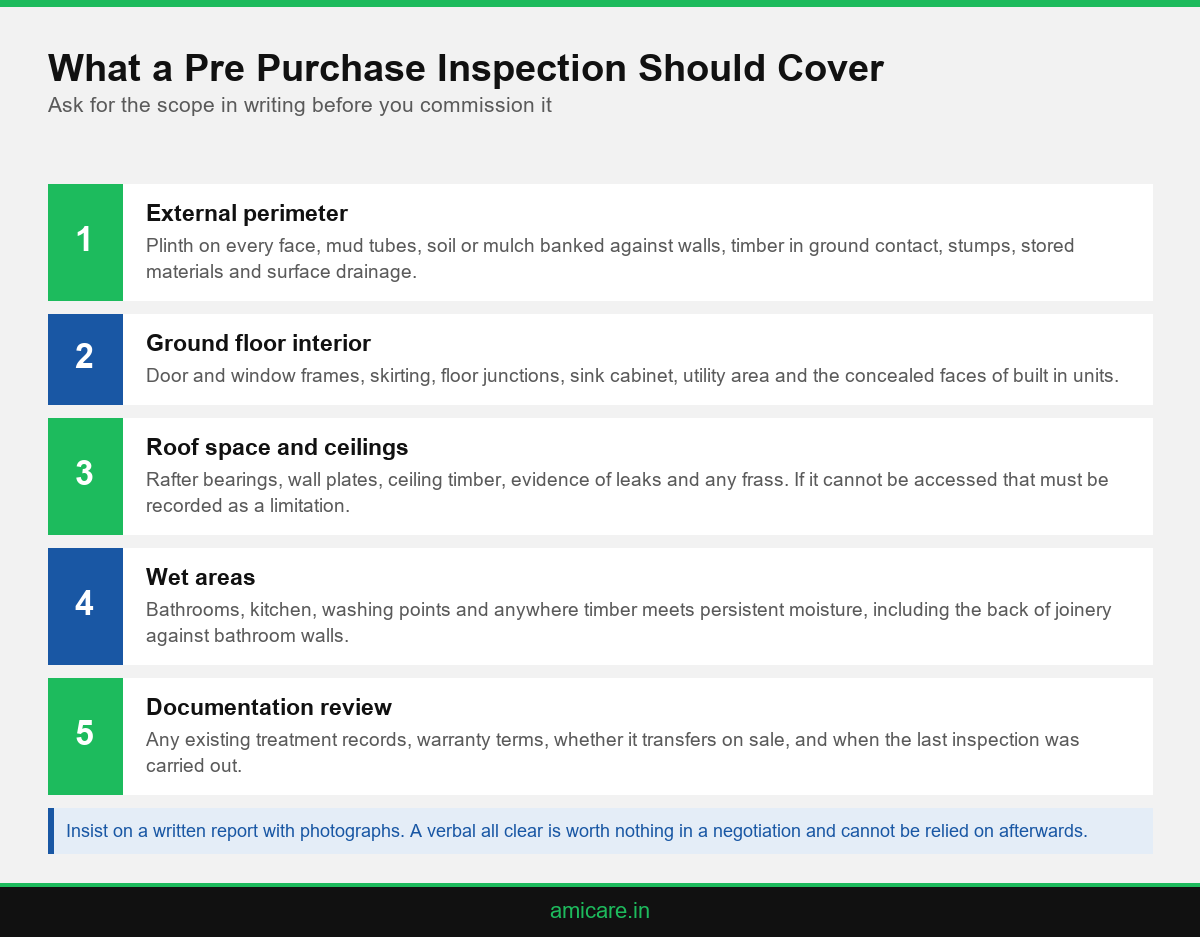
A competent pre purchase inspection is systematic rather than a walk round. Externally it covers the plinth on every face, checking for mud tubes, soil banked against the wall, timber in ground contact, stumps and stored materials, and the condition of drainage away from the building.
Internally it covers door and window frames, skirting, floor level junctions, the underside and rear of built in units, the sink cabinet and utility area, and every accessible timber element. The technician taps rather than looks, because a hollow note is the only reliable indicator of internal loss.
The roof space is the part most often skipped and most often decisive. Rafter bearings, wall plates, ceiling timber and any evidence of leaks belong in the report. If a roof space is inaccessible, that should be stated as a limitation rather than passed over in silence.
What the Findings Are Worth to You
A clear report buys certainty, which is what you paid for. It also establishes a baseline, so if activity appears eighteen months after you move in you know it arrived on your watch rather than having been concealed at sale.
A report that finds activity is more valuable still, because it converts a hidden risk into a negotiating position. There are three standard outcomes. The seller treats the property before completion at their cost, the price is reduced by the assessed cost of remediation, or you walk away from a building whose damage is more extensive than the price reflects.
The third outcome is the one buyers underweight. Where structural timber has been substantially lost, the remediation is carpentry and structural work rather than a pest treatment, and the cost can be a significant fraction of the purchase price. Knowing that before exchange is the entire point of the exercise.
Questions to Ask the Seller
Three questions are worth putting directly, and the manner of the answer is often as informative as the content. Has the property ever been treated for termites, and if so, when and by whom. Is there a warranty, is it still valid, and does it transfer to a new owner.
Then ask whether any structural or plumbing work has been carried out that would have disturbed treated soil. Extensions, new drainage, cable trenching and landscaping all break a barrier, and a property with a valid warranty and a recently dug garden may have a gap nobody has reported.
Get the answers in writing as part of the pre contract enquiries. A seller who has treatment records and produces them readily is giving you genuine reassurance. One who is vague about whether the property has ever been treated is giving you a reason to inspect more thoroughly rather than less.
Warranty transfer is worth checking
Many Kerala termite warranties are written to the original customer rather than the property, and lapse on sale. Where a warranty does transfer it is a genuine asset and worth confirming in writing with the provider rather than accepting the seller's description of it.
Timing It Correctly in the Purchase
Commission the inspection after your offer is accepted in principle and before you are contractually committed. Too early and you may pay for an inspection on a property you do not secure. Too late and the findings arrive when you have lost the ability to act on them.
Allow enough time in the schedule. A thorough inspection of an independent house takes a few hours and the written report follows, so build a week into the timeline rather than trying to compress it into the days before completion.
Attend if you can. Walking the property with the technician is genuinely educational, because they will point out the entry routes, the moisture defects and the maintenance issues that a report summarises in a line. That knowledge is useful for years afterwards, whether or not you proceed.
Buying an Apartment Rather Than a House
Flats change the exercise without removing the need for it. Your inspection covers your unit, but the risks that matter most sit partly in shared structure you cannot survey and do not control.
Ask the association two things. Whether the building has a pest management contract and what it covers, and whether there is any history of termite activity in the block, particularly at ground and basement level. A committee that keeps records and answers plainly is itself a positive signal about the building.
Inside the flat, focus on what is realistic. Drywood activity in fitted joinery and furniture, moisture around bathrooms and kitchens, and any evidence at floor level in a ground floor unit. The differences between flats and independent houses shape what an inspection can and cannot establish.
Reading the Report Without Overreacting
A report that finds something is not automatically a reason to withdraw. Findings sit on a spectrum, and knowing roughly where a given finding falls prevents both complacency and unnecessary panic.
At the low end are conditions rather than damage. Soil banked against the plinth, a timber stack against the wall, poor drainage, a stump in the garden. These are risk factors, they are cheap to correct, and they are entirely normal findings on a Kerala property. They justify remediation, not renegotiation.
In the middle sits active infestation without structural loss. Mud tubes, activity in skirting or joinery, drywood activity in furniture. This is treatable, the cost is knowable, and the reasonable outcome is that the seller treats before completion or the price reflects the treatment cost.
At the high end is structural loss, meaning rafters, wall plates, frames or floor structure that have lost significant section. Here the remediation is carpentry and possibly structural work, the cost is much larger and harder to bound, and a second opinion from a structural engineer is worth having before deciding anything.
Conclusion
Commission the inspection, get it in writing, and use it. A clear report gives you a documented baseline for the property you are buying. A report that finds something gives you a price reduction, a remediation condition or a reason to walk away. Against a Kerala purchase price the cost is close to rounding. Book a pre purchase property survey with Amicare once your offer is accepted.
Frequently Asked Questions
Is a termite inspection necessary before buying in Kerala?

What does a pre purchase inspection cover?
When should I commission it?
What do I do if the report finds termites?
Does a new or renovated property still need checking?
Should I ask the seller about previous treatment?
Do termite warranties transfer when a property is sold?
Is an inspection worth it for an apartment?
Can I do the inspection myself?
How long does the inspection take?