Is Pest Control Safe? Chemicals, Warranty and Precautions

Pest control safety is the question most Kerala households actually want answered before they book anything, and it is the one providers explain worst. The honest answer is neither that treatment is entirely without risk nor that homes must be evacuated for days. It depends on which product is used, where it is placed and whether the instructions are followed. This guide sets out what is used, what the real precautions are, and what a warranty should cover.
Key Takeaways
- Products used in Indian pest management must be registered with the Central Insecticides Board. Ask for the product name and expect a documented answer.
- Placement matters more than the product. Gel bait inside a cabinet crack presents a completely different exposure from a sprayed room.
- Children, pregnancy and pets justify specific precautions rather than avoiding treatment, because an untreated infestation carries its own health cost.
- A treatment warranty is only as good as its conditions. Read what voids it before signing, not at claim stage.
What Is Actually Being Applied in Your Home
Professional pest control in India does not use a single product. A residential visit may involve a gel bait, a residual liquid, an insecticidal dust and a termiticide, and each behaves differently in terms of where it goes and how long it remains active. Treating them as one undifferentiated chemical is what makes the safety conversation so confused.
Every product used must be registered through the Central Insecticides Board, and the registration framework administered by the plant protection directorate is publicly accessible. Registration means the product has been assessed for the specific use claimed, which is not the same as it being harmless, but it does mean the risks and precautions are known and documented.
The practical implication for a homeowner is simple. You are entitled to know the product name, its active ingredient and where it was applied, and any professional operator will provide that without hesitation. A provider who will not name the product is either using something unregistered or does not know, and both are reasons to stop.
Why the label is the safety document
The label is not marketing material. It carries the legally binding directions for use, the precautions, the re entry interval and the first aid information, and applying a product contrary to its label is a misuse regardless of intent. Guidance on what pesticide labels contain and why they matter explains the structure, and the same logic applies to Indian registered products.
Concentration is part of the product
A registered termiticide applied at half the specified concentration is not a safer treatment, it is an ineffective one that still puts chemical into your soil. Dilution to cut cost is one of the commonest corners cut in low quotations, and it produces the worst of both outcomes.
Placement Decides Exposure
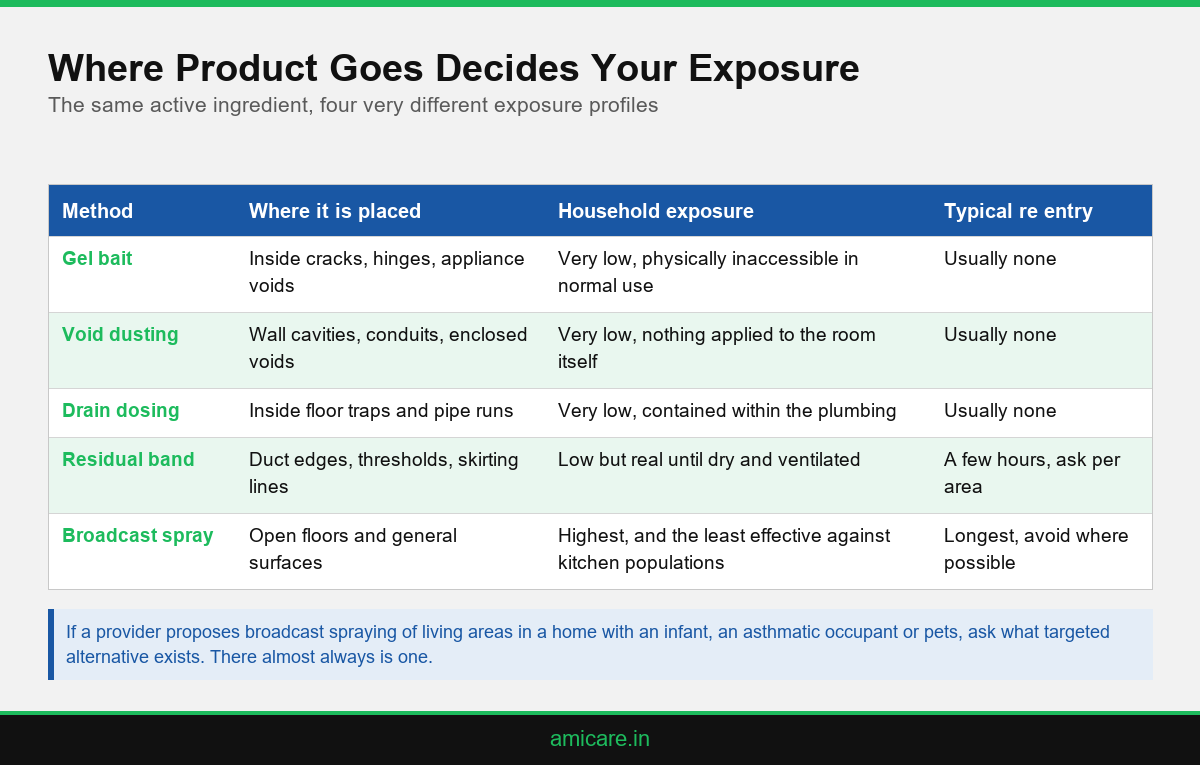
The single most important safety variable is not which chemical is used but where it is put. A gel bait deposited inside a hinge recess, a cabinet corner or an appliance void is physically inaccessible to a child or a pet under normal circumstances. The same active ingredient sprayed across an open floor presents a completely different exposure profile.
This is why modern professional practice has moved so decisively toward targeted placement. Baiting, crack and crevice application, void dusting and drain dosing all put product where the insects are and where people are not. Broadcast spraying of living areas does the opposite, and it is also less effective against the species that matter most in Kerala homes.
The framework behind this is integrated pest management, set out in the integrated pest management principles published by the US Environmental Protection Agency, which prioritises inspection, exclusion and targeted intervention over routine chemical application. It produces better results and lower exposure simultaneously, which is why it is the standard.
Children, Pregnancy and Pets
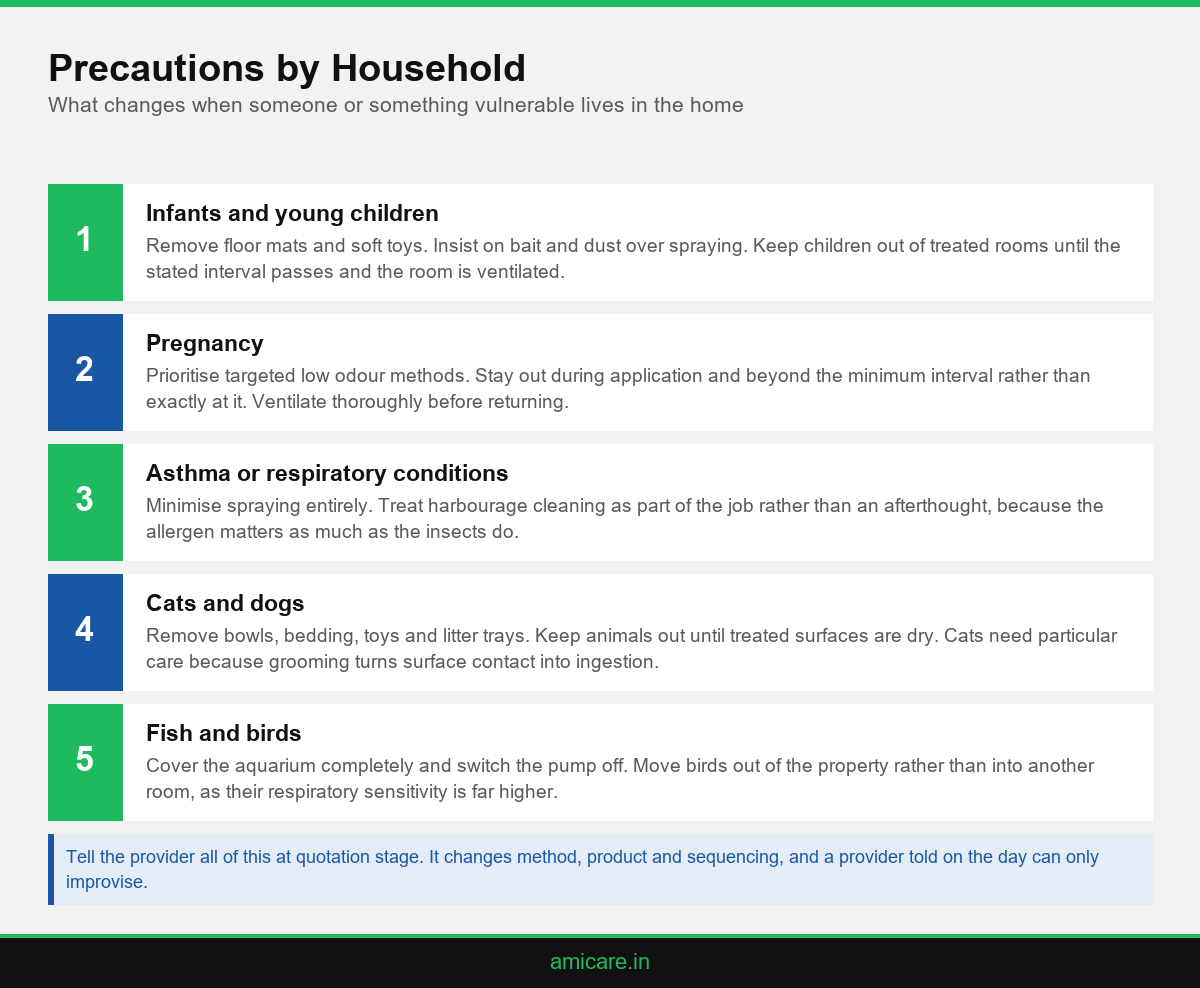
These three categories generate the most anxiety and deserve specific answers rather than blanket reassurance. Children are more exposed than adults for behavioural reasons. They spend time on floors, put hands in mouths and have a higher intake relative to body weight, which is why guidance on pesticides and children focuses on reducing contact rather than on toxicity alone.
For pregnancy the sensible approach is precautionary. There is no need to avoid treating an infestation, but discuss it with the provider so that low odour targeted methods are prioritised, re entry intervals are observed generously, and the person concerned is out of the property during application and for a period afterwards.
Pets need more attention than they usually get. Cats groom obsessively and will ingest anything that lands on their coat or paws. Fish are extremely sensitive to airborne insecticide and aquariums must be covered with the pump switched off during treatment. Birds are more sensitive still. Practical advice on pesticide use around pets is worth reading before the visit.
What to tell the provider in advance
Say who lives in the property before the quotation, not on the treatment day. An infant, a pregnancy, an asthmatic occupant, an elderly relative, cats, dogs, birds or an aquarium all change the method selection, the product choice and the sequencing. A provider told in advance can plan around it. One told at the door will improvise.
The risk of not treating
Safety conversations often ignore the other side of the ledger. Cockroach allergens are a documented asthma trigger, rodents contaminate food surfaces, and termites compromise structure. Leaving an infestation untreated because of chemical anxiety substitutes a known biological risk for a managed chemical one.
Odour, Re Entry and What the Smell Means
Households consistently read strong smell as evidence that a treatment was thorough. The relationship is closer to the opposite. Professional gel baits are close to odourless, and modern residual formulations are formulated specifically to reduce odour. A heavy chemical smell through a house usually indicates broadcast spraying rather than targeted placement.
Re entry intervals are product specific and should be stated rather than guessed. For gel baiting there is typically no re entry restriction at all, because nothing is applied to open surfaces. For residual spraying of a room, a period of a few hours with ventilation is common. For void dusting, the treated void is sealed and the room itself is unaffected.
The correct question to ask is therefore not how long the smell lasts but what the stated re entry interval is for the specific product applied in each area. That number comes from the label, and a technician should be able to give it immediately.
Ventilation is the other half of the answer and it is largely in your hands. Opening windows and running fans after a residual application clears airborne product far faster than waiting passively, and in Kerala's climate cross ventilation is usually straightforward. Where a room has no external window, such as an internal bathroom or a utility space, extend the interval rather than relying on the stated minimum, because that figure assumes normal air exchange.
Different products, different intervals
Do not apply one number to the whole property. A kitchen treated by gel baiting may have no restriction at all while a bedroom that received a residual band along the skirting has an interval of a few hours, and a void that was dusted has none because nothing was applied to the room itself. Ask per area and write the answers down.
Low Odour, Herbal and Eco Friendly Claims
The Kerala market is full of eco friendly, herbal and organic pest control offers, and the category contains both genuine options and marketing. The useful distinction is between products with a lower toxicity profile, which exist and are legitimate, and the implication that a treatment is chemical free, which is almost never true.
Genuinely lower impact approaches do exist and are worth asking about. Baiting rather than spraying, botanical actives, growth regulators that interrupt the insect life cycle rather than killing on contact, heat and steam for certain applications, and above all physical exclusion, which uses no chemistry at all and is permanent.
Be sceptical of anything described as completely safe or entirely natural while still promising rapid elimination of an established infestation. Existing guidance on eco friendly pest control for modern Kerala homes sets out what the category realistically delivers, and the honest position is lower exposure rather than none.
Preparation and Aftercare That Actually Reduce Exposure
A significant share of household exposure is avoidable through preparation, and most of it takes under half an hour. Cover or remove food, crockery and utensils. Put away pet bowls, toys and bedding. Cover aquariums and switch off the pump. Move children's floor mats and soft toys out of treated rooms.
Afterwards the rule that matters most is the one most often broken. Do not deep clean treated cracks, hinges and cabinet corners for about two weeks, because that removes the bait before the colony has fed through it. Normal floor and worktop cleaning should resume immediately, and in fact reduces both residue and food availability.
Wash hands after contact with treated areas, keep children off floors that have received residual application until they are dry and ventilated, and store any leftover retail products out of reach. The citizen's guide to pest control and pesticide safety covers household handling in more depth.
Homes That Also Prepare Food Commercially
A significant number of Kerala households run a small food operation from a domestic kitchen, whether that is catering, a tiffin service, baking or a cloud kitchen arrangement. The moment food leaves the property for sale, the standard applied to pest control changes from private preference to documentary obligation.
Two things become mandatory rather than advisable. Product records, meaning what was applied, where, at what concentration and on what date, need to be retained rather than discarded. And treatment needs planning around production, because product cannot be applied to surfaces that will contact food and re entry intervals have to be respected before the kitchen returns to use.
Method selection tightens as well. Broadcast spraying in a food preparation area is inappropriate regardless of the product, and targeted bait placement, void dusting and exclusion become the default rather than one option among several. Monitoring devices also earn their place, because they generate the evidence trail that an inspection will ask for.
The relevant standards sit under the food safety framework rather than under pest control law, and the regulations administered by the food safety authority on residues in food explain why documentation of what was applied matters so much. The practical requirements are closer to commercial pest management practice than to a domestic visit, and it is worth telling a provider at the outset that food is being prepared for sale.
What to keep on file
The treatment date, the technician's name, the product name and active ingredient, the concentration and the areas treated, plus any monitoring records and the schedule of visits. Keeping this in one folder converts an ordinary pest control arrangement into something that survives an inspection without a scramble.
Why Home Treatment Often Increases Risk
Retail insecticides are frequently assumed to be safer than professional treatment because they are sold openly. In practice household application often produces higher exposure, because the products are applied broadly rather than precisely and by someone with no training in placement or dosage.
The common pattern is over application. A household that sees continuing activity sprays again, then again, accumulating residue across surfaces where people actually live while the colony sits untouched inside a wall void. Aerosol use in a closed kitchen produces meaningful airborne exposure for the person spraying.
There is a second cost that is specific rather than general. Repellent retail sprays scatter German cockroach colonies and make subsequent professional baiting less effective for weeks, which is a recurring theme in why do it yourself pest control fails in Kerala homes. The household ends up with more chemical in the living space and a harder problem to solve.
Protective Equipment and What It Tells You
Watch what the technician wears. A company that equips its staff with appropriate gloves, respiratory protection where the product requires it and suitable clothing is a company that takes the product hazard seriously. One whose technician sprays a house in a polo shirt and sandals is telling you something about its standards.
This is not a superficial signal. The applicator is by far the most exposed person in the process, because they handle concentrate, mix product and work in the space during application. An employer indifferent to that exposure is unlikely to be careful about a household's.
It also indicates training. Knowing which product needs respiratory protection and which does not requires having read the label and understood it, which is precisely the knowledge that determines whether your re entry interval is accurate or invented.
The corollary matters too. If the product genuinely requires the technician to wear respiratory protection during application, that is a good moment to ask what the re entry interval is for the room and whether a less aggressive method would achieve the same result. Often it would.
Spills, Accidents and What to Do
Incidents are rare with professional application but households should know the response rather than improvising. If product is spilled on skin, wash the area with soap and water rather than solvent. If it reaches eyes, irrigate with clean water for several minutes. If anyone swallows any amount, seek medical advice immediately and take the product label or packaging with you.
The label is the critical item in any of these situations, because it carries the first aid guidance and the active ingredient a clinician needs. This is one practical reason to ask for the product name in writing rather than accepting a verbal answer that nobody will remember under pressure.
For pets the same principle applies. Contact a veterinarian rather than waiting to see whether symptoms develop, and be able to say what the animal was exposed to. Cats warrant particular urgency because grooming converts surface contact into ingestion quickly.
Keep any leftover retail products locked away and out of reach, in original containers with labels intact. Decanting insecticide into a drinks bottle is a genuinely dangerous habit and it remains common. Independent reference material from the National Pesticide Information Center covers household handling in detail.
What a Treatment Warranty Should Cover
A warranty converts a one off application into an accountable programme, and its conditions matter far more than its headline length. Termite treatments in Kerala are commonly offered with cover from one to ten years, and a ten year warranty with unreasonable conditions is worth less than a five year one written plainly.
Read for four things. What triggers a free re treatment and who determines it. What voids the cover, which typically includes structural alterations, disturbance of treated soil, unreported leaks and engaging a second provider. Whether the inspections needed to keep the warranty live are included or charged. And whether the warranty is transferable on sale of the property, which matters more than people expect.
Cockroach and general pest work is usually structured as a service agreement rather than a warranty. There the equivalent questions are the number of scheduled visits, the callback response time, whether callbacks are chargeable and which areas are included. Drain line work is frequently priced separately, and in Kerala that exclusion matters a great deal.
Keep the paperwork
Retain the treatment date, product name and concentration, the areas treated, drill spacing where applicable, warranty terms and every inspection report in one place. This file supports a warranty claim, informs any future provider, and has direct value at resale when a buyer's surveyor asks what protection the building carries.
Safety in Apartments and Shared Buildings
Flats introduce a dimension that independent houses do not have, which is that your neighbours' treatment decisions affect your household. Shared plumbing risers, common ducts and continuous voids mean product applied two floors away can migrate, and so can the population it displaces.
The most common practical issue is displacement rather than chemical drift. A neighbour who sprays a repellent product through their kitchen does not eliminate their cockroaches, they push them along the riser into adjacent units. Households with an infant or an asthmatic occupant frequently find their exposure rising because of a treatment they had no part in.
Where a building treats collectively, ask the association to circulate the product details and the re entry guidance to every resident in advance rather than on the day. Households with vulnerable occupants need lead time to arrange to be elsewhere, and five days' notice costs the committee nothing.
Ask also whether common areas are being treated by spraying or by targeted placement. Lobbies, corridors, stairwells and basement areas are shared space that children use, and the same argument for placement over broadcast application applies there with more force than it does inside a private flat.
Choosing a Provider on Safety Grounds
Safety and competence are the same question asked from different angles. A provider who inspects before quoting, identifies the species, explains why a method follows from it and places product precisely is by definition applying less chemical to fewer places than one who sprays everything.
The verifiable checks are straightforward. Ask which products are used and whether they are registered. Ask whether technicians wear appropriate protective equipment, since a company that does not protect its own staff is unlikely to be careful about your household. Ask what the re entry interval is and expect a number rather than a shrug.
Certification is worth weighing here for practical reasons rather than presentation. The argument for working with a certified pest management company rests on documented procedure and traceable product use, which is exactly what you need if something does go wrong, and it is part of what separates a reliable provider from a cheap one.
Conclusion
Pest control safety in a Kerala home comes down to three things you can actually verify. Which registered product is being used, where it is being placed, and what the stated re entry interval is. A provider who answers all three clearly is running a controlled process, and controlled processes are both safer and more effective. Discuss your household's specific requirements with Amicare before treatment is scheduled rather than on the day.
Frequently Asked Questions
Is professional pest control safe for my family?

Do I need to leave the house during treatment?
Is pest control safe during pregnancy?
How do I protect my pets during treatment?
What does CIB approved actually mean?
Why does the treatment smell so strong?
Are herbal or eco friendly treatments genuinely safer?
When can I clean after treatment?
Is doing it myself safer than hiring someone?
What should a termite warranty include?