Is Pest Control Safe for Children, Pregnancy and Pets?

Is pest control safe for babies is the question that stops most Kerala parents from booking a treatment, and the answer they usually get is an unhelpful reassurance. The honest position is that exposure depends on method and placement, that specific precautions genuinely matter, and that leaving an infestation untreated carries its own health cost that rarely gets weighed.
Key Takeaways
- Targeted placement means gel bait inside cracks and voids, which is physically inaccessible to a crawling child under normal use.
- Tell the provider about infants, pregnancy, asthma and pets before the quotation, not on the treatment day.
- Cats and aquariums need the most attention. Cats groom whatever lands on them and fish are highly sensitive to airborne product.
- An untreated cockroach infestation is itself a documented asthma trigger, so doing nothing is not the risk free option.
Why Children Are More Exposed Than Adults
The difference is behavioural before it is biological. Small children spend time on floors, crawl across surfaces adults only walk on, put hands and objects in their mouths, and breathe closer to the ground where heavier vapours settle. They also have a higher intake relative to body weight.
This is why credible guidance focuses on reducing contact rather than debating toxicity in the abstract. The reference material on pesticides and children is built around exposure routes, and the practical conclusions are all about where product is placed and what surfaces a child can reach.
It follows that method selection matters more for a household with a baby than for one without. Gel bait inside a hinge recess and residual spray across a floor deliver the same active ingredient with entirely different exposure profiles, and only one of them is appropriate where an infant crawls.
Practical Precautions for a Home With Children
Before the visit, remove or cover food, crockery and feeding equipment. Take up floor mats, play mats and soft toys from the rooms being treated. Move the cot or high chair away from walls and skirting where residual application might be used, and put away anything a child habitually mouths.
During the visit, keep children out of the rooms being treated. This is easier than it sounds because a competent treatment works room by room rather than all at once. Ask the technician for the re entry interval for each area rather than assuming a single figure applies to the whole house.
Afterwards, ventilate treated rooms before children return, wipe accessible surfaces that were not deliberately treated, and wash hands after any contact with treated areas. Do not clean inside treated cracks and hinges, because that removes the bait, and those locations are not places a child reaches in any case.
Asthmatic children need a different conversation
Where a child has asthma the calculation changes in both directions. Airborne product is a greater concern, so spraying should be minimised in favour of bait and exclusion. At the same time cockroach allergen is itself a documented trigger, so an untreated infestation is actively harmful. The answer is targeted treatment plus thorough cleaning of harbourage, not avoidance.
Pregnancy: A Precautionary Approach
There is no general prohibition on pest control during pregnancy, and an untreated infestation is not a neutral alternative. The sensible framing is precaution rather than avoidance, and it is worth raising with the provider at quotation stage so the plan accounts for it.
The practical measures are straightforward. Prioritise bait, dust and exclusion over spraying. Ask for low odour formulations where a residual is genuinely needed. Ensure the pregnant person is out of the property during application and for a period beyond the stated re entry interval rather than exactly at it. Ventilate thoroughly before return.
Where treatment can reasonably be deferred, such as a preventive visit with no active infestation, deferring is a legitimate choice. Where there is an active infestation, particularly rodents or a heavy cockroach population, the contamination and allergen risks argue for treating rather than waiting.
Pets: The Category Most Often Overlooked
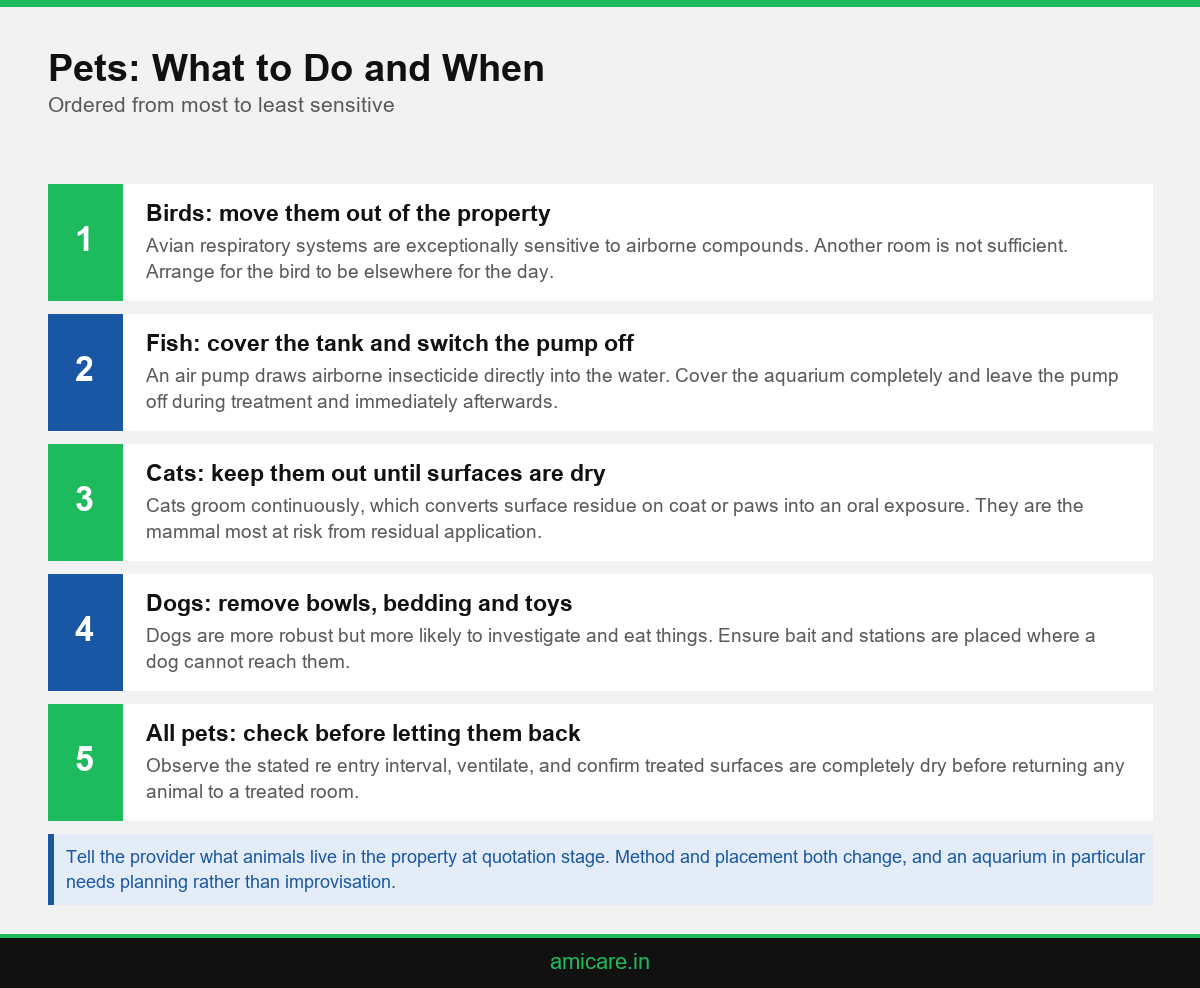
Pets receive far less attention than children in most treatment planning and in some respects need more. Cats are the clearest case. They groom continuously and will ingest anything that settles on their coat or paws, which turns a surface residue into an oral exposure.
Fish and birds are the most sensitive of all. Aquariums must be covered and the air pump switched off during and immediately after treatment, because airborne insecticide entering the water is a serious risk. Birds have respiratory systems that are exceptionally sensitive to airborne compounds and should be moved out of the property entirely.
Dogs are generally more robust but are also more likely to investigate and eat things. Bait stations and gel placements must go where a dog cannot reach, and food and water bowls should be removed. Practical guidance on pesticide use around pets is worth reading before the visit rather than after it.
What to move and when
Bowls, bedding, toys and litter trays out before the technician arrives. Cats and dogs confined to an untreated room or out of the property during application. Aquarium covered and pump off. Birds relocated. Return pets only after the stated re entry interval and once treated surfaces are fully dry.
The Risk of Not Treating
Safety conversations almost always consider only one side of the ledger, and that produces poor decisions. An untreated infestation carries documented health costs, and in a household with a child those costs fall on the same person the chemical anxiety is meant to protect.
Cockroach allergen is the clearest example. It is an established indoor asthma trigger, particularly in children, and the association is well documented in the medical literature including the review on cockroaches and allergic disease. Rodents contaminate food preparation surfaces along the route they travel.
The correct comparison is therefore not chemical exposure against zero, but a controlled and time limited chemical exposure against an ongoing biological one. Framed that way, the case for targeted professional treatment in a household with vulnerable occupants is usually stronger than the case for waiting.
What to Tell Your Provider, and When
The single most useful thing a household can do is disclose early. Say who lives in the property at quotation stage rather than on the treatment day, because it changes the method selection, the product choice, the sequencing and sometimes the price.
The list worth mentioning is short. Infants and young children. Pregnancy. Anyone with asthma or a respiratory condition. Elderly or immunocompromised occupants. Cats, dogs, birds, fish, and any unusual pets. Whether anyone works nights and sleeps during the day, which affects when rooms can be treated and ventilated.
A provider given this information can plan a genuinely different treatment. One told at the door will improvise, and improvisation is where preparation gets skipped. This is part of what a residential pest management plan should account for rather than an unusual request.
Living in a Flat: What You Cannot Control
Households in apartments face a version of this question that independent houses do not. Your exposure is partly determined by what your neighbours do, and you have no say in it.
The mechanism is displacement more often than drift. A neighbouring flat that sprays a repellent product does not eliminate its cockroach population, it pushes the insects along the shared riser into adjacent units. A household that has carefully chosen targeted treatment for the sake of an infant can find its problem worsening because of a treatment two doors away.
What you can do is ask the association to give advance notice of any building wide treatment, including the product being used and the re entry guidance. Five days' notice lets families with infants, pregnancies or asthma arrange to be elsewhere, and it costs the committee nothing to circulate.
It is also worth asking how common areas are treated. Lobbies, corridors and stairwells are shared space that children use daily, and the argument for targeted placement over broadcast spraying applies there at least as strongly as it does inside a private flat.
Conclusion
Treat the safety question as a planning question rather than a yes or no. Disclose who lives in the property, insist on targeted placement over spraying, observe the stated re entry intervals, and give particular attention to cats and aquariums. Done that way, treatment is a controlled and short exposure, and the infestation it removes is not. Tell Amicare about your household before booking so the method is planned around it.
Frequently Asked Questions
When should I tell the provider about my family?

Is pest control safe for babies and toddlers?
Can pest control be done during pregnancy?
How long should children stay out of a treated room?
Are cats more at risk than dogs?
What about my aquarium?
Should I move my birds?
Is it safer to just not treat at all?
Do I need to wash everything afterwards?
Are natural treatments better for a home with children?