How Often Should a Kerala Home Be Treated for Cockroaches?

Deciding how often pest control for cockroaches should be carried out is where most Kerala households either overspend or leave themselves exposed. Annual treatment is too infrequent for this climate. Monthly is unnecessary for most homes. The right interval depends on the property type, whether it sits on a shared plumbing stack, and where you are in the monsoon cycle.
Key Takeaways
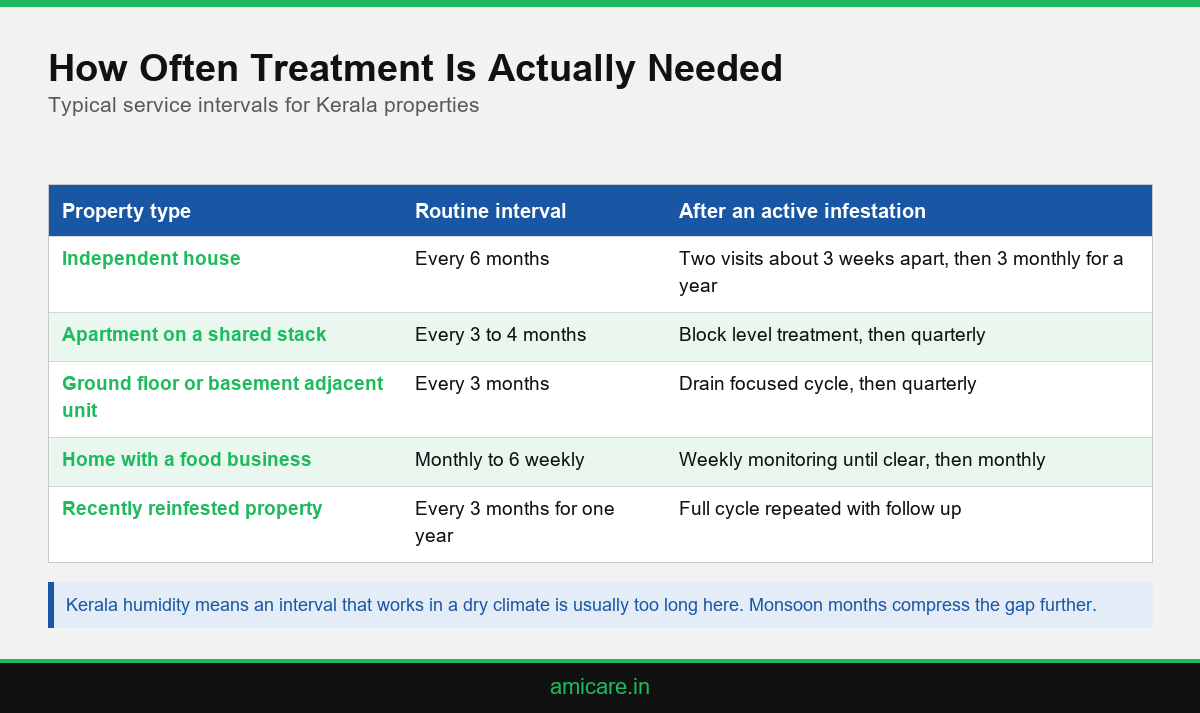
- An independent house with no history needs treatment about every six months. An apartment on a shared stack usually needs three to four months.
- Kerala humidity removes the seasonal breeding pause, so intervals borrowed from drier states are consistently too long.
- After an active infestation, expect an initial cycle of two visits about three weeks apart before moving to maintenance.
Why Kerala Needs Shorter Intervals Than Most of India
In much of India, cooler and drier months slow cockroach breeding enough to give a treated property a natural recovery period. Kerala does not get that pause. Warm nights and year round humidity keep reproduction active, which means a treated property starts rebuilding pressure sooner than the same property would elsewhere.
The practical effect is that a service interval taken from a national template will usually leave a gap at the end of the cycle where the population has recovered but the next visit has not yet fallen. That gap is where households conclude that treatment stopped working.
This is worth understanding before comparing quotes. A provider offering two visits a year is not necessarily cheaper than one offering four. They are offering a different level of cover, and in a coastal humid climate the difference shows up in the last six weeks of each cycle.
Frequency by Property Type
Property type matters more than floor area. An independent house with no infestation history and no drain problems can usually be maintained on a six monthly cycle. An apartment on a shared plumbing stack cannot, because its exposure is continuous and outside the owner's control.
Ground floor units and flats adjacent to basement sumps sit at the highest end of the range. Homes that run a food business, however small, need the tightest schedule, because the consequence of a lapse is regulatory as well as practical under the food safety regulations administered by FSSAI.
A property with a recent infestation is a separate category. For the first year after clearance it should be treated as higher risk than its type would suggest, on a three monthly cycle, because residual harbourage and any missed egg cases make relapse more likely during that period.
Timing Against the Kerala Season
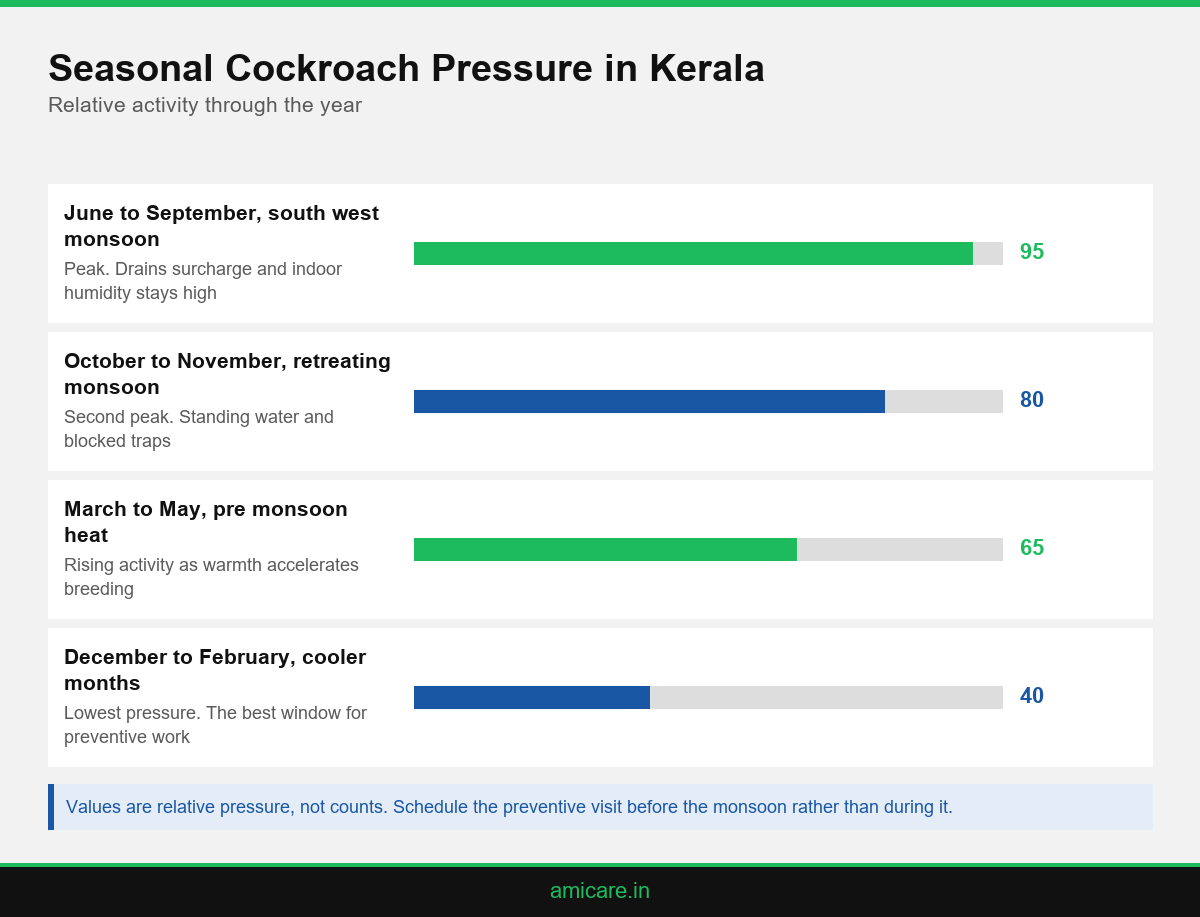
Interval length is one decision. Timing is a separate one, and it is where scheduling can be made to work harder for the same money. Pressure peaks during the south west monsoon and again during the retreating monsoon, when drains surcharge and standing water accumulates.
The useful conclusion is to place preventive visits before those peaks rather than during them. A visit in late April or early May goes into the monsoon with the population already suppressed. The same visit in July is treating a population that is already at its annual maximum.
The cooler months from December to February are the lowest pressure window of the year, which makes them the right time for the structural work that reduces future treatment need. Sealing pipe collars, replacing failed trap covers and clearing stored cardboard are all easier and more effective when activity is low.
What a Maintenance Contract Should Include
A maintenance agreement is worth having when it specifies what happens between visits, and worth questioning when it does not. It should state the number of scheduled visits, the response time for a callback within the covered period, whether callbacks are chargeable, and which areas are included.
Two exclusions are worth reading carefully. Drain line work is sometimes priced separately, which matters a great deal in Kerala. Common areas in apartment buildings are usually outside a household contract entirely. A contract that offers an identical interval to every property regardless of type is a commercial product rather than a technical schedule, and worth comparing against what a residential pest management plan should cover.
Ask what the provider does if activity continues between scheduled visits. A contract that treats a callback as a chargeable extra transfers the risk of an incomplete treatment back onto you, which is the opposite of what a maintenance agreement is supposed to do.
Signals That Your Interval Is Wrong
The schedule should be reviewed against what actually happens in the property rather than left running because it was set once. Four signals indicate the interval needs shortening.
The first is activity returning in the final weeks of every cycle. If sightings reappear at week ten of a twelve week schedule, and then again at week ten of the next, the population is recovering faster than the visits arrive. That is a timing problem, not a treatment quality problem, and adding a fifth visit a year usually resolves it.
The second is seasonal clustering. If complaints concentrate in July and August every year, the preventive visit is falling too late. Moving it earlier in the calendar is free and often more effective than increasing the number of visits.
The third is a change to the property. A new food business, a renovation that opens wall voids, a neighbouring unit left vacant, or new drainage work all change the exposure. The fourth is a change in the building around you, which matters most in apartments, where a neighbouring flat ending its own contract can increase pressure on yours within a single season.
Equally, an interval can be too short. If two consecutive visits find no activity, no droppings and no evidence at any monitoring point, there is a reasonable case for extending the cycle rather than continuing to pay for visits that are finding nothing.
Building a Twelve Month Schedule
Once you have settled how often pest control for cockroaches suits your property, it is worth writing the year out rather than booking visit by visit. A written schedule costs nothing and prevents the most common failure, which is a visit slipping by six weeks because nobody was tracking it.
For a typical Kerala apartment on a four monthly cycle, the useful pattern places visits in late April, late August and late December. The April visit suppresses the population before the south west monsoon. The August visit falls inside the peak, when pressure is highest and a lapse costs the most. The December visit lands in the low season, which makes it the right point to add exclusion work such as sealing pipe collars and replacing failed trap covers.
An independent house on a six monthly cycle works best with visits in late April and late October, bracketing both monsoon peaks. A property recovering from an active infestation should run quarterly for the first year regardless of type, then be reassessed rather than automatically moved back.
Record two things alongside the dates. Note what was found at each visit, even when the answer is nothing, because that record is what justifies extending or shortening the cycle later. Note any change to the property or the building, since a renovation, a new food business or a neighbouring vacancy all shift the exposure and should trigger a review rather than waiting for the next scheduled visit.
If you are in an apartment, align your household schedule with the building programme wherever one exists. A flat treated two months out of step with its own stack gains far less than the same visit timed alongside it, and a scheduled treatment programme is considerably cheaper to run than a series of reactive callbacks.
Conclusion
Set the interval from the property rather than from a price list. Six months suits a low risk independent house. Three to four months suits most apartments. Ground floor units and homes with food businesses need tighter cycles, and every schedule should place preventive work ahead of the monsoon rather than inside it. Ask Amicare to set an interval based on your property instead of a standard package.
Frequently Asked Questions
How often pest control for cockroaches is needed in a Kerala house?

Do apartments need more frequent treatment than houses?
Is annual pest control enough?
When is the best time of year to schedule treatment?
Why does an active infestation need two visits?
What should a maintenance contract cover?
Does frequent treatment cause resistance?
Can I extend the interval if I see nothing?
Is monthly treatment ever justified?
Does the interval change for commercial premises?