Drain Line Cockroach Treatment for Kerala Plumbing
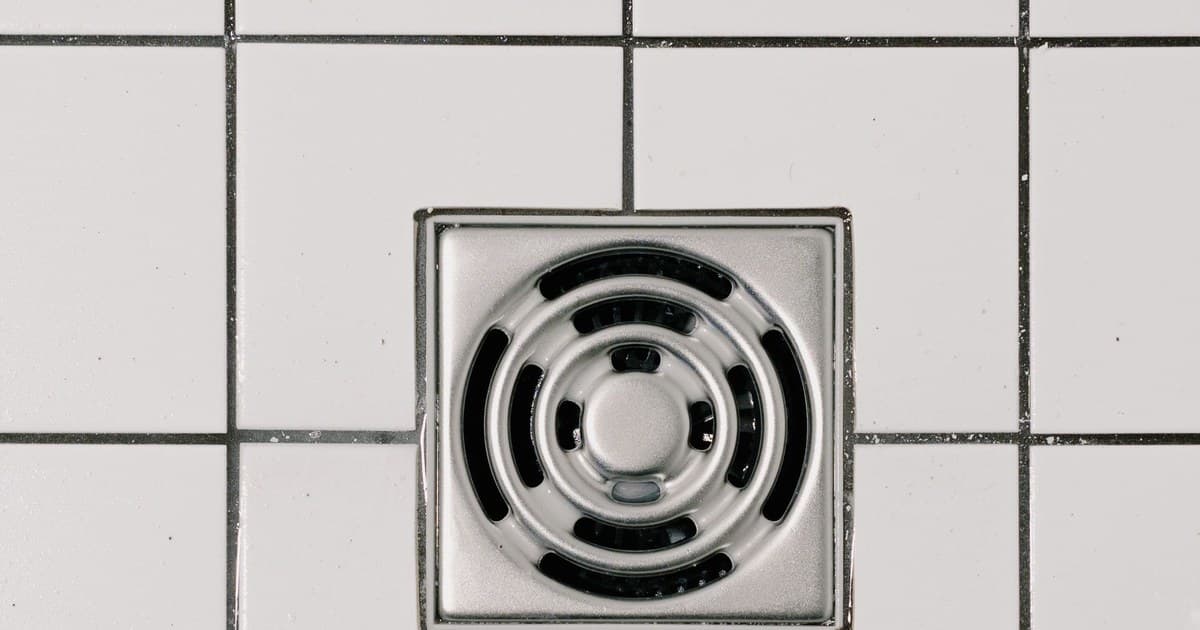
Finding a cockroach in bathroom drain openings at night is one of the most common complaints in Kerala homes, and one of the most consistently mistreated. The insects are visible on the bathroom floor, so the bathroom floor gets sprayed. The population, however, is inside the pipe run. Until the line itself is treated and the pipe penetrations are sealed, the bathroom will keep refilling from below.
Key Takeaways
- The large cockroaches seen in bathrooms at night live in the drain line and sewer connection, not in the room.
- A dried out floor trap removes the water seal and turns a drain into an open corridor from the sewer.
- Drain treatment means dosing the pipe wall above the water seal and sealing pipe collars, not spraying the floor.
Why Bathrooms Are the Symptom and Not the Source
American cockroaches are drain dwellers. They live in the warm, wet, undisturbed environment of the pipe run and the sewer connection, and they enter the room to forage, usually after dark when the property is quiet. What a household sees on the bathroom floor is a foraging trip, not a nest.
This is why bathroom cleaning produces so little improvement. The room can be spotless and the population underneath it is unaffected. It is also why sightings cluster at night and disappear during the day, which households often misread as the problem resolving itself.
The behaviour has a useful diagnostic value. If you switch on a bathroom light at two in the morning and find insects on the floor that scatter toward the drain rather than toward the door, you have confirmed both the species and the harbourage in a single observation. That is more information than most daytime inspections produce.
The Kerala Plumbing Conditions That Make It Worse
Two local conditions turn a manageable situation into a persistent one. The first is monsoon drainage load. When systems surcharge during heavy rain, sewer dwelling populations are pushed upward into buildings through the nearest available opening. The second is the dried water seal.
A floor trap functions because standing water fills the bend and blocks the pipe. In guest bathrooms, unused washing points and second floor rooms that are rarely occupied, that water evaporates within days in Kerala heat. Once it is gone the trap is an open pipe. Running water into every unused drain once a week costs nothing and closes the most common entry route in the house.
Older properties add a third factor. Pipe collars, the point where a pipe passes through a wall or a slab, are frequently left unsealed or have degraded over time. That void is both an entry route and a harbourage in its own right, and it sits outside anything a bathroom cleaning routine can reach.
What a Real Drain Treatment Involves
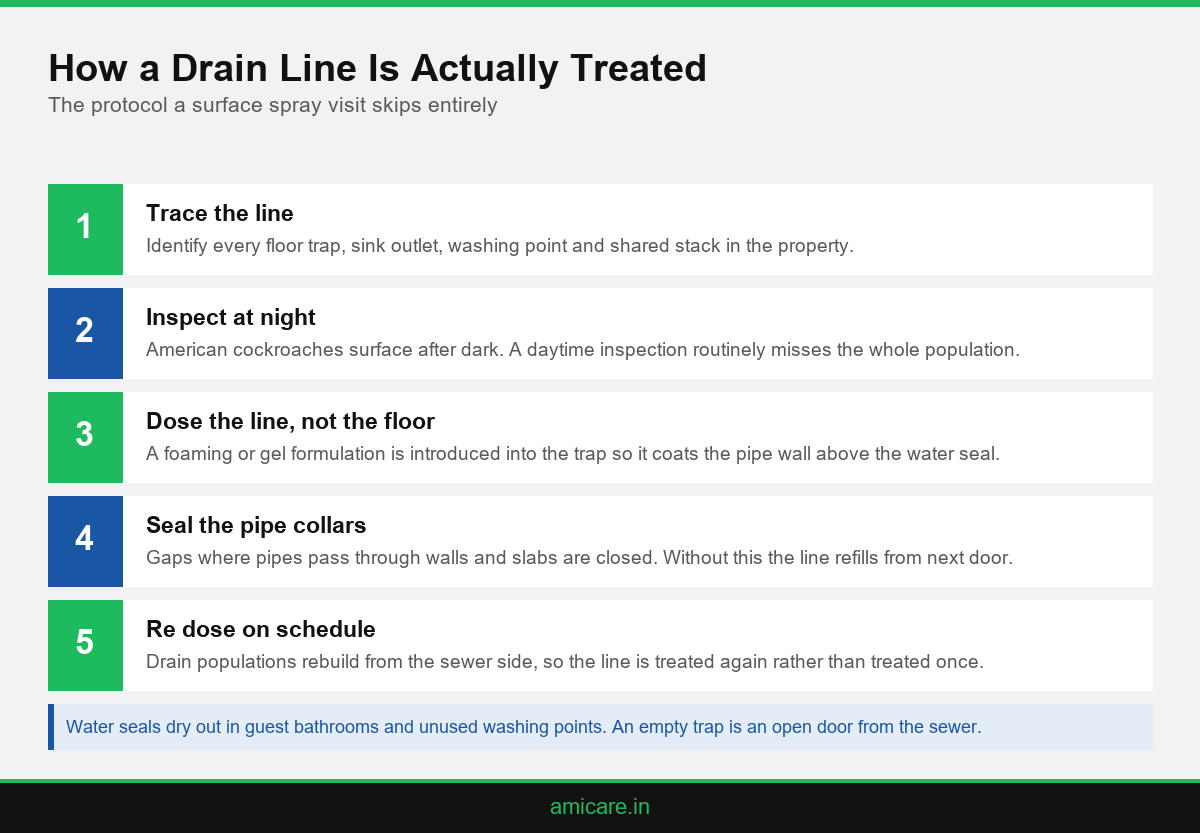
Treating a drain line properly is a sequence, and skipping any step in it undermines the rest. It begins with tracing every trap, outlet and shared stack in the property, and it includes a night inspection, because a daytime survey routinely misses the population entirely.
The treatment itself introduces a formulation into the trap so that it coats the pipe wall above the water seal, where the insects travel, rather than washing straight through into the sewer. Pipe collars are then sealed. Without that, the line simply refills from the adjacent unit or the common stack.
The final step is scheduling rather than application. Drain populations rebuild from the sewer side regardless of how well the line was treated, because the sewer is not yours to treat. A drain focused programme therefore re doses on a defined interval instead of treating once and waiting for the complaint to return.
Why Surface Spraying Cannot Solve It
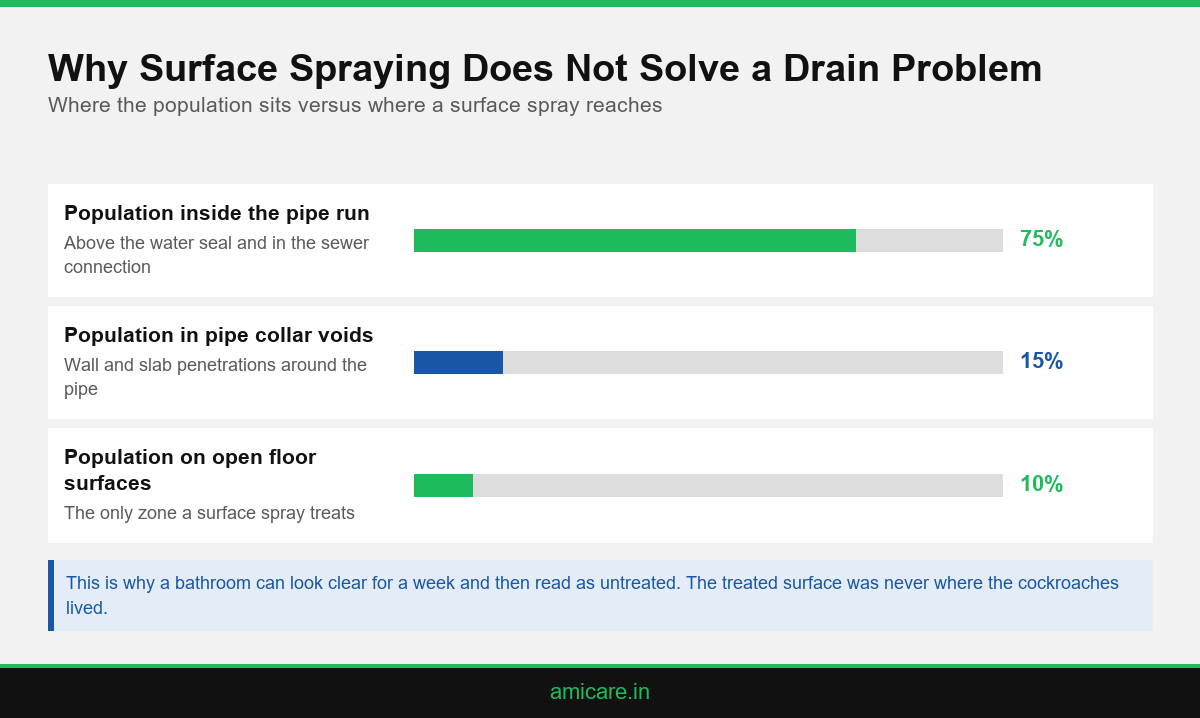
The arithmetic is unforgiving. The overwhelming majority of the population sits inside the pipe run and in the voids around pipe penetrations. Only a small fraction is ever on an open floor surface at any moment, and that fraction is the only part a surface spray reaches.
A bathroom can therefore look clear for a week and then read as completely untreated, because the treated surface was never where the insects lived. It is the same underlying reason that cockroach problems return after apparently successful treatment, and it applies with particular force to drain populations.
There is a second problem with spraying here. A repellent product applied around a drain opening can push foraging insects to use a different route into the property rather than stopping them. The sightings move to another room, the household believes the bathroom is fixed, and the underlying line is untouched.
What Households Can Do Between Treatments
Drain populations are professional work, but three household measures genuinely reduce pressure between visits, and all three address the entry route rather than the insects. The first is maintaining every water seal in the property. Pour a mug of water into each unused floor trap, guest bathroom drain and spare washing point once a week. In Kerala heat those seals evaporate within days, and a dry trap is an open pipe.
The second is fitting proper covers. Many Kerala floor traps use loose grilles with gaps wide enough for an adult American cockroach to pass. A close fitting cover with a fine grating costs very little and physically closes the route. Where a trap is used regularly, a hinged cover kept closed overnight is more practical than one that has to be lifted each time.
The third is checking pipe collars. Look at the point where waste pipes pass through walls and floor slabs, particularly behind the toilet and under the sink. Gaps around the pipe are both an entry route and a harbourage, and sealing them properly is permanent in a way that no chemical treatment is.
What does not help is pouring products down the drain. Bleach, phenyl, boiling water and retail drain cleaners all pass straight through without persisting on the pipe wall where the insects travel, and some will damage the seal or the pipework. They also create a false sense that the line has been treated when it has not.
When the Problem Belongs to the Building
There is a point at which a cockroach in bathroom drain complaint stops being a household problem and becomes a building one. Recognising that point saves a great deal of money, because treatments commissioned by individual flat owners cannot solve it.
Three signs indicate the problem is above your ceiling or below your floor. The first is simultaneous complaints from flats in the same vertical column, which points at the shared stack rather than at any one bathroom. The second is a treated bathroom that stays clear for two or three weeks and then returns to exactly its previous level, which indicates the line is refilling from an untreated section. The third is activity concentrated on the lowest floors, which usually points at a basement sump or the main sewer connection.
In any of those situations the correct step is to raise it with the association rather than book another individual treatment. A stack has to be treated as a stack, and common areas such as sumps and inspection chambers sit outside what a flat owner can authorise. Individual treatment in that context buys a few quiet weeks at full price.
For independent houses the equivalent question is the septic connection and the external drain run. If internal traps are sealed and treated and activity continues, the source is usually outside the walls, in an inspection chamber or a gully trap that has not been opened in years. A drain focused treatment programme should include those external points in its scope rather than stopping at the threshold.
Conclusion
If large cockroaches appear in your bathroom at night and keep appearing after cleaning and spraying, the problem is in the plumbing rather than the room. The line needs dosing, the collars need sealing and the unused traps need water. Surface treatment alone will not hold. Request a drain focused inspection from Amicare and have the whole line traced rather than the floor treated.
Frequently Asked Questions
Why do cockroaches come out of my bathroom drain at night?

Will pouring bleach down the drain kill them?
What is a dried water seal and why does it matter?
Can I seal the drain to stop them?
Does this problem get worse in the monsoon?
Why does my neighbour's bathroom affect mine?
How long does drain treatment last?
Are drain cockroaches a health risk?
Do gel baits work on drain populations?
Should the kitchen sink drain be treated too?