Gel Baiting or Spraying? What Cockroach Treatment Does
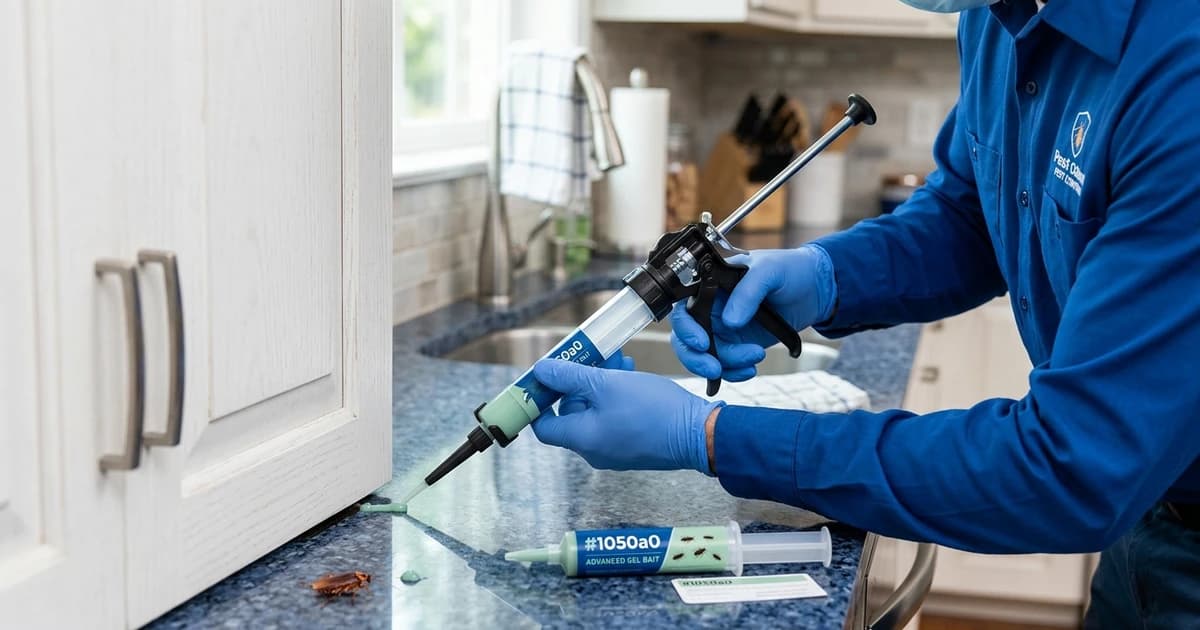
Cockroach gel bait application replaced spraying as the standard professional method for a specific reason, and understanding that reason tells you a great deal about the quality of the treatment you are buying. Gel and spray do different jobs. One removes a colony, the other clears a surface. Knowing which your property needs is the difference between a result and a temporary improvement.
Key Takeaways
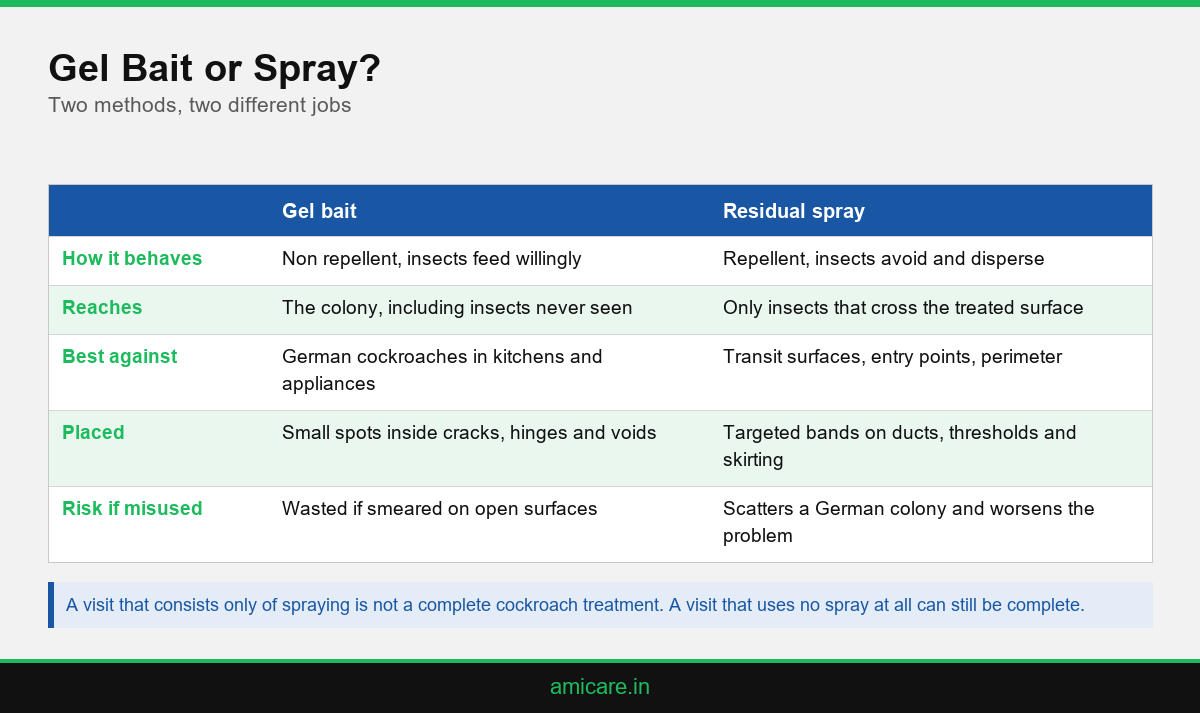
- Gel bait is non repellent and is carried through the colony. Spray is repellent and scatters German cockroaches into new harbourage.
- Placement matters more than quantity. Bait belongs inside cracks and hinges, never smeared on open surfaces.
- Spraying still has a role for perimeter and transit surfaces. It is a supporting method, not the main treatment.
Why Gel Replaced Spraying
Retail insecticide sprays are repellent by design, because visible knockdown is what sells them. That property is actively unhelpful against a German cockroach population. A repellent driven through a kitchen scatters the colony into new harbourage across a wider area rather than killing it, and the problem returns spread over more ground than before.
Gel bait works on the opposite principle. It is non repellent, so insects encounter it without avoidance, feed on it, and return to harbourage before the slow acting ingredient takes effect. The active then passes through the population by secondary transfer as other insects contact the dead and their droppings.
The practical consequence is that baiting reaches insects the technician never sees and never has access to, including nymphs deep in wall voids. That is why professional programmes across the industry moved to bait as the primary method, a shift documented in extension entomology guidance on cockroach control.
Where the Gel Actually Goes
Placement is what separates a competent application from a poor one, and it is easy to assess even without technical knowledge. Bait should be placed as small discrete spots inside cracks, cabinet corners, hinge recesses, the gaps behind and beneath appliances, and along the concealed edges where units meet walls.
It should not be smeared in visible lines along open surfaces, worktops or skirting faces. Cockroaches feed in shelter, not in the open, so bait on an exposed surface is largely wasted. It also collects dust, dries out faster and is far more likely to be cleaned away by the household.
Quantity is not the measure of thoroughness. Many small placements distributed across the harbourage map outperform a few large deposits, because a cockroach will only travel so far to feed. Coverage of the right locations is what determines the outcome.
When Spraying Is Still the Right Call
Spray has not been abandoned, and a provider who refuses to use it at all is being as dogmatic as one who uses nothing else. Residual application to transit surfaces has a genuine role. Service duct edges, thresholds, the perimeter of a building and the routes between units in an apartment block are all sensibly treated this way.
It also suits large open commercial areas and outdoor perimeters where baiting is impractical, and situations requiring rapid knockdown of a heavy visible population before the slower bait programme takes over. The key is that it supports the bait rather than replacing it.
What it should never be is a repellent spray applied through a kitchen where a German population is established. That specific combination reliably makes the problem harder to solve, and it is the single most common reason a household reports that the cockroaches came back worse than before.
Dusting, Drains and the Rest of the Toolkit
A complete treatment usually involves more than two methods. Insecticidal dust is used in dry voids, wall cavities, electrical conduits and the space behind fitted units, where a liquid would be absorbed or would not persist. Dust stays effective in those locations for a long time and reaches harbourage nothing else can.
Drain and floor trap treatment addresses the American cockroach population that lives in the pipe run rather than the room. That work is separate from anything happening in the kitchen and is frequently omitted from cheaper quotations, which is why bathrooms keep producing insects after a kitchen focused visit.
Exclusion completes the set. Sealing pipe collars, fitting close grating to floor traps and closing gaps where units meet walls is unglamorous, permanent and reduces how much chemical the property needs over time. It is also the part most often skipped when a quotation is being trimmed.
Why appliances need separate attention
Fridge compressor bays, microwave vents, water purifier housings and the void behind a built in oven stay warm continuously and are almost never cleaned. They are prime German cockroach harbourage and they need bait placed into the gaps rather than around the appliance. A technician who does not move or open anything has not treated them.
Monitoring between visits
Simple sticky monitors placed under the sink, behind the fridge and near floor traps turn guesswork into evidence. They show whether activity is falling, where it persists and which species is present, and they cost very little. For anyone on a maintenance schedule they are the cheapest way to know whether the interval is right.
How to Tell What Your Provider Actually Did
You can assess the work without expertise. Open a cabinet door after the visit and look at the hinge recess and the internal corners. Small discrete bait spots in those positions indicate correct placement. Nothing there, but a chemical smell through the room, indicates the visit was a spray walkthrough.
Ask three questions before the technician leaves. Which product went where. Whether the floor traps and drains were treated. When the follow up visit falls. A professional answers all three immediately, and the answers become your record if the problem persists.
Strong odour is not evidence of thoroughness. Professional gel is close to odourless, and a heavy chemical smell usually indicates broadcast spraying rather than targeted placement. Households often read the smell as proof that something was done, when it is closer to the opposite.
Why Bait Sometimes Underperforms
Gel baiting fails in predictable ways, and almost all of them are avoidable. Knowing the causes lets you rule out a genuine product problem before assuming one.
The most common cause is prior spraying. If a household or a previous provider has sprayed a repellent product through the treated area, insects avoid the surfaces where bait is placed and feeding drops sharply. This can persist for weeks and is the single biggest reason a competent bait application underdelivers.
The second is cleaning. Washing treated cracks, hinges and cabinet corners in the first fortnight removes the bait before the colony has fed through it. The third is competing food. A kitchen with heavy overnight residue, open provisions and an uncleared bin gives insects a more attractive alternative, so basic housekeeping genuinely improves bait performance.
The fourth is bait aversion, which is real but far rarer than it is blamed. Populations exposed repeatedly to the same bait matrix can develop reduced acceptance, which is why professional programmes rotate formulations between visits. If placement was correct, no spraying occurred and the bait was left undisturbed, rotation is the reasonable next step rather than more of the same product.
What to tell the provider when it has not worked
Be specific rather than general. Say which rooms still show activity, at what time of day, roughly what size the insects are, and whether anything was sprayed or deep cleaned since the visit. That detail lets a technician distinguish between a placement gap, a drain source that was never treated and genuine bait aversion, and those three problems have three different answers.
Conclusion
Gel and spray are not competing products, they are different tools for different jobs. Bait removes a colony, residual spray manages transit and perimeter, dust reaches voids and drain work handles the pipe run. A quotation that includes only one of these is not cheaper, it is partial. Ask Amicare which methods your property actually needs and expect the reasons with the answer.
Frequently Asked Questions
Why is gel better than spray for cockroaches?

Where should cockroach gel be placed?
Is spraying ever the right treatment?
How long does gel bait take to work?
Can I buy and apply cockroach gel myself?
Why does my treatment smell so strong?
What is insecticidal dust used for?
Should the drains be treated as well?
Will cleaning remove the gel?
How do I know the gel was placed correctly?