Cockroach Control Cost in Kerala: What the Price Covers

Cockroach control cost in Kerala varies more than most households expect, and the variation is rarely explained. Two quotations for the same flat can differ by a factor of three, and the cheaper one is often pricing a fundamentally different piece of work. This guide sets out what actually drives the cost and what to check before comparing numbers.
Key Takeaways
- Property type and species drive cost more than floor area. A drain problem is a different scope from a kitchen one.
- An active infestation needs an initial cycle of two visits. A single visit price is not comparable to a cycle price.
- Drain line work and follow up visits are the two items most often excluded from a low quotation.
- Ask for the initial cycle and the ongoing maintenance to be priced as separate lines.
What Actually Drives the Price
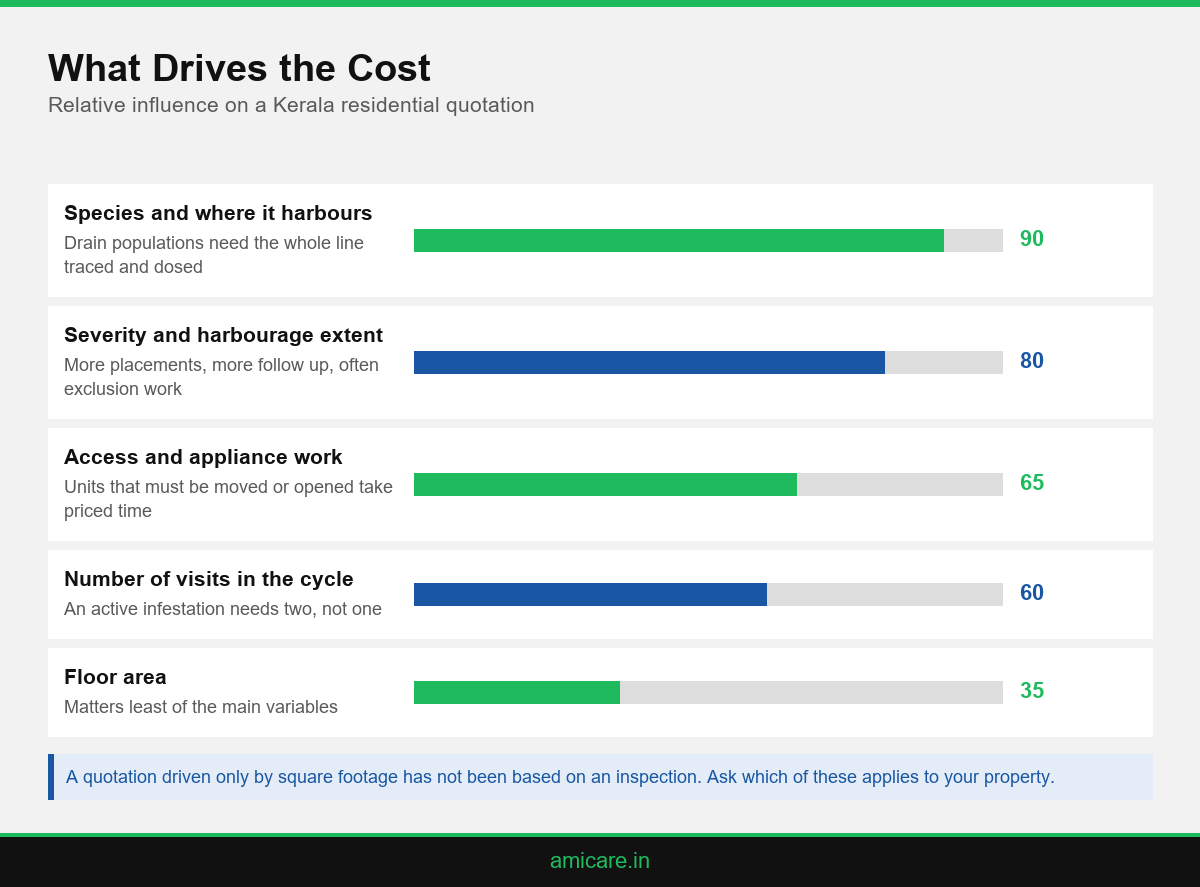
Floor area matters least of the main variables, which surprises people. A one bedroom flat with an established German population in the kitchen and a drain problem in the bathroom is more work than a large house with light activity in one room.
The species is the first real driver. A German population confined to a kitchen is a baiting job concentrated in one area. An American population in the drains requires the whole plumbing run traced and dosed, which is more time and more product. A property with both is two jobs.
Severity is the second. An early infestation may clear in one cycle. An established one with heavy harbourage across appliances, voids and drains needs more placements, more follow up and often exclusion work. The third is access, because appliances that must be moved and built in units that must be opened take time that has to be priced.
Single Visit or Treatment Cycle
This is the most common reason two quotations are not comparable. An active cockroach infestation cannot be cleared in one visit, because no product penetrates the egg case. Eggs laid before treatment hatch about three weeks later, and that generation has to be dealt with.
A properly structured quotation therefore prices an initial cycle of two visits roughly three weeks apart, followed by maintenance at an agreed interval. A quotation offering one visit at a lower price is not cheaper, it is incomplete, and the second visit will be sold separately once the relapse occurs.
Ask explicitly whether the price covers a cycle or a visit, and whether the follow up is included or chargeable. This single question resolves most of the apparent price variation in the Kerala market and is the reason infestations return after apparently successful treatment.
The Line Items That Get Quietly Dropped
Three items are routinely omitted from a low quotation, and all three matter in Kerala. Drain and floor trap treatment is the first and most significant. Where large cockroaches appear at night, the population lives in the pipe run, and a kitchen focused visit leaves it entirely untouched.
Appliance and void work is the second. Moving a fridge, opening a built in unit and treating the cabinet void behind it takes time, and it is the most labour intensive part of a kitchen treatment. It is therefore the first thing trimmed when a provider is competing purely on price.
Exclusion is the third. Sealing pipe collars, fitting close grating to floor traps and closing gaps where units meet walls is unglamorous, permanent and reduces how often the property needs treating. It is almost never in a budget quotation because it does not fit the model of a fast visit.
How to compare two quotations fairly
Put them side by side on five points rather than price. Number of visits in the initial cycle, whether drains and floor traps are included, whether appliances will be moved, whether exclusion work is in scope, and whether callbacks within the period are chargeable. Differences on these five explain almost every price gap you will see.
Maintenance Pricing and What It Should Include
Once an infestation is cleared, ongoing cost depends on interval, which depends on property type. An independent house with no history sits at the longer end. An apartment on a shared plumbing stack needs shorter intervals because its exposure is continuous and outside the owner's control.
A maintenance agreement should state the number of scheduled visits, the callback response time, whether callbacks are chargeable and which areas are included. The last point matters because drain work is frequently priced outside the standard agreement, and in Kerala that is a significant exclusion.
Be wary of a provider offering an identical interval and price to every property regardless of type and history. That is a commercial package rather than a technical schedule, and it will be either more than a low risk house needs or less than a ground floor flat requires.
Why the Cheapest Quote Usually Costs More
The economics here are consistent. A cheap visit suppresses visible activity for two or three weeks by killing foraging insects. The reservoir in the drains, voids and appliance housings is untouched, the population rebuilds, and the household pays again.
Two or three such cycles cost more in total than one properly scoped treatment and deliver a worse outcome. They also make the eventual correct treatment harder, because repeated repellent spraying scatters a German population across a wider area and can reduce bait acceptance.
The reasonable position is not to pay the highest price but to establish what is included. A mid priced quotation that covers a two visit cycle, drains, appliance access and a follow up is usually better value than a low one that covers a single spray walkthrough, which is the same argument made about cheap termite treatment.
What You Can Do to Reduce Cost
Some of the price is within your control and it is worth knowing which parts. Preparation is the clearest. A property where cabinets are cleared, appliances are accessible and floor traps are not buried under storage takes less time to treat properly, and time is what you are paying for.
Acting early is the second. An early infestation confined to one area is a smaller scope than an established one distributed across appliances, voids and drains. The interval between noticing a few insects and having a substantial problem is short with German cockroaches.
Third, address the conditions rather than only the insects. Removing stored cardboard, maintaining water seals in unused floor traps, cleaning appliance recesses and sealing obvious gaps all reduce how quickly a population rebuilds, which lengthens the interval you need and lowers the annual cost.
Cost Over a Year Rather Than Per Visit
Households compare per visit prices because that is what quotations present, but the meaningful number is what the property costs to keep clear over twelve months. Those two figures can rank providers in opposite orders.
Work it out directly. Take the initial cycle, add the number of maintenance visits the interval implies, and add any callbacks the agreement treats as chargeable. A provider with a higher visit price and a four month interval can easily cost less annually than one with a low visit price who is back every six weeks because the reservoir was never treated.
Include the things that reduce future cost as well. Exclusion work is a one off expense that lengthens the interval permanently, so it should be assessed against several years rather than charged against the first visit. Sealing pipe collars and fitting proper trap covers is the clearest example.
Then judge value on outcome. A programme that holds for four months and needs no callbacks is delivering something a cheaper arrangement with two callbacks a quarter is not, even when the invoices look similar. That is the comparison worth making before renewing an agreement.
Conclusion
Compare scope rather than price. Ask how many visits are in the initial cycle, whether drains and floor traps are included, whether appliances will be moved and whether exclusion is in scope. Those four answers explain nearly every price difference you will be quoted, and they predict which treatment will still be holding in six months. Ask Amicare for an itemised quotation rather than a single figure.
Frequently Asked Questions
What does cockroach control cost in Kerala?

Why do quotations differ so much?
Is one visit enough to clear cockroaches?
Should drain treatment cost extra?
Does floor area determine the price?
What should a maintenance agreement include?
Is the cheapest quotation ever the right choice?
Can I reduce the cost myself?
How often will I need to pay for treatment?
Does the species affect the price?