Block Wide Cockroach Control for Apartment Associations
Effective cockroach control in apartment buildings is an organisational problem before it is a technical one. The treatment method is well understood. What defeats most Kerala associations is sequencing, funding and access. A block where twenty flats are treated properly and four are not will be reinfested within weeks, and the association will be told that the treatment failed.
Key Takeaways
- Flats on a shared plumbing stack must be treated on the same day. Staggered treatment moves the population rather than removing it.
- Common services such as risers, chutes and sumps are treated before individual flats, not after.
- Agree the cost split and log refused access in writing before the first visit, not after a dispute.
Why Individual Flat Treatment Does Not Hold
Apartment buildings are connected in ways residents rarely think about. A single plumbing riser serves a vertical column of flats. Electrical conduits, common ducts and garbage chutes link floors horizontally and vertically. Cockroaches use all of them, and they move toward untreated space when a neighbouring unit is treated.
This produces a pattern associations know well. One owner treats their flat, sees a genuine improvement for three weeks, and then reports that the problem has returned worse than before. Often it has moved next door in the interval and come back. The unit was treated correctly. The building was not.
It also explains why the households that complain loudest are frequently the ones keeping their flats cleanest. Housekeeping determines how attractive a unit is once cockroaches arrive. It has almost no influence on whether they arrive, because that is decided by the shared services running past every flat on the stack.
Sequencing a Coordinated Treatment
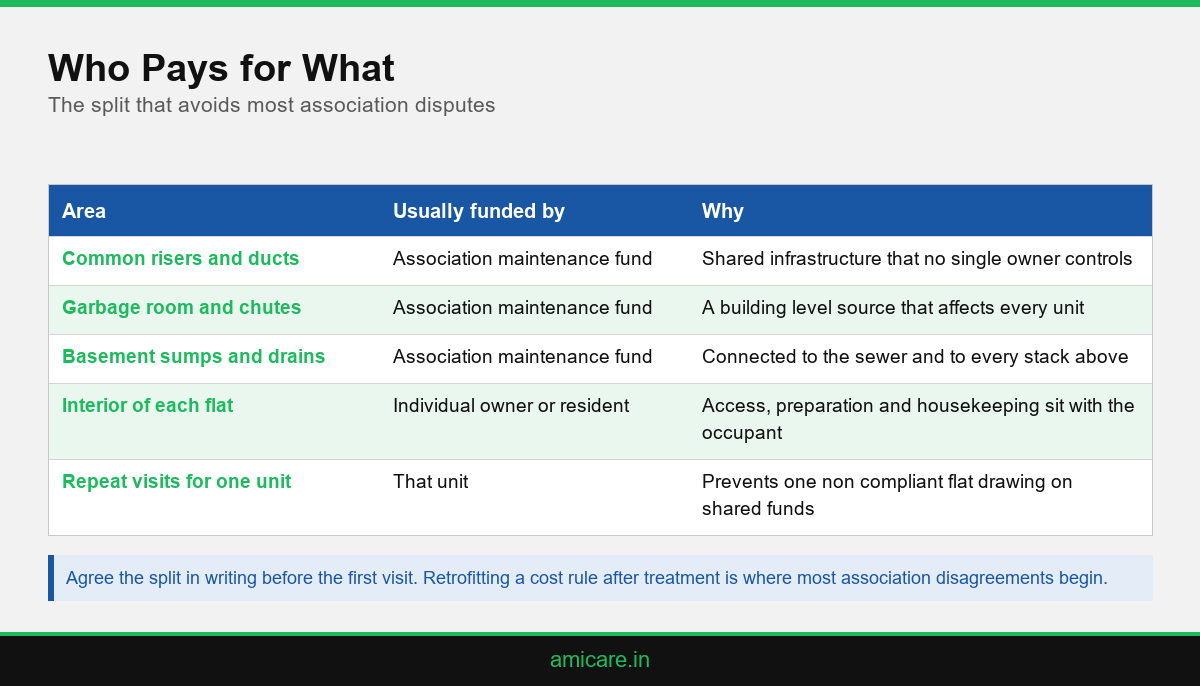
A block treatment follows an order, and the order is what makes it work. The building is surveyed before anything is quoted, so the scope reflects the actual stacks, sumps and garbage areas rather than a flat count. Common services are then treated first, because they are the reservoir that feeds the units.
Individual flats on a shared stack are treated on the same day. This is the step associations most often compromise on, usually to accommodate residents' schedules, and it is the step that most often costs them the result. A follow up visit then confirms the outcome and catches units that were locked.
Communication belongs in the sequence as well. Residents need the preparation instructions several days ahead, not on the morning of the visit, because clearing cabinet backs and moving stored cartons takes time. A block where half the flats are unprepared on treatment day produces a half treated stack, and the stack is the unit that matters.
Funding, Access and the Disputes That Follow
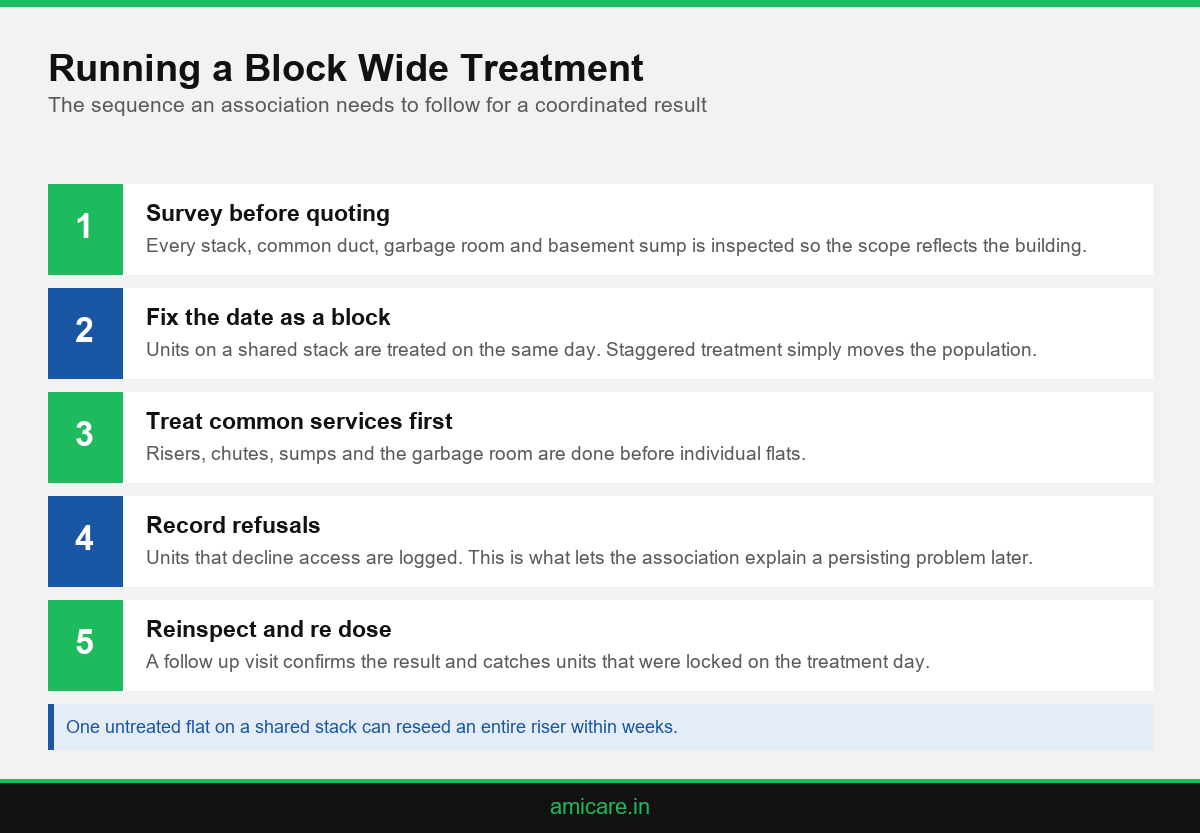
Most association disagreements about pest control are not about whether to treat. They are about who pays for what, and they surface after the invoice rather than before. The workable split is straightforward. Shared infrastructure that no single owner controls is funded from the maintenance fund. Flat interiors sit with the occupant.
Access is the other recurring problem. Some units will decline, and an association cannot compel entry. What it can do is record the refusal in the treatment log. That record is what allows the committee to explain a persisting problem later without the dispute becoming personal, and it is what justifies charging repeat visits for a single non compliant unit to that unit.
Rented flats need a specific rule agreed in advance. Tenants are often unreachable on a fixed treatment date and owners are frequently not local. Deciding in advance who is responsible for providing access, and what happens when nobody does, prevents the most common cause of a partially treated stack.
What Associations Should Ask a Provider For
A provider quoting for a block should be asked for a survey report naming the stacks and common areas inspected, a treatment plan that sequences common services before flats, a written follow up date, and a unit level log that records what was treated and what was refused. A per flat rate with no building survey behind it is a quote for a series of unrelated visits rather than a block treatment.
Documentation matters more in a building than in a house, because the association has to account to its members. This is the same reasoning behind why commercial and institutional clients prefer certified providers, where traceable procedure is part of what is being purchased.
Ask specifically how the basement sump and garbage room will be handled. These are the two areas most often left out of a per flat quotation and the two most likely to be feeding the entire building. A provider who has not mentioned them has not surveyed properly.
Building the Case to the General Body
Committees frequently know what needs doing and still struggle to get it approved, because a block treatment costs more than the individual quotations members have collected privately. The comparison is not like for like, and saying so clearly is usually what carries the vote.
Three arguments tend to work. The first is arithmetic. Twenty owners each paying separately for repeated individual treatments across a year spend more in total than one coordinated programme, and get a worse result, because each treatment is undone by the untreated units around it. The second is the complaint record. Most associations already hold months of correspondence showing the same flats reporting the same problem after paying privately, which is direct evidence that the individual approach has failed.
The third is asset condition. Persistent infestations in common ducts, garbage rooms and basement sumps affect saleability and rental value across the whole building, not just the units currently complaining. That reframes the spend as building maintenance rather than as a subsidy to the worst affected flats, which is usually the objection being raised.
Put the proposal in writing with the survey report attached, state the cost split before the vote rather than after it, and name the follow up date. Associations that approve a treatment without agreeing those three points in advance are the ones that end up in dispute regardless of how well the work is done.
Preparing Residents for Treatment Day
Preparation is where a well planned programme for cockroach control in apartment buildings most often loses its result, and it is entirely within the committee's control. Send instructions at least five days ahead, not the night before, because clearing cabinet backs and removing stored cartons takes more than an evening.
Keep the instruction list short enough that people read it. Residents need to clear and cover food and utensils, move pet bowls, empty the cabinet under the sink, pull small appliances away from walls where they can, and make sure every floor trap is accessible rather than covered by a washing machine or a storage rack. They also need to know not to deep clean the treated points for two weeks afterwards, which is the instruction most often ignored.
Tell residents what to expect as well as what to do. If nobody warns them that visible activity increases for the first two days, the committee will receive a wave of complaints on day two claiming the treatment has made things worse. A single line explaining that this is the bait working prevents most of them.
Finally, nominate one point of contact for the whole building. A technician working through twenty flats cannot also field twenty separate queries, and a single coordinator who holds the schedule, the access arrangements and the refusal log is the difference between a treatment day that runs to plan and one that leaves half the stack untreated.
Conclusion
Treating a Kerala apartment for cockroaches without treating the block around it is buying a three week reprieve. Survey the building, treat the common services first, put every flat on the stack on the same date and record what was refused. That sequence is what turns a series of visits into a result. Talk to Amicare about a coordinated block survey before your association commissions individual flat treatments.
Frequently Asked Questions
Why does cockroach control in apartment blocks need to be coordinated?

Can one flat be treated on its own?
Who should pay for common area treatment?
What happens if a flat refuses access?
How long does a block treatment take?
Should the basement and garbage room be treated first?
How often should an apartment building be treated?
Is a per flat quote reasonable?
Does the treatment disrupt residents?
Can associations handle this without a professional provider?