Termites, Wood Borers or Carpenter Ants? Tell Them Apart
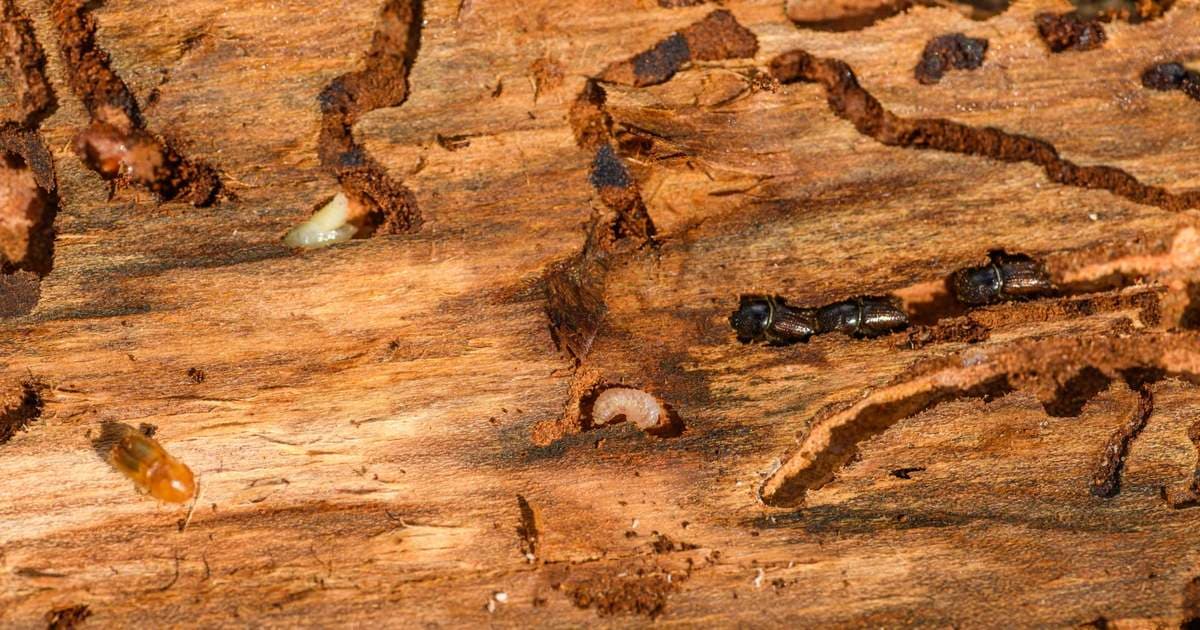
Wood termite control and wood borer treatment are frequently confused, and the confusion is expensive. Three different insects damage timber in Kerala homes, they leave different evidence, and they need different treatment. Paying for termite work on a borer problem, or the reverse, is one of the most common wasted expenses in domestic pest control.
Key Takeaways
- Round exit holes with powdery dust mean wood borer. Mud tubes and hollow timber mean termites.
- Carpenter ants excavate galleries but do not eat wood. They push out coarse shavings rather than fine powder.
- The three need different products and different scopes of work, so identification must come before quotation.
- Establish whether the infestation is still active before paying for treatment. Old damage looks identical to current damage and needs a structural assessment rather than chemistry.
Three Insects, Three Kinds of Damage
Termites eat cellulose and digest it, which is why they hollow timber out completely while leaving a thin intact surface. Wood boring beetles lay eggs on or in timber and the larvae tunnel through it as they develop, emerging as adults through characteristic round holes. Carpenter ants do neither. They excavate galleries to nest in and discard the material.
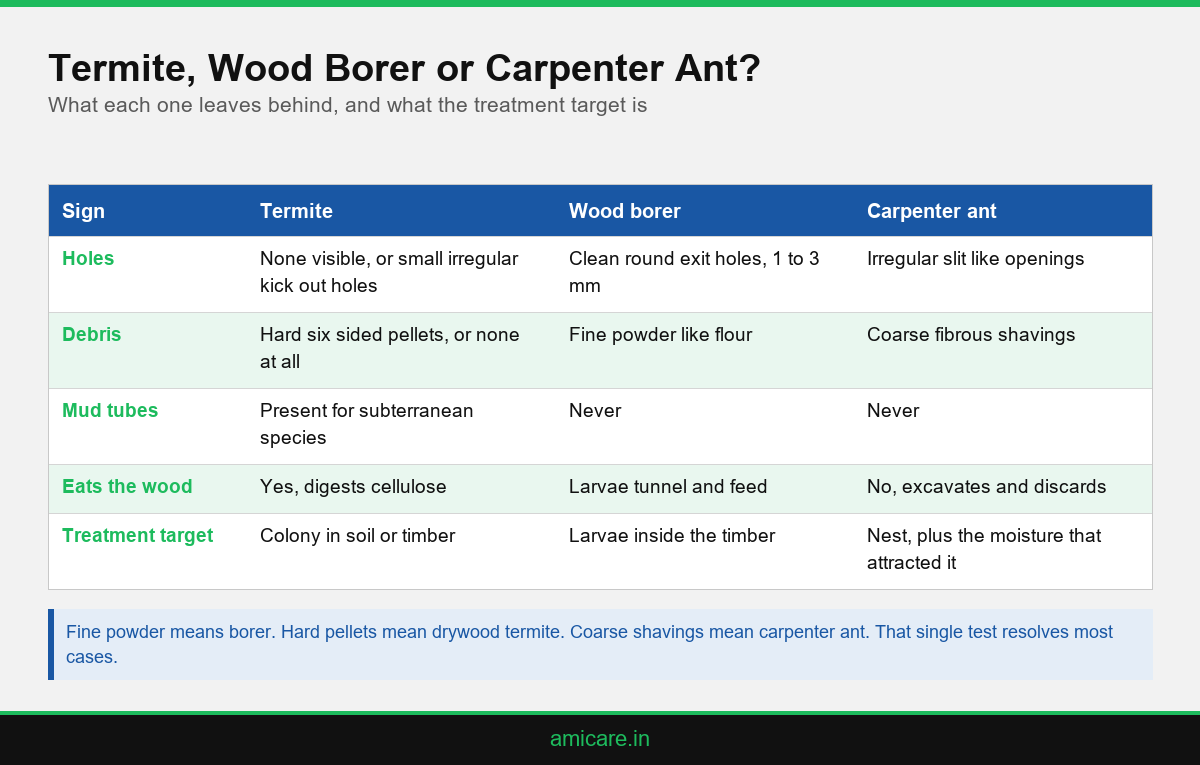
The distinction is not academic, because each behaviour leaves a different signature and each responds to a different treatment. Termite work targets a colony that may be in the soil. Borer work targets larvae inside the timber. Carpenter ant work targets a nest and usually a moisture problem alongside it.
In Kerala all three occur, though the balance differs. Termites dominate structural damage, borers are common in furniture, plywood and stored timber, and carpenter ants are less frequent but turn up reliably where timber has been persistently wet.
The Evidence Each One Leaves
Look at the holes first. Wood borers leave clean round exit holes, typically one to three millimetres across, often described as looking as though the timber were shot with fine pellets. Termites do not produce exit holes at all in the same way, because subterranean species stay enclosed and drywood species use small irregular kick out holes.
Then look at what falls out. Borers produce fine powdery frass with the texture of flour or talc, which accumulates below the exit holes. Drywood termites produce hard six sided pellets. Carpenter ants produce coarse fibrous shavings that look like sawdust, sometimes mixed with insect fragments.
Finally look for mud. Mud tubes on masonry are conclusive for subterranean termites and are produced by neither of the other two. Extension guidance on wood boring beetles in homes and on carpenter ant identification and control uses the same diagnostic features.
Why the Wrong Treatment Wastes Money
A soil barrier is the correct response to subterranean termites and does nothing at all for a borer infestation in a wardrobe, because the larvae are inside the timber and have no soil connection. Conversely, treating a subterranean termite problem as a furniture issue leaves the colony feeding on structural timber while the visible symptom is addressed.
Carpenter ants add a further trap. Because they nest in wood, they are often treated as termites, but the effective response is to find and destroy the nest and to fix the damp timber that attracted them. Chemical treatment of the surface alone rarely resolves it.
The financial consequence is straightforward. The wrong treatment costs the full price, delivers no result, and the correct treatment then has to be bought afterwards. Identification is the cheapest part of the entire process and the part most often skipped.
Where Each One Turns Up in a Kerala House
Termites concentrate where timber meets masonry or soil. Door and window frames, skirting, floor joists and roof members set into walls are the classic sites, along with anything in contact with the ground. Drywood species extend the range upward into furniture and rafters.
Wood borers concentrate in furniture, plywood, MDF and stored timber, and they very often arrive inside a purchased item rather than migrating in. Sapwood is more vulnerable than heartwood, which is why cheaper furniture and untreated plywood suffer disproportionately. Existing guidance on wood borer treatment in Kerala covers the response in detail.
Carpenter ants favour timber that has been wet. Roof edges below a persistent leak, bathroom joinery, window sills exposed to driving rain and any buried or ground contact timber are the usual locations, which is why they so often accompany a maintenance defect.
Furniture and plywood
Wardrobes, bed frames, kitchen carcasses and storage units built from plywood or blockboard are where most Kerala households first meet a wood borer. Sapwood rich, inadequately seasoned material is the usual culprit, and because the larvae develop unseen inside, the first sign is often exit holes appearing months after purchase.
Roof spaces and concealed timber
Rafters, purlins, ceiling boards and the timber above a false ceiling are the highest risk locations for a long undetected problem, simply because nobody looks. Any of the three insects can be present there, and a torch inspection once a year is worth considerably more than it costs in effort.
What to Do Before You Call Anyone
Spend ten minutes gathering evidence and you will get a better quotation. Photograph the holes close up with something for scale, a coin or a pen works well. Collect a small sample of the debris on white paper, where the difference between powder, pellets and shavings is immediately obvious.
Tap the timber along its length and listen. A hollow note over a stretch of otherwise sound looking wood indicates internal loss and points toward termites. Note whether the affected timber is damp, and whether the damage sits near ground level or high in the building.
Do not sand, fill, repaint or replace the affected piece before the inspection. It removes the diagnostic evidence entirely and, if the insect is still active, simply conceals a continuing problem behind a fresh surface.
Is the Infestation Still Active?
Old damage and current damage look almost identical, and a great deal of unnecessary treatment is sold on the strength of holes that stopped being made years ago. Three checks distinguish them, and they cost nothing.
First, look at the colour inside the holes. Fresh borer exit holes show clean, pale timber inside, the same colour as freshly cut wood. Old holes are darkened, dusty and often partially filled. Second, look for fresh frass. Clear the powder or pellets away completely, mark the date, and check again after two weeks. New debris means active insects. Nothing means the damage is historic.
Third, listen. Carpenter ant nests are often audible as a faint rustling in a quiet room, particularly at night. Termite galleries sometimes produce a hollow note that changes along the length of a member as you tap it, which maps the extent of the damage.
This matters commercially as well as technically. A borer infestation that finished its cycle years ago needs the timber assessed for strength, not a chemical treatment. A provider who proposes full treatment without establishing that the insects are still present has skipped the question that determines whether the work is needed at all.
The two week paper test
Clear all debris from beneath the affected timber, lay a sheet of white paper underneath and mark the date on it. Check after two weeks. Fresh powder, pellets or shavings on clean paper is unambiguous evidence of an active infestation, and the type of debris also confirms which insect you are dealing with. It is the cheapest diagnostic available to a homeowner.
Conclusion
Identify the insect before buying the treatment. Fine powder and round holes mean borer. Hard pellets or mud tubes mean termite. Coarse shavings mean carpenter ant and usually a leak. Ten minutes with a torch and a sheet of white paper will tell you more than a quotation issued over the phone. Ask Amicare to identify the insect before quoting and get the scope matched to the actual problem.
Frequently Asked Questions
Should I replace infested furniture or treat it?

How did wood borers get into new furniture?
Does humidity in Kerala make borer attack worse?
How do I tell termite damage from wood borer damage?
Are wood borers as damaging as termites?
Do carpenter ants eat wood?
Can one piece of furniture have more than one insect?
Why does the treatment differ so much?
Do round holes in furniture always mean borer?
Can I treat borer holes with oil or kerosene?