Subterranean, Drywood or Dampwood Termites in Kerala?
Termite species identification is the step that decides everything after it. Subterranean, drywood and dampwood termites live in different places, arrive by different routes and require different treatment. A homeowner who can tell them apart, even roughly, will spend less and get a better result, because the diagnosis directs the entire job.
Key Takeaways
- Mud tubes mean subterranean. Pellet frass means drywood. Wet or decaying timber means dampwood.
- Subterranean termites cause most structural damage in Kerala. Drywood infestations usually sit in furniture and roof timbers.
- Dampwood activity is a moisture defect first and an insect problem second. Fix the leak or the treatment will not hold.
Why the Type Decides the Treatment
A subterranean colony lives in the soil and enters the building. A drywood colony lives inside the timber and never touches soil at all. That single difference changes where the treatment goes, what equipment is needed and how much it costs.
Treating a drywood infestation in a first floor wardrobe with a soil barrier achieves nothing, because there is no soil connection to interrupt. Treating a subterranean infestation by spraying the visible damaged skirting achieves almost as little, because the colony is in the ground and simply re enters elsewhere.
This is why an inspection that names the type is worth more than a quotation that does not. University extension guidance on termite control organises its entire treatment advice around the species, and any competent local provider will do the same.
The Four Checks You Can Make Yourself
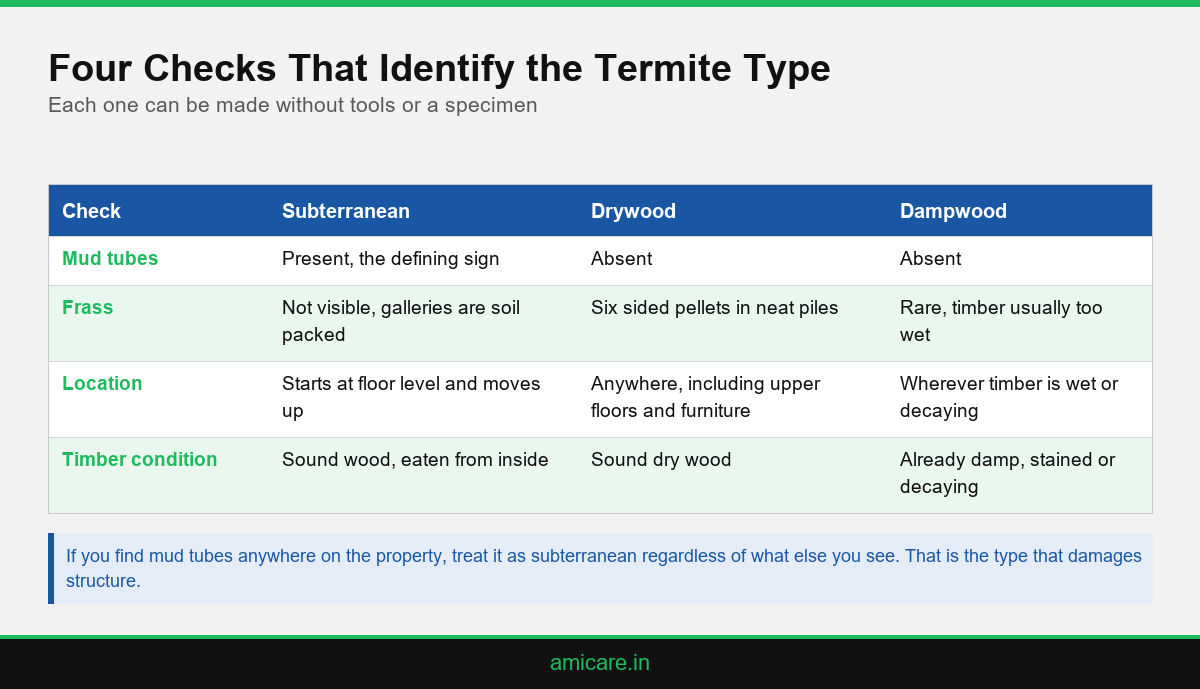
You do not need to see an insect. Four observations will place almost any Kerala infestation into the right category, and all of them can be made without tools.
First, look for mud tubes. These are pencil width tunnels of soil and saliva running up foundation walls, across masonry or along pipes, and they are conclusive evidence of subterranean activity. Second, look for frass. Drywood termites push tiny six sided pellets out of small holes, and they collect in neat piles below the infested timber.
Third, note the location relative to the ground. Damage confined to upper floor furniture with no connection to soil points to drywood. Damage starting at skirting and floor level and moving upward points to subterranean. Fourth, check whether the timber is wet. Dampwood termites only establish in timber that is already damp or decaying, so their presence indicates a leak.
What Each Type Means for Your Building
Subterranean termites are the structural threat. They attack load bearing timber, door and window frames set into masonry, skirting and flooring, and because they work from inside outward the surface can look intact until it fails. In Kerala they are active year round, which removes the recovery period a building would get in a drier climate.
Drywood termites are usually a joinery and furniture problem rather than a structural one, though roof rafters and wooden ceilings are a significant exception. They spread slowly, which means an early response often confines the work to a few members rather than a whole roof.
Dampwood termites are the most informative of the three, because they are a symptom. Their presence means timber has been wet long enough to begin decaying, which points at a roof leak, a failed bathroom seal or ground contact. Treating the insects without fixing the water simply invites them back.
Why subterranean damage is worse than it looks
Because these termites work from inside outward, they consume the softer growth rings first and leave a thin shell of surface timber intact. A door frame can look sound, take paint normally and still have lost most of its section. This is why tapping matters more than looking, and why damage is routinely found only when something fails under load.
How fast drywood colonies actually spread
Drywood colonies grow slowly compared with subterranean ones, which is genuinely good news. A problem caught early in one wardrobe or one run of rafters can often be confined to those members. The risk is that the slow pace lets an infestation run for years unnoticed in a roof space nobody enters.
How Each Type Gets Into a Kerala Home
Subterranean colonies arrive through the ground. They exploit foundation cracks, expansion joints, service penetrations where pipes and cables pass through the slab, and any point where soil or debris bridges the plinth. Garden soil banked against an external wall is one of the most common avoidable entry routes in Kerala houses.
Drywood colonies arrive inside timber. Second hand furniture, reclaimed wood, untreated roof members and imported joinery all carry the risk, and a single infested piece brought into a clean house can start a new colony. Winged reproductives also fly in and enter through unsealed cracks in exposed timber.
Dampwood colonies do not need to travel far. Where timber stays wet, they establish. Buried fence posts, timber in contact with soil, and roof edges with persistent leaks are the usual sites, and the fix is drainage and repair rather than chemistry alone.
When You Cannot Tell, and What to Do
Mixed evidence is common. A house can have subterranean activity at the plinth and a separate drywood problem in an upstairs wardrobe, and these are two independent infestations that happen to share a building. Finding one does not rule out the other, and a proper inspection checks for both.
If the evidence is ambiguous, photograph what you have found, note exactly where each item was and whether the timber was wet, and leave the material undisturbed. Sweeping up frass or breaking open a mud tube removes the evidence a technician would use, and it does not slow the colony down.
Do not spray a retail product over the area before an inspection. Repellent products drive termites into new routes, which makes both the diagnosis and the subsequent treatment harder. This is a recurring theme in why do it yourself pest control fails in Kerala homes, and it applies with particular force to termites.
What the Type Means for Cost and Scope
The three types differ sharply in what treating them involves, and therefore in price. A subterranean infestation in a finished house requires perimeter and internal drilling, injection at set intervals and sealing, which is labour intensive and priced on built up area. It is the largest of the three scopes and the one with the longest warranty attached.
A drywood infestation confined to furniture or a run of joinery is usually a localised job. Treatment targets the affected timber directly through injection and surface application, and in some cases replacement of a badly tunnelled member is cheaper than treating it. The cost sits closer to a furniture repair than to a structural treatment.
Dampwood work is different again, because the largest cost is often not the pest control at all. Repairing the leak, replacing decayed timber and correcting drainage typically exceeds the treatment itself, and a provider who quotes only for the insects has not addressed the actual problem.
This is why a quotation issued before an inspection tells you very little. Two houses of identical size with different termite types warrant entirely different scopes, and any price given over the phone is a placeholder rather than an estimate.
Questions that reveal whether the type was established
Ask which type is present and what evidence supports it. Ask whether the soil is being treated, the timber, or both, and why. Ask what would change the scope if the inspection had found something different. A provider who has genuinely diagnosed the property answers all three without hesitation, and one working from a standard package will not.
Conclusion
Identify before you treat. Mud tubes point to subterranean and to structural risk. Pellet frass points to drywood and usually to joinery. Wet timber points to dampwood and to a leak that needs fixing first. That single distinction directs the method, the cost and the outcome. Ask Amicare to confirm the termite type at your property before any treatment is priced.
Frequently Asked Questions
What are mud tubes and what do they mean?

What does termite frass look like?
Can one house have two termite types at once?
Which termite type causes the most damage?
Do drywood termites need contact with soil?
What does finding dampwood termites tell me?
Should I clean up frass before the inspection?
How do termites get into an upstairs room?
Are flying termites a different species?
Does the species change the treatment cost?