German, American or Brown Banded? Identify Your Cockroach
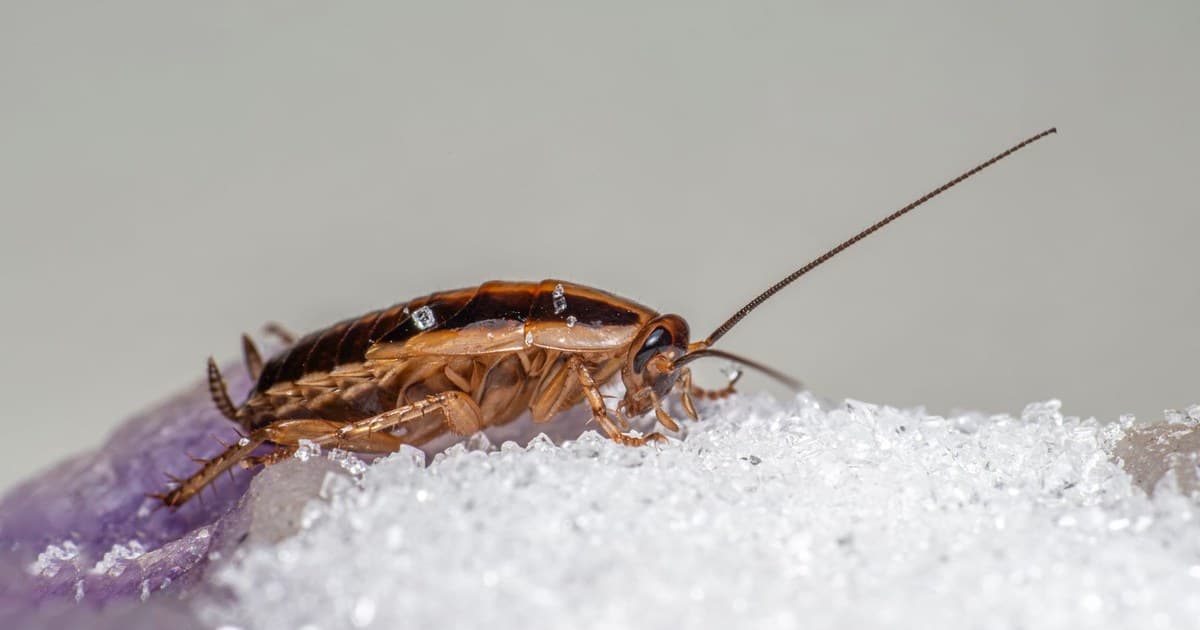
Correct cockroach identification is the step most households skip and most failed treatments trace back to. A cockroach is not a cockroach. The three species found in Kerala homes live in different places, feed differently and respond to entirely different methods. Getting the species right takes about a minute and changes whether a treatment holds or collapses within a month.
Key Takeaways
- Many small cockroaches in the kitchen almost always means German. A few very large ones at night in the bathroom means American.
- Size, colour markings, location and whether the insect flies are enough to identify all three species without equipment.
- The species determines the method. A drain problem treated as a kitchen problem will keep returning.
Why the Species Matters More Than the Count
People usually describe an infestation by how many insects they are seeing. Technicians describe it by which species and where it harbours, because that is what determines the treatment plan. A dozen German cockroaches in a kitchen cabinet and a dozen American cockroaches in a bathroom are two unrelated problems that happen to share a name.
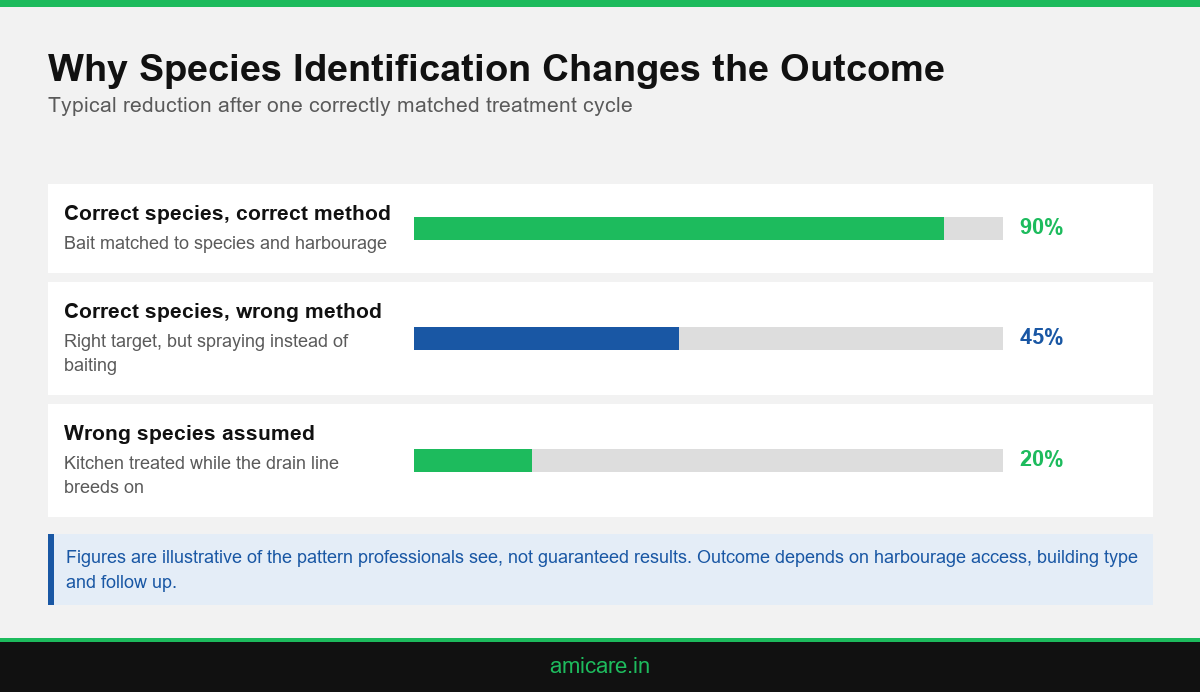
The practical consequence is direct. Gel bait placed in kitchen cracks does very little to a population breeding in a drain line. Drain dosing does very little to a colony living inside a fridge compressor housing. Both treatments can be executed perfectly and still fail, purely because the target was wrong.
Count is a poor guide for a second reason. Cockroaches are shelter seeking, and they emerge into open space mainly when harbourage becomes crowded. By the time a household is seeing insects regularly in daylight, the population is already well past its early stage. Seeing few insects does not mean the problem is small, and seeing many does not necessarily mean it is recent.
The Four Checks That Separate the Three Species
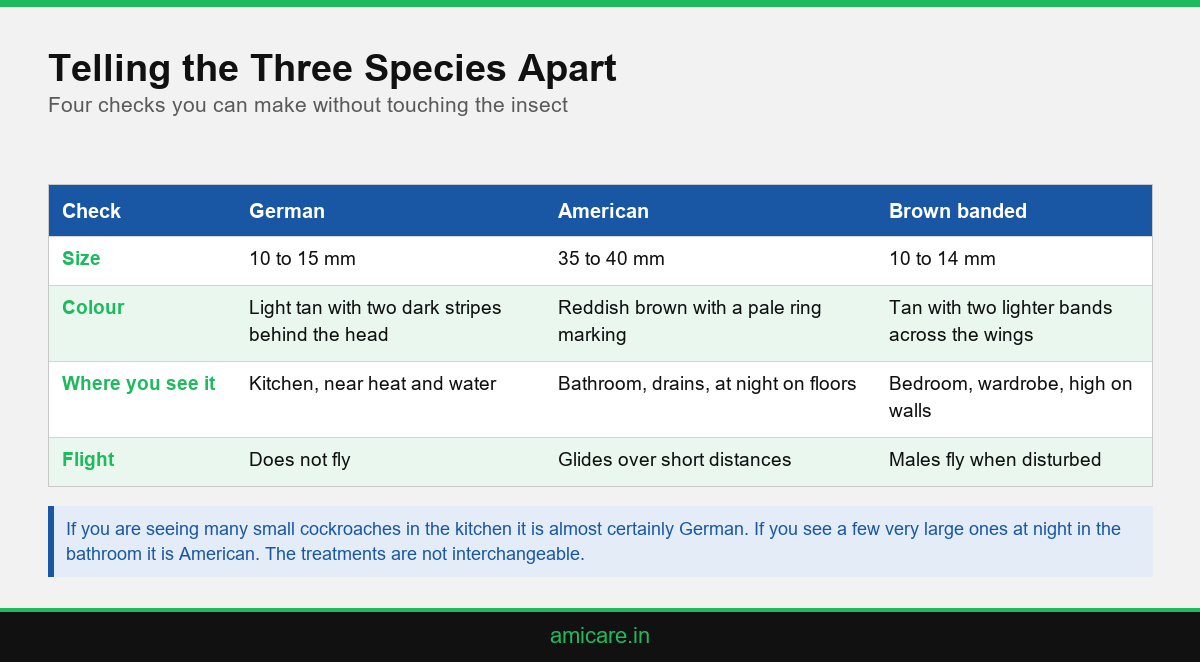
You do not need a specimen or a magnifier. Four observations are enough, and you can make all of them from a safe distance. Size and colour narrow it immediately. Location and flight behaviour confirm it. Extension entomology resources such as the University of California integrated pest management guidance use the same diagnostic features.
Size is the fastest discriminator. An adult German cockroach is roughly the length of a thumbnail. An adult American cockroach is three times that and unmistakable once seen. If you are unsure whether an insect is small or large, it is small, because nobody hesitates over an American cockroach.
Colour and markings confirm it. German cockroaches carry two dark parallel stripes running back from behind the head. Americans are uniformly reddish brown with a pale ring marking behind the head. Brown banded cockroaches show two lighter bands running across the wings rather than along the body, which is the detail that separates them from German cockroaches at similar size.
What Each Species Tells You About Your Home
The species is also a diagnosis of the building. A German population indicates a sustained indoor food and moisture source, usually a kitchen with harbourage in cabinet joints or appliance housings. It rarely arrives through a window. It usually arrives inside a carton.
An American population indicates a drainage connection. Somewhere in the property a floor trap has dried out, a pipe collar is unsealed or a sump is open. The insects are not living in your bathroom. They are visiting it. A brown banded population indicates dry warm harbourage away from water, which is why it turns up in bedrooms and behind electronics and is so often missed entirely.
This is why a technician asks where and when you see them before asking how many. The room narrows the species, the time of day confirms the behaviour, and together they point at the harbourage. A household that reports large insects in the bathroom after dark has already given the technician most of the diagnosis without realising it.
How Much Difference Identification Actually Makes
The gap between a correctly targeted treatment and a misdirected one is not marginal. When the species and harbourage are both correct, a single properly executed cycle removes the large majority of the population. When the species is assumed rather than confirmed, the same effort and the same products produce a fraction of the result, and the household concludes that pest control does not work.
This is also why a technician who inspects before quoting is worth more than one who does not. Identification is not a formality at the start of the visit. It is the decision the whole treatment depends on, and it is one of the signs of a competent pest control provider.
There is a cost dimension too. A misdirected treatment is not simply ineffective. Spraying a German population with a repellent product disperses it into new harbourage across a wider area, which means the correct treatment afterwards has more ground to cover and takes longer. The wrong first move makes the right second move more expensive.
Common Identification Mistakes in Kerala Homes
Four errors account for most misidentification, and all of them are avoidable. The first is treating nymphs as a separate species. Immature cockroaches are smaller, paler and often wingless, and households regularly report two different insects when they are seeing one species at two life stages. The presence of nymphs is significant information in itself, because it confirms breeding inside the property rather than insects entering from outside.
The second is confusing brown banded with German cockroaches. They are similar in size, and the distinguishing feature is the direction of the markings. German cockroaches carry two dark stripes running lengthwise behind the head. Brown banded cockroaches show lighter bands running across the body. Location settles it quickly, because brown banded cockroaches avoid the damp areas German cockroaches prefer.
The third is assuming that large means worse. An American cockroach is visually alarming and is usually the easier problem, because it is a drain population that responds to line treatment. A quiet German population inside kitchen cabinets is smaller, less visible and considerably harder to remove.
The fourth is identifying from a dead insect found in daylight. Insects that die in the open are often damaged or discoloured, and colour is one of the two main diagnostic features. A photograph of a live insect, or a note of where and when it was seen, is more reliable than a specimen.
What to Do Once You Know the Species
Cockroach identification is only useful if it changes what happens next, and for each species the next step is different. Knowing which one you have should immediately narrow both where you look and what you ask a provider to treat.
If you have identified German cockroaches, stop spraying. A repellent aerosol scatters the colony into new harbourage across a wider area and makes the subsequent professional treatment slower and more expensive. Instead, open the places they actually live. Pull the fridge forward, look into the compressor bay, check the cabinet corners under the sink and the hinges of any unit near the hob. Remove stored cardboard the same day.
If you have identified American cockroaches, the priority is plumbing rather than surfaces. Check every floor trap in the property for a working water seal, look at the pipe collars behind the toilet and under the sink, and note whether sightings cluster in one bathroom or several. That distinction tells a technician whether the problem is a single trap or the whole stack.
If you have identified brown banded cockroaches, extend the search away from water. Wardrobes, bedside furniture, the backs of wall mounted electronics and the space behind framed pictures are all normal harbourage, and a kitchen focused treatment will leave the population untouched. In every case, correct cockroach identification also tells you what to expect afterwards, because the three species clear at noticeably different speeds.
Conclusion
Before you buy a spray or book a visit, spend a minute working out what you are actually dealing with. Note the size, the markings, where you see them and at what time of day. That single observation directs the entire treatment and is the difference between a result that holds and one that does not. Ask the Amicare team to confirm the species at your property before any treatment is priced.
Frequently Asked Questions
What are the small cockroaches in my kitchen?

Are the large cockroaches in my bathroom a different species?
Do cockroaches in Kerala fly?
Can one home have more than one species?
Why does identification change the treatment?
Are baby cockroaches a different species?
Which species is hardest to eliminate?
Does seeing one cockroach mean there is an infestation?
How do I tell brown banded from German cockroaches?
Should I try to catch one to identify it?