Flying Termites in Kerala: What a Swarm Actually Means
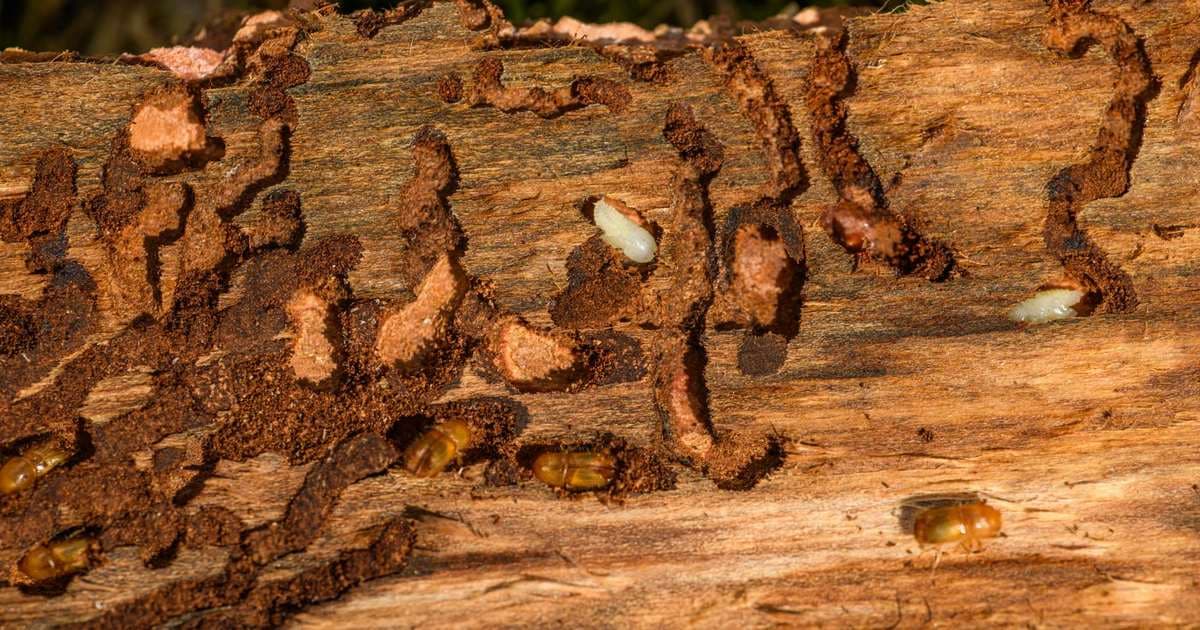
Flying termites in house rooms after an evening of rain are one of the most common calls Kerala pest controllers receive, and one of the most misunderstood. The insects themselves do no damage and most will be dead by morning. What matters is what their appearance tells you, because a swarm means a mature colony is already established nearby and has begun producing reproductives.
Key Takeaways
- A swarm is a signal, not the damage. It means a mature colony exists close by, often inside or under the building.
- Discarded wings on window sills and near lights are the most useful evidence. Collect a few rather than sweeping them away.
- Termite alates have four equal wings and a straight body. Flying ants have unequal wings and a pinched waist.
What a Swarm Is and Why It Happens
Mature termite colonies produce winged reproductives, called alates, whose only job is to leave, pair up and start a new colony elsewhere. A colony only does this once it has reached a certain size and age, which is why a swarm is such a useful diagnostic event.
In Kerala swarms typically follow rainfall, particularly the first heavy showers of the season and again during the retreating monsoon, when humidity is high and the soil is soft enough for a new pair to establish. Warm still evenings after rain are the classic conditions.
The insects are drawn to light, which is why they appear around indoor lamps, tube lights and lit windows. That attraction is also why householders encounter them indoors even when the colony is outside in a garden stump or under the plinth.
What the Swarm Tells You About Your Property
The key inference is maturity. Colonies do not produce alates in their first years, so a swarm indicates an established colony that has been feeding somewhere for a considerable time. If that somewhere is your structure, damage has already accumulated.
Location narrows it further. Alates emerging from inside the house, from a wall, a skirting joint or a wooden frame, indicate a colony within the building envelope and are the more serious finding. Alates flying in through an open window from outside may indicate a colony in a garden stump, a fence post or a neighbouring property.
Either way the correct response is inspection rather than insecticide. Killing the swarmers has no effect on the colony that produced them, and by the time you see a swarm the silent damage that termites cause is usually already underway.
Swarming from inside the building
Alates emerging from a wall joint, a skirting gap, a window frame or a ceiling crack are the most significant version of this finding. It places a mature colony inside the building envelope rather than in the garden, and it usually means structural timber has been feeding it. Mark the emergence point and leave it undisturbed for the inspection.
Swarming from outside
Alates arriving through an open window or around an outdoor light may originate from a stump, a fence post, a timber stack or a neighbouring property. This is less immediately alarming but not irrelevant, because founding pairs that land near your plinth are looking for exactly the conditions an unprotected building offers.
Telling Termite Alates From Flying Ants
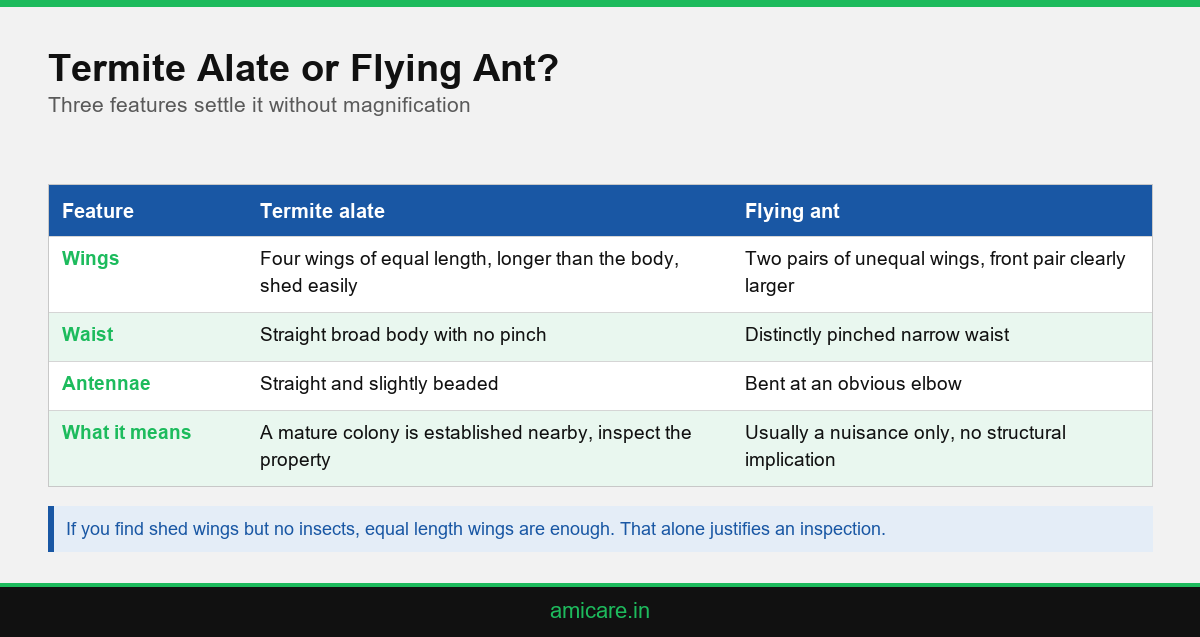
The two are routinely confused, and the distinction matters because flying ants are largely harmless while termite alates indicate a structural risk. Three features separate them and all are visible to the naked eye if the insect is still.
Wings are the clearest test. A termite alate has four wings of equal length, noticeably longer than its body, that break off easily. A flying ant has two pairs of unequal wings, with the front pair clearly larger. Waists differ too. Termites have a straight, broad body with no pinch. Ants have the narrow pinched waist that gives them their familiar shape.
Antennae complete the identification. Termite antennae are straight and slightly beaded. Ant antennae are bent at an obvious elbow. If you find only wings and no bodies, equal length wings still point to termites.
The First 48 Hours: What to Do
The useful actions are all about evidence rather than control. Collect a small number of insects or wings in a clear container or photograph them close up, and note the exact room and the time. If they appeared to emerge from a specific point, mark it, because that location is the single most valuable piece of information a technician can receive.
Switch off or reduce lighting in the affected room and open an external route if practical, which reduces the number entering. Do not spray a repellent aerosol around the emergence point. It kills visible insects, disperses the rest and can drive the colony to seal that route and use another, which makes locating it harder.
Then book an inspection promptly. The swarm itself passes within a day or two, and homeowners frequently conclude the problem resolved itself. It did not. The colony that produced the swarm continues feeding, and the window in which the evidence is freshest is the best time to trace it.
Preventing the Conditions That Invite Swarms
You cannot prevent a swarm, because it originates in a colony that already exists. What you can do is remove the conditions that let arriving pairs establish, and reduce the chance that your property becomes the next colony site.
Clear timber debris, old stumps, offcuts and stored firewood away from the building, since these are prime establishment sites. Keep garden soil and mulch from banking against the plinth, because soil contact with the wall bridges any barrier. Fix leaks promptly, as consistently damp timber is far easier for a founding pair to colonise.
Fit or repair insect screens on windows near external lights, and reduce bright outdoor lighting during swarm season if practical. None of this replaces a soil barrier, but it lowers the pressure meaningfully, and it complements the routine measures set out for new homeowners protecting a property in Kerala.
What Happens If You Ignore a Swarm
Nothing visible happens, which is precisely the problem. The swarm ends, the insects are swept up, and the household concludes the episode is over. Meanwhile the colony that produced it continues feeding at the same rate it was before, and the founding pairs that survived begin establishing new colonies elsewhere on or near the property.
The cost curve is unforgiving. An infestation caught at the swarm stage typically means treating a colony before it has done significant structural damage. The same infestation found three or four years later, when a door frame gives way or a rafter fails, means treatment plus carpentry plus in some cases structural repair.
There is a resale dimension as well. Undisclosed active termite activity is the kind of finding that derails a property sale late, and a buyer's surveyor who spots mud tubes will reasonably assume the worst about everything they cannot see. A documented treatment history is a far better position to negotiate from than an unexplained swarm the neighbours remember.
The counterargument homeowners raise is that swarms happen every year in the area and nobody else treats. That is often true and it is not reassuring. It usually means several properties in the neighbourhood host mature colonies, which raises rather than lowers the pressure on yours.
What an inspection after a swarm involves
The technician traces the emergence point, checks the plinth externally for mud tubes, taps timber along frames and skirting, examines the roof space where accessible, and looks at any garden stump, fence post or timber stack within a short distance of the building. The output should be a written finding rather than a verbal impression, whether or not treatment is recommended.
Conclusion
Treat a swarm as information rather than an incident. The insects will be gone within a day, but the colony that produced them will not. Collect a few wings, note where they emerged, resist the aerosol, and get the property inspected while the evidence is fresh. Book an inspection with Amicare after a swarm rather than waiting to see whether it happens again.
Frequently Asked Questions
Are flying termites dangerous to people?

Why do flying termites appear after rain?
Does a swarm mean termites are inside my house?
Should I spray flying termites?
What should I do with the wings I find?
How can I tell termite swarmers from flying ants?
How long does a termite swarm last?
Can I prevent swarms next season?
Do swarms happen at the same time every year?
How soon should I get an inspection after a swarm?