After Termite Treatment: Timeline and How to Verify It

Knowing how long termite treatment lasts is only half of what a homeowner needs. The other half is knowing how to tell whether it worked. Termites are concealed, so absence of visible activity proves very little on its own. This guide sets out the expected timeline after treatment, the checks that actually verify it, and the signals that mean you should call the provider back.
Key Takeaways
- A correctly applied soil barrier typically holds for five to ten years in Kerala, with rainfall shortening the upper end.
- Activity should stop within four to six weeks. Continuing fresh mud tubes after that indicates a gap in the barrier.
- Verification means scheduled inspection of specific points, not simply the absence of insects in the living areas.
The Expected Timeline After Treatment
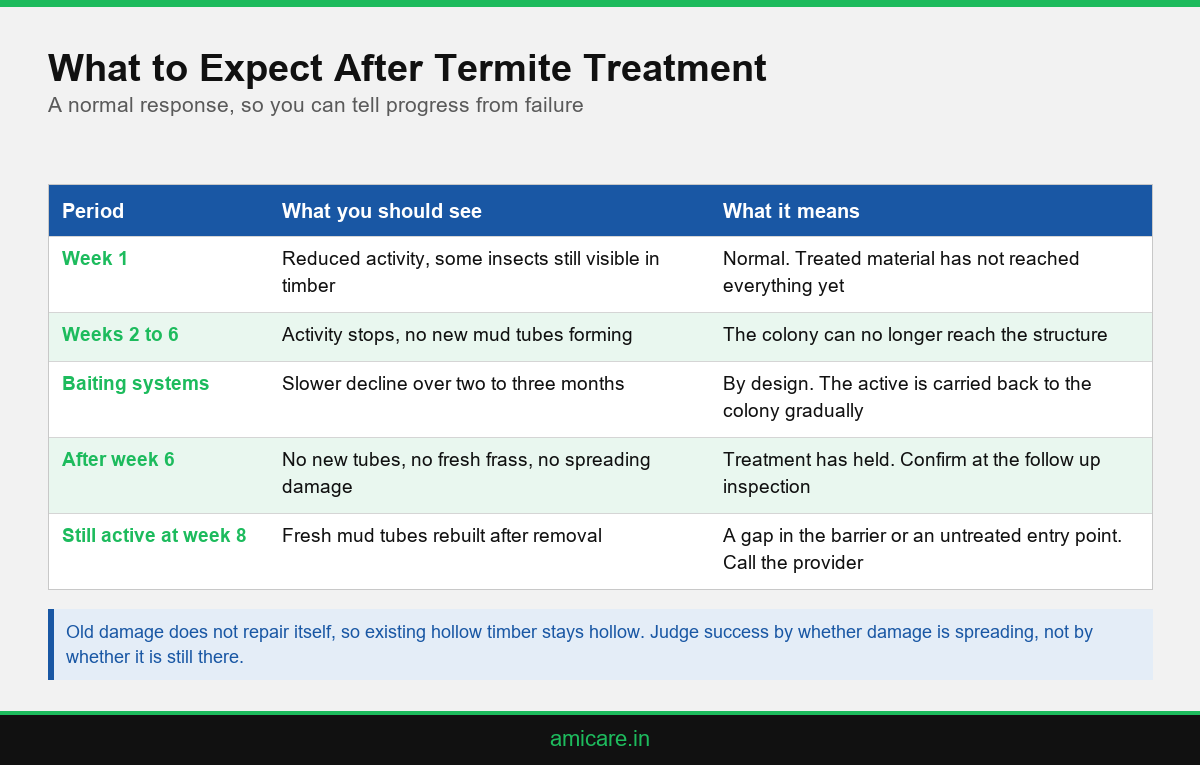
Termite treatment does not work instantly, and expecting it to leads homeowners to call a job a failure while it is still taking effect. In the first week, activity in treated areas usually reduces noticeably, though insects already inside timber continue until the treated material reaches them.
Between two and six weeks the colony's ability to reach the structure collapses. With a barrier, workers attempting to cross the treated soil die or turn back. With a baiting system the process is slower by design, because the active ingredient is carried back to the colony over weeks, and full effect can take two to three months.
Beyond six weeks you should see no new mud tubes, no fresh frass and no further extension of damage. That is the point at which a treatment can reasonably be judged, and it is why a first follow up inspection at four to six weeks is the industry norm rather than an upsell.
How to Verify It Worked
Verification is a set of specific checks rather than a general impression. The most useful single technique is the mud tube test. Break away a short section of any tube found and mark the date. If the tube is rebuilt within a few weeks, the colony still has an active route and the treatment has a gap. If it stays broken, that route is dead.
Second, re tap the timber that sounded hollow before treatment and note whether the affected length has grown. Termite damage does not heal, so the timber will still sound hollow. What matters is whether the boundary of the damage has moved.
Third, check the drilled and sealed points if a barrier was installed. They should be evenly spaced, properly filled and intact. Wide or irregular spacing is a sign the barrier may be discontinuous, which is exactly where activity resumes first.
Set up your own monitoring points
Choose three or four locations you can check easily, such as the plinth on each external face, the utility area and any previously affected frame. Photograph each one on the day the treatment finishes. Comparing a photograph at six months removes the guesswork about whether something has changed, which memory alone handles badly.
What a follow up inspection should cover
A proper follow up re examines the original activity points, checks the barrier line for disturbance, looks at any new construction or plumbing work, and produces a written note of what was found. A visit that consists of a walk through and a verbal all clear is not an inspection, and it will not support a warranty claim later.
What Shortens a Treatment's Life in Kerala
Rainfall is the dominant factor. Water moving through soil gradually reduces the concentration of a chemical barrier, and Kerala's rainfall is at the high end of what these systems are designed for. A barrier rated for a decade in a dry climate may need attention considerably sooner here.
Disturbance is the second factor and the one most within your control. Any work that moves treated soil breaks the barrier at that point. New plumbing, cable trenching, landscaping against the plinth, extending a patio and planting close to the wall all create gaps, and termites find gaps efficiently.
The third is drainage. Water pooling against the plinth keeps soil saturated and accelerates depletion while making conditions ideal for the colony. Correcting surface drainage often extends barrier life more than any additional chemical would.
When to Call the Provider Back
Four situations justify a callback rather than waiting for the next scheduled visit. Fresh mud tubes appearing more than six weeks after treatment, particularly rebuilt after you removed them. Damage visibly extending into timber that was sound at the time of treatment. A swarm emerging from inside the building. Any excavation or plumbing work that has disturbed treated soil.
The fourth is worth stressing because it is preventive rather than reactive. Telling the provider before or immediately after soil disturbing work lets them re treat the affected section cheaply. Discovering the gap later, after termites have used it, is far more expensive.
Keep the treatment record accessible when you call. The date, product, method and drill spacing let a technician assess quickly whether the problem is a barrier gap, a new entry point or a separate infestation, and it is also what a warranty claim will be assessed against.
Keeping the Warranty Valid
Most Kerala termite warranties require scheduled inspections, usually annual, and lapse quietly if they are missed. The inspection is not a formality. It is the mechanism by which a gap is found before it becomes damage, and it is the condition on which free re treatment normally depends.
Read what voids the cover. Structural alterations, disturbance of treated soil, unreported leaks and using another provider to treat the same property are common exclusions. None of these are unreasonable, but homeowners typically encounter them for the first time at claim stage.
Retain everything in one place. Treatment date, product name and concentration, drill spacing, areas treated, warranty terms and every inspection report. Beyond the warranty itself this file has real value at resale, when a buyer's surveyor asks what protection the building carries, which is the same reason a documented approach matters when choosing a provider.
Living With a Treated Property
A treated building is not a sealed one, and a small amount of ongoing awareness keeps the protection working. The habits that matter are few and none of them are onerous.
Keep the plinth clear. Soil, mulch, stacked firewood, planters and building materials pushed against an external wall all bridge the treated zone, and this is the most common way a good barrier is quietly defeated. Check the perimeter once or twice a year and pull anything back that has crept against the wall.
Watch the wet spots. A new leak, a failed bathroom seal or a downpipe discharging against the plinth creates exactly the conditions that shorten barrier life and attract dampwood activity. Fixing water promptly protects the treatment as much as it protects the building.
Report structural work in advance. Extending a room, laying a new path, trenching for a cable or replumbing a bathroom all disturb treated soil. A provider told beforehand can re treat the affected section as part of the job for a small sum. The same gap discovered two years later, after termites have used it, is a far larger conversation and frequently falls outside the warranty.
An annual ten minute check
Once a year, walk the external plinth and pull back anything stacked against the wall. Tap the door and window frames at floor level and listen for a change in note. Look at the utility area and under the sink for mud. Check the roof space with a torch if it is accessible. That routine catches most problems long before they become structural, and it costs nothing but the time.
Conclusion
Do not judge a termite treatment by whether you can see insects, because you rarely could before it either. Judge it by whether mud tubes are rebuilt, whether damage is spreading and whether the scheduled inspections are actually happening. Those three checks tell you more than any guarantee certificate. Arrange a post treatment inspection with Amicare and keep the record file complete.
Frequently Asked Questions
How long does termite treatment last in Kerala?

How soon should termite activity stop after treatment?
Will the damaged wood recover after treatment?
What is the mud tube test?
Why do I still see termites a week after treatment?
Does building work affect my termite protection?
How often should a treated property be inspected?
What normally voids a termite warranty?
Can I check the treatment quality myself?
Is re treatment ever needed before the warranty expires?